Cute and Easy Crochet with Flowers
Dublin City Public Libraries
Ravelry
This is an interesting idea, using floral motifs to create projects.
The book starts with section on how to crochet, which doesn't have a section on left-handedness and also appears to neglect to mention the difference between US and UK terminology. It's divided in three sections: Starting out; Practice makes Perfect and Confident Crocheting. There are basically two types of use of Floral motifs, applique and as part of the stitch.
Chapter 1: Starting Out.
Poppy Purse - a purse with a poppy motif in Aran yarn.
Kindle Cover - crocheted flat, seamed and lined with flower appliques, in sportweight yarn
Tote Bag - made in pieces, seamed and with appliqued flowers. Aran weight yarn.
Rose Headband - this has been in and out of fashion and it's an Aran Weight, with an applied Rose.
Baby Beanie Hat - Another pattern with applied flowers in a 4 ply yarn.
Ear Flap Hat - small earflaps on this aran-weight hat with applied flowers and a contrast trim, this one is quite pretty.
Fingerless Gloves - fingerless gloves with a small trim of flowers in a contrast colour around the wrist. Worked in Aran-weight yarn.
Bunting - triangular bunting in a DK yarn with a floral centre and linked by flowers.
Egg Cosies - again with applied flowers. worked in DK weight yarn.
Floral-edged Jam Pot Covers worked in DK yarn this is quite ornamental and would be suitable for gifts.
Pin Cushions nested flowers stuffed in DK yarn.
Hexagon Flower Throw work multiple hexagons in DK yarn this could be a good use of leftovers.
Pansy and Kittens - Cat toys with flowers applied.
Chapter 2: Practice Makes Perfect
Butterfly and Blossom Key Ring- worked in Cotton Glace this is a set of key-ring charms.
Blossom Necklace a fine necklace worked in DK yarn that is reminiscent of Daisy chains.
Flower Garland - a series of flowers on a chain in DK
Shelf Edging - a shelf edging with flowers along it in a 4-ply yarn.
Floral Shell Stitch Cushion Cover - fairly simple cushion with bouquet of flowers in the centre in Aran yarns.
Tablecloth - flowers are used as weights in each corner, DK yarn.
Lido Swimming Cap Tea Cosy Aran weight yarn used double for the body and then decorated with multicoloured Flowers, just like an old-fashioned swimming cap.
Crown-edged Cushion Cover it's like a granny square but with multicoloured centre and plain around until the edging which is in a crown-like edging.
Place Mats - using a heavy cotton yarn these circular mats have applied flowers in a finer yarn.
Oven Cloths - floral centres on these lined oven cloths.
Buggy Blanket squares created and then connected together, done in dk weight yarn.
Chevron and Daisy Scarf - Rows of colour interrupted with a few rows of a contrast and then embellished with flowers, made in an Aran weight yarn.
Beaded Craft Kit Roll - Catherine Wheel stitch in two colours with beading in a DK weight yarn.
Baby Blanket a shell stitch blanket in a dk weight yarn with an edging embellished with flowers.
Chapter 3: Confidence Crocheting
Brooch - a flower made into a brooch made in a dk yarn.
Floral Bag - multiple flowers make up this bag that's then lined. Made in DK yarn. The flowers are each created separately before, making it easy to connect them.
Daisy Scarf - worked in squares in a sportweight yarn and then joined.
Floral Lace Scarf - a flower edged shawl worked in a fine mohair yarn. Edged with flowers in a variety of sizes.
Vintage-style Vase Coaster - doileys worked in dk weight yarn. in multiple colours.
Round Rose Cushion - multiple roses worked in Aran-weight yarn and then attached to a croceted backing.
Gypsy Queen Throw - DK weight yarn in multiple colours, worked in squares and crocheted together with a loop edging.
Wash Cloths - floral centered wash cloths in DK cotton yarn. There are three, a Blossom Burst Cloth; Flower Square Cloth (with a 3-d flower); and a Petal edged circle, which is both centered with a flower and edged with a petal like edging.
It's a good book of designs which aren't too complex but do have a good result, many of them involve a lot of finishing. Many of them are too flouncy for my taste but they're quite nicely done if that's your taste and you're happy with a fair amount of sewing.
As usual this was borrowed from Dublin City Public Libraries who offer no inducement to write these others than supply plus my wage.
Wednesday, 15 July 2015


Monday, 15 June 2015
Knit Nordic Review
Knit Nordic
Dublin City Public Libraries
Ravelry
Using a variety of patterns inspired by Nordic traditional jumper patterns creating accessories. Most of them could be interchanged with each other. Creating a huge variety of patterns. I have knit one of them, the iPad cover
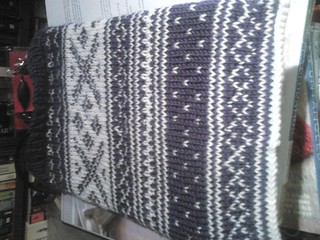 myself as a gift. And I found the instructions clear and simple. The recipient is happy with it which is a bonus.
Each section covers a particular pattern; Marius; Setesdal; Fana and Voss, there's also a section on techniques and advice on stranded knitting. She discusses each pattern and it's history in Norway and how it developed.
Marius mostly blue and white with some red highlights.
All-Day Handbag using a chunky yarn in the original the bag has red highlights on the top
Racerback top with a deep rib and patterning above it, then red on the top and along the edging on the top knit in DK yarn
Hotpants - exactly what they imply, red to the bottom. 4ply yarn.
Maurice the Teddy Bear - mostlly blue and white with some red highlights and a red head. Knit in DK
Christmas Stocking - red heel, toe and some highlights, knit in DK.
Setesdal black and white contrasts, it's an interesting traditional pattern
iPad Cover - see my version above, it's a nice piece, the contrasts make it stand out. Knit in DK.
Necktie - mostly black with a black and white end. Knit in DK.
Slippers - the slippers swap the regular pattern exchanging the white and black and Brioche stitch sides and bottom. Knit in DK.
Wristwarmers - lowering the contrast to grey and cream, knit in DK again.
Beanie Hat - again using the grey and cream, also pictured in white and red. This is knit in DK.
Fana lowers the contrast yet again to light blue and white, delicate but interesting.
Beret - knit in DK.
Half-sweater - again in DK this is sometimes referred to as a Caplet by many people, it's a shoulder cover that comes just down to the underarms.
Sleeves - could be combined with the half-sweater under or over a coat for added warmth. Knit in DK again.
Cafetiere cosy - Knit in DK again, this would be a good starter to learn how to do the techniques.
Cup Cosies - also in DK, this uses a variety of the Fana patterns for handle-less cups or tall glasses.
Voss - almost like tiles, patterns are contained within squares.
Toilet Roll Cover - for containing one toilet roll, knit in DK.
Potholder - tiled potholder, knit in 4ply doubled
Snood - a dk neckwarmer.
Cushion Cover - a superchunky cushion cover.
iPhone cover - knit in 4ply yarn
I got this from Dublin City Public Libraries and it's one I'm somewhat tempted to buy. Its another book that's very useful as inspiration for adapting traditional patterns, it's a book that would encourage looking at traditional patterns and adapting them for new uses.
Dublin City Public Libraries offer me no inducement to write these other than a salary and access to the books.
Dublin City Public Libraries
Ravelry
Using a variety of patterns inspired by Nordic traditional jumper patterns creating accessories. Most of them could be interchanged with each other. Creating a huge variety of patterns. I have knit one of them, the iPad cover
myself as a gift. And I found the instructions clear and simple. The recipient is happy with it which is a bonus.Each section covers a particular pattern; Marius; Setesdal; Fana and Voss, there's also a section on techniques and advice on stranded knitting. She discusses each pattern and it's history in Norway and how it developed.
Marius mostly blue and white with some red highlights.
All-Day Handbag using a chunky yarn in the original the bag has red highlights on the top
Racerback top with a deep rib and patterning above it, then red on the top and along the edging on the top knit in DK yarn
Hotpants - exactly what they imply, red to the bottom. 4ply yarn.
Maurice the Teddy Bear - mostlly blue and white with some red highlights and a red head. Knit in DK
Christmas Stocking - red heel, toe and some highlights, knit in DK.
Setesdal black and white contrasts, it's an interesting traditional pattern
iPad Cover - see my version above, it's a nice piece, the contrasts make it stand out. Knit in DK.
Necktie - mostly black with a black and white end. Knit in DK.
Slippers - the slippers swap the regular pattern exchanging the white and black and Brioche stitch sides and bottom. Knit in DK.
Wristwarmers - lowering the contrast to grey and cream, knit in DK again.
Beanie Hat - again using the grey and cream, also pictured in white and red. This is knit in DK.
Fana lowers the contrast yet again to light blue and white, delicate but interesting.
Beret - knit in DK.
Half-sweater - again in DK this is sometimes referred to as a Caplet by many people, it's a shoulder cover that comes just down to the underarms.
Sleeves - could be combined with the half-sweater under or over a coat for added warmth. Knit in DK again.
Cafetiere cosy - Knit in DK again, this would be a good starter to learn how to do the techniques.
Cup Cosies - also in DK, this uses a variety of the Fana patterns for handle-less cups or tall glasses.
Voss - almost like tiles, patterns are contained within squares.
Toilet Roll Cover - for containing one toilet roll, knit in DK.
Potholder - tiled potholder, knit in 4ply doubled
Snood - a dk neckwarmer.
Cushion Cover - a superchunky cushion cover.
iPhone cover - knit in 4ply yarn
I got this from Dublin City Public Libraries and it's one I'm somewhat tempted to buy. Its another book that's very useful as inspiration for adapting traditional patterns, it's a book that would encourage looking at traditional patterns and adapting them for new uses.
Dublin City Public Libraries offer me no inducement to write these other than a salary and access to the books.
Friday, 15 May 2015
Review of Pop knitting
Pop Knitting
Dublin City Public Libraries
Ravelry
This is a book to inspire, to expore and work with knitting stitches to create different textures and to play with shapes in your knitting, a book to add to your design library more than a book to just knit from, there is a pattern and some samples but they're just there to help you start.
Many different ideas, some of which were more along the lines of what I wouldn't knit, I don't really like jumpers with holes in, but other people's mileage may vary.
Dublin City Public Libraries
Ravelry
This is a book to inspire, to expore and work with knitting stitches to create different textures and to play with shapes in your knitting, a book to add to your design library more than a book to just knit from, there is a pattern and some samples but they're just there to help you start.
Many different ideas, some of which were more along the lines of what I wouldn't knit, I don't really like jumpers with holes in, but other people's mileage may vary.
Wednesday, 15 April 2015
Review of Knitter's Book of Wool
Knitter's Book of Wool
Dublin City Public Libraries
Ravelry Link
The book starts with a tonne of information about wool and how it's processed to produce the yarn we know and many of us use. It's interesting and informative and worth the admission price. It expands quite considerably on the information in the Knitters Book of Yarn.
The patterns are almost an added bonus to the book.
They fall into four categories; Hats, Hands and Feet; Sweaters and Tops; Scarves, Shawls and Stoles and Home and Beyond. Any patterns without designer attribution are by Clara Parkes
Hats, Hands and Feet
Hill Country Hat - a simple hat with an interesting twist. In a bulky-weight yarn.
Ficka Hat - fairly simple colourwork hat, a band of colourwork, sportweight yarn. Designed by Shelia January
Sweet Fern Mitts - fingerless mitts with a cable, simple but effective. Worsted weight yarn.
Risti Mittens - Colourwork mittens with colourful cuffs, designed by Nancy Bush. Fingering weight yarn.
Cabin Socks - lightweight yarn socks with a simple pattern. Effective and quite beginner or conservative male friendly.
Windjammer Socks - a sock with nice cables and a little lace, designed by Jennifer Tepper Heverly. In a fingering weight yarn.
Reversing Leaves Socks - a Cat Bordhi pattern with an interesting patterning in a fingering-weight yarn.
Sweaters and Tops
Bella Baby Ensemble - a wrap top for under 2-year-olds, quite sweet, designed by Sandi Rosner, knit in pieces and seamed. Knit in sportweight yarn. Also a Bonnet and Booties
The Three Bears Pullovers - designed by Sandi Rosner a set of family jumpers, children and women's jumper features a wide rib, man's jumper is knit plain. Simple jumpers but well designed.
Comfy Cardigan - in a mediumweight yarn, worked side-to-side on the top and then down from the bodice. Designed by Pam Allen.
Allegan Cardigan - ribs make this worsted-weight cardigan designed by Sandi Rosner with tapered ribs which make the yoke a feature. Sleeves and body are worked first and then joined at the yoke
Leafy Glen Shell - has strategically placed lacework, designed by Ilga Leja in lightweight yarn, for me this would need carefully planned underwear, which might negate the airiness of the top.
Scarves, Shawls and Stoles
Nara Scarf - lightweight yarn lace scarf designed by Shelia January
Prairie Rose Lace Shawl - fingering weight shawl by Evelyn A Clark with diamond patterns. Flower and leaf pattern.
Falling Waters Shawl - designed by Jane Cochran, knit in a lightweight yarn, this is miles of beautiful stole that is begging for a special yarn.
Tibetan Clouds Beaded Stole - fingering-weight yarn lacy shawl with beads, designed by Sivia Harding, knit from the centre and then out the side.
Lillia Hyrna Shawl - 2-ply laceweight yarn, triangular shawl with several motifs designed by Shelia January in two-colours.
Home and Beyond
Frida Pillow - by M. Diane Brown, knit in DK weight yarn, this is a colourful cushion.
Reflecting Pools Bag - knit in fingering-weight yarn, this is an interesting colourwork pattern with flowers and stripes.
The book closes with some advice on washing wool.
Overall the information on Wool itself attracts me more than most of the patterns, it's the shawls and the bag that attracted me most.
I got the book from Dublin City Public Libraries who offer me no inducement to do these other than paying my wage and giving me access to the books.
Dublin City Public Libraries
Ravelry Link
The book starts with a tonne of information about wool and how it's processed to produce the yarn we know and many of us use. It's interesting and informative and worth the admission price. It expands quite considerably on the information in the Knitters Book of Yarn.
The patterns are almost an added bonus to the book.
They fall into four categories; Hats, Hands and Feet; Sweaters and Tops; Scarves, Shawls and Stoles and Home and Beyond. Any patterns without designer attribution are by Clara Parkes
Hats, Hands and Feet
Hill Country Hat - a simple hat with an interesting twist. In a bulky-weight yarn.
Ficka Hat - fairly simple colourwork hat, a band of colourwork, sportweight yarn. Designed by Shelia January
Sweet Fern Mitts - fingerless mitts with a cable, simple but effective. Worsted weight yarn.
Risti Mittens - Colourwork mittens with colourful cuffs, designed by Nancy Bush. Fingering weight yarn.
Cabin Socks - lightweight yarn socks with a simple pattern. Effective and quite beginner or conservative male friendly.
Windjammer Socks - a sock with nice cables and a little lace, designed by Jennifer Tepper Heverly. In a fingering weight yarn.
Reversing Leaves Socks - a Cat Bordhi pattern with an interesting patterning in a fingering-weight yarn.
Sweaters and Tops
Bella Baby Ensemble - a wrap top for under 2-year-olds, quite sweet, designed by Sandi Rosner, knit in pieces and seamed. Knit in sportweight yarn. Also a Bonnet and Booties
The Three Bears Pullovers - designed by Sandi Rosner a set of family jumpers, children and women's jumper features a wide rib, man's jumper is knit plain. Simple jumpers but well designed.
Comfy Cardigan - in a mediumweight yarn, worked side-to-side on the top and then down from the bodice. Designed by Pam Allen.
Allegan Cardigan - ribs make this worsted-weight cardigan designed by Sandi Rosner with tapered ribs which make the yoke a feature. Sleeves and body are worked first and then joined at the yoke
Leafy Glen Shell - has strategically placed lacework, designed by Ilga Leja in lightweight yarn, for me this would need carefully planned underwear, which might negate the airiness of the top.
Scarves, Shawls and Stoles
Nara Scarf - lightweight yarn lace scarf designed by Shelia January
Prairie Rose Lace Shawl - fingering weight shawl by Evelyn A Clark with diamond patterns. Flower and leaf pattern.
Falling Waters Shawl - designed by Jane Cochran, knit in a lightweight yarn, this is miles of beautiful stole that is begging for a special yarn.
Tibetan Clouds Beaded Stole - fingering-weight yarn lacy shawl with beads, designed by Sivia Harding, knit from the centre and then out the side.
Lillia Hyrna Shawl - 2-ply laceweight yarn, triangular shawl with several motifs designed by Shelia January in two-colours.
Home and Beyond
Frida Pillow - by M. Diane Brown, knit in DK weight yarn, this is a colourful cushion.
Reflecting Pools Bag - knit in fingering-weight yarn, this is an interesting colourwork pattern with flowers and stripes.
The book closes with some advice on washing wool.
Overall the information on Wool itself attracts me more than most of the patterns, it's the shawls and the bag that attracted me most.
I got the book from Dublin City Public Libraries who offer me no inducement to do these other than paying my wage and giving me access to the books.
Sunday, 29 March 2015
Scanned Crochet books
From 1911 Irish Crochet Lace by Sara Hadley
Priscilla Irish Crochet Book ed. by Eliza A Taylor from 1912.
I may update this post from time to time with more Irish Crochet books that are available online.
Priscilla Irish Crochet Book ed. by Eliza A Taylor from 1912.
I may update this post from time to time with more Irish Crochet books that are available online.
Tuesday, 17 March 2015
Review of the Irisn Countrywomen's Association book of Crafts
ICA Book of Crafts
Dublin City Public Libraries
I will admit that I have not been positive about the ICA before but I'm trying to be as positive as possible here. This is part of a series the ICA have recently published, most of which are cookbooks, this one is crafts though and it does have a few knitting patterns, none of which seem to have made it to Ravelry, yet.
The book is divided into 4 sections; Stitch and Sew; Make and Wear; Store and Keep and Celebrate and the range of skills is quite impressive. However I felt, looking through it, that it wasn't really for me, many of them felt too simple, maybe it's just my skillset.
The book starts with a short introduction to the ICA and how it has been involved with crafts, with an emphasis on how the ICA enabled women to create their own income. This did lead to women realising that they could have an independent income.
Stitch and Sew
Entertainingly the first pattern is by a family friend. The Hairpin lace Stole that is a basic instruction on how to do this technique. Aran weight yarn used.
Crochet Cushion cover is made using motifs which are then joined, which if you wanted could create a bigger project, like a bedspread. The instructions are written out. No. 20 crochet cotton used.
Alsorts Patchwork Quilt very sparse instructions, quite general.
Chicken Scratching Embroidery Tea Cosy "you can check the internet for patterns"
Smocking gives basic stitches and how-tos but really doesn't enter into any depth, the created piece illustrated is beautiful.
Shadow Embroidery again a general description of how to do the technique. No real depth.
Redwork Embroidery Cushion Cover basically using a stem stitch in red embroidery thread to create a pattern. An outline pattern is given but no notes on enlarging or anything like that.
Cross-Stitch Bookmark - using a piece of Aida and not using strips of Aida that are readily available, and glued with PVA to felt. This made my inner Cross Stitcher twitch.
Rag Rug again quite general. Mentions a rag rugging tool but doesn't go into any specifics.
Make and Wear
Child's Aran Jacket written in pieces, raglan sleeves. This is written as I have seen many traditional patterns written with a pattern set between a set number of edge stitches. Mentions Aran yarn
Crochet Hats starting from the top and working down in a shell like pattern. DK weight yarn
Whirl Scarf using the astoundingly popular wide mesh-like yarn, this is the basic instructions on how to knit with it. The illustrations are poorly reproduced and look like multiple generation photocopies.
Upcycled Child's skirt and Cap using very general instructions that would require basic sewing skills, and honestly would be best done with a commercial pattern as a template to help.
Clones Lace Wild Rose Medallion Necklace uses no10 and no20 crochet cotton. A Rose medallion with a crocheted chain. Would also look good in Pink and Green threads. Written instructions
Irish Crochet a crochet sequare and an abstract flower
Peyote Stitch Bracelet a basic how-to on Peyote Stitch with extra instructions on adding the fixings for a bracelet.
Beaded Ring Necklace how to use some fairly basic beading and how to make rings that connect.
Tissue Paper Pompom exactly what it says.
Donegal Tweed Necklace and Ring using fabric, beads and buttons to create a ring and necklace.
Felted Bead Necklace how to use needle felting and wet felting to create beads.
Button Rings - using buttons and beads to create rings.
Store and Keep
Lumra Rug written directions in quite a general manner, using wool tops. Sounds something that would be quite doable but I would like some illustrations to help me, it is one of those crafts that is sadly under-represented online.
Leather Bag basic instructions on how-to create a bag. Again suggests using the internet to find patterns and leather.
Covered File Box the quite good instructions are marred by a preamble that involves getting "hubbie and his tools" to work on it. Why not learn how to use new tools? Apart from that the instructions seem clear.
Hedgerow Basket no-nonsense how-to with willow weaving. I was reading this wondering if I could use some of my lavender or grape vines to make this. I found it inspirational.
Rushwork Coil Table Mat - using bull rushes, suggests shaking off mould before using which made me worry about the instructions, granted there is varnishing afterwards but mould needs to be treated carefully. There's no real information about joining lengths of rushes.
Hand Stamped Tea Towel using potato stamping and aCookie Biscuit cutter
Celebrate
Lace Crochet Baby Bonnet and Bootees using no10 crochet cotton, this looks like the kind of heirloom project for a very special occasion like a baptism.
Iris Folding an interesting way of playing with paper, somewhat like quilting.
DIY circular disc Banner - sewn 5" paper circles,
Mr and Mrs Claus two stuffed toy figurines, lacks patterns or templates
Two little angels mostly knit figurines.
Carrickmacross Lace an embroidered lace piece, well illustrated.
Mini Wreath stuffed and plaited, interesting.
Christmas Table Runner and Place Mats again lacking patterns or outlines, this gives general outlines on how to create the runner and place mats. Despite the lack of patterns the instructions are quite clear.
Hat Pin Cushion a lace adorned pin cushion.
DIY Ribbon Dispenser painted pasta jar with hole cut in lid... yes indeed.
Christmas Card Holder this design would also be useful as a mail holder for a family in a more plain fabric.
Knitted Easter Chick DK knitting yarn, with a stuffed head and embellishment. Cute egg cosy.
Homemade Blackboard Sign exactly that. Painted blackboard, beading as framing glued on and then holes drilled for a cord through it.
Honestly my overriding feeling from it is that it needs more, more patterns, more information, could be so much better, sadly left me wanting.
I got this from Dublin City Public Libraries who offer me no inducement to writing these reviews other than the unlimited access I have to the book stock.
Dublin City Public Libraries
I will admit that I have not been positive about the ICA before but I'm trying to be as positive as possible here. This is part of a series the ICA have recently published, most of which are cookbooks, this one is crafts though and it does have a few knitting patterns, none of which seem to have made it to Ravelry, yet.
The book is divided into 4 sections; Stitch and Sew; Make and Wear; Store and Keep and Celebrate and the range of skills is quite impressive. However I felt, looking through it, that it wasn't really for me, many of them felt too simple, maybe it's just my skillset.
The book starts with a short introduction to the ICA and how it has been involved with crafts, with an emphasis on how the ICA enabled women to create their own income. This did lead to women realising that they could have an independent income.
Stitch and Sew
Entertainingly the first pattern is by a family friend. The Hairpin lace Stole that is a basic instruction on how to do this technique. Aran weight yarn used.
Crochet Cushion cover is made using motifs which are then joined, which if you wanted could create a bigger project, like a bedspread. The instructions are written out. No. 20 crochet cotton used.
Alsorts Patchwork Quilt very sparse instructions, quite general.
Chicken Scratching Embroidery Tea Cosy "you can check the internet for patterns"
Smocking gives basic stitches and how-tos but really doesn't enter into any depth, the created piece illustrated is beautiful.
Shadow Embroidery again a general description of how to do the technique. No real depth.
Redwork Embroidery Cushion Cover basically using a stem stitch in red embroidery thread to create a pattern. An outline pattern is given but no notes on enlarging or anything like that.
Cross-Stitch Bookmark - using a piece of Aida and not using strips of Aida that are readily available, and glued with PVA to felt. This made my inner Cross Stitcher twitch.
Rag Rug again quite general. Mentions a rag rugging tool but doesn't go into any specifics.
Make and Wear
Child's Aran Jacket written in pieces, raglan sleeves. This is written as I have seen many traditional patterns written with a pattern set between a set number of edge stitches. Mentions Aran yarn
Crochet Hats starting from the top and working down in a shell like pattern. DK weight yarn
Whirl Scarf using the astoundingly popular wide mesh-like yarn, this is the basic instructions on how to knit with it. The illustrations are poorly reproduced and look like multiple generation photocopies.
Upcycled Child's skirt and Cap using very general instructions that would require basic sewing skills, and honestly would be best done with a commercial pattern as a template to help.
Clones Lace Wild Rose Medallion Necklace uses no10 and no20 crochet cotton. A Rose medallion with a crocheted chain. Would also look good in Pink and Green threads. Written instructions
Irish Crochet a crochet sequare and an abstract flower
Peyote Stitch Bracelet a basic how-to on Peyote Stitch with extra instructions on adding the fixings for a bracelet.
Beaded Ring Necklace how to use some fairly basic beading and how to make rings that connect.
Tissue Paper Pompom exactly what it says.
Donegal Tweed Necklace and Ring using fabric, beads and buttons to create a ring and necklace.
Felted Bead Necklace how to use needle felting and wet felting to create beads.
Button Rings - using buttons and beads to create rings.
Store and Keep
Lumra Rug written directions in quite a general manner, using wool tops. Sounds something that would be quite doable but I would like some illustrations to help me, it is one of those crafts that is sadly under-represented online.
Leather Bag basic instructions on how-to create a bag. Again suggests using the internet to find patterns and leather.
Covered File Box the quite good instructions are marred by a preamble that involves getting "hubbie and his tools" to work on it. Why not learn how to use new tools? Apart from that the instructions seem clear.
Hedgerow Basket no-nonsense how-to with willow weaving. I was reading this wondering if I could use some of my lavender or grape vines to make this. I found it inspirational.
Rushwork Coil Table Mat - using bull rushes, suggests shaking off mould before using which made me worry about the instructions, granted there is varnishing afterwards but mould needs to be treated carefully. There's no real information about joining lengths of rushes.
Hand Stamped Tea Towel using potato stamping and a
Celebrate
Lace Crochet Baby Bonnet and Bootees using no10 crochet cotton, this looks like the kind of heirloom project for a very special occasion like a baptism.
Iris Folding an interesting way of playing with paper, somewhat like quilting.
DIY circular disc Banner - sewn 5" paper circles,
Mr and Mrs Claus two stuffed toy figurines, lacks patterns or templates
Two little angels mostly knit figurines.
Carrickmacross Lace an embroidered lace piece, well illustrated.
Mini Wreath stuffed and plaited, interesting.
Christmas Table Runner and Place Mats again lacking patterns or outlines, this gives general outlines on how to create the runner and place mats. Despite the lack of patterns the instructions are quite clear.
Hat Pin Cushion a lace adorned pin cushion.
DIY Ribbon Dispenser painted pasta jar with hole cut in lid... yes indeed.
Christmas Card Holder this design would also be useful as a mail holder for a family in a more plain fabric.
Knitted Easter Chick DK knitting yarn, with a stuffed head and embellishment. Cute egg cosy.
Homemade Blackboard Sign exactly that. Painted blackboard, beading as framing glued on and then holes drilled for a cord through it.
Honestly my overriding feeling from it is that it needs more, more patterns, more information, could be so much better, sadly left me wanting.
I got this from Dublin City Public Libraries who offer me no inducement to writing these reviews other than the unlimited access I have to the book stock.
Saturday, 7 February 2015
Knit to Flatter review
Knit to Flatter by Amy Herzog
1617690171 / 9781617690174
Now I have read the introduction to this before, on Amy Herzog's blog, and yes, it's packed full of useful and interesting information about fit and how to find patterns that will flatter you. And by flatter she has a set of criteria and I did like how many of the models looked in their sweaters. Your mileage may vary.
She also has an interesting piece on changing an existing pattern to make it work more for your size and what parts are easiest to change (set-in-sleeves are unsurprisingly hard to change)
She divides shapes into three basics, Top-heavy, bottom heavy and proportional with another chapter about other issues, like larger busts, smaller busts and on the straight. Curvy waists get a mentionand longer or shorter torsos get a look in. It's the kind of book you need to sit down with and work with and maybe you don't like the patterns, but the information is sound and merits application.
Starting with the Top-Heavy patterns, and all patterns have some suggestions for modifications, the First pattern is the Draper vest/cardigan is an almost waterfall style cardigan that's more fitted.
The Cypress Cardigan has a scooped neck and lace to break up the monotony
The Eloria Turtleneck has cables and bell sleeves with some of the cabling incorporated. If I was knitting it myself I would lose the cowl neckline.
The Oceanic Skirt seems almost out of place in a book that's talking about sweaters...
Next up Bottom Heavy patterns. The Striper wrap has some colourwork detail on the sleeve and shoulders, which makes this wrap into an interesting pattern.
The Flutter pullover has short wide sleeves with some cable detail on them, and cables down the sides.
Andies cardigan is a round necked cardigan with short sleeves.
Stoker Cowl has 3/4 length sleeves and a large cowl.
Next we have proportional shapes, the Classic Pullover is cropped with cables and has a crew neck.
The Holloway Pullover has some lace to the side and a wide collar
The Squared Cardigan features an unusual squared necklone and some textured stitches at the hem and sleeve to give it some interest. Loved the yarn too.
Coin Cable Cardigan, single button at the bust trimmed with a cabled pattern
The other issues start with the Dorica Hoodie, some minor patterning again breaks up the plainness and makes it an interesting design
The Delish cardigan has an interesting textured pattern a pattern I liked
The Dansez pullover has a lacy hem and a deep scoopneck, the lace is repeated on the 3/4 length sleeves.
The Minx Tank has a high neckline and cables along the length.
The Chimera cardigan is a roundnecked cardigan with some cables down the sides, pattern is for both the long-sleeved and a short-sleeved version.
The Enrobed wrap would be a great pattern to use a tweedy yarn, as shown. Miles of stocking stitch tho.
Overall the book is interesting and useful and I am tempted to pick it up.
I got the copy from Wexford County Libraries via the Borrowbooks scheme, thanks to Dublin City Public Libraries where I work, but have no influence on my opinion on this book.
1617690171 / 9781617690174
Now I have read the introduction to this before, on Amy Herzog's blog, and yes, it's packed full of useful and interesting information about fit and how to find patterns that will flatter you. And by flatter she has a set of criteria and I did like how many of the models looked in their sweaters. Your mileage may vary.
She also has an interesting piece on changing an existing pattern to make it work more for your size and what parts are easiest to change (set-in-sleeves are unsurprisingly hard to change)
She divides shapes into three basics, Top-heavy, bottom heavy and proportional with another chapter about other issues, like larger busts, smaller busts and on the straight. Curvy waists get a mentionand longer or shorter torsos get a look in. It's the kind of book you need to sit down with and work with and maybe you don't like the patterns, but the information is sound and merits application.
Starting with the Top-Heavy patterns, and all patterns have some suggestions for modifications, the First pattern is the Draper vest/cardigan is an almost waterfall style cardigan that's more fitted.
The Cypress Cardigan has a scooped neck and lace to break up the monotony
The Eloria Turtleneck has cables and bell sleeves with some of the cabling incorporated. If I was knitting it myself I would lose the cowl neckline.
The Oceanic Skirt seems almost out of place in a book that's talking about sweaters...
Next up Bottom Heavy patterns. The Striper wrap has some colourwork detail on the sleeve and shoulders, which makes this wrap into an interesting pattern.
The Flutter pullover has short wide sleeves with some cable detail on them, and cables down the sides.
Andies cardigan is a round necked cardigan with short sleeves.
Stoker Cowl has 3/4 length sleeves and a large cowl.
Next we have proportional shapes, the Classic Pullover is cropped with cables and has a crew neck.
The Holloway Pullover has some lace to the side and a wide collar
The Squared Cardigan features an unusual squared necklone and some textured stitches at the hem and sleeve to give it some interest. Loved the yarn too.
Coin Cable Cardigan, single button at the bust trimmed with a cabled pattern
The other issues start with the Dorica Hoodie, some minor patterning again breaks up the plainness and makes it an interesting design
The Delish cardigan has an interesting textured pattern a pattern I liked
The Dansez pullover has a lacy hem and a deep scoopneck, the lace is repeated on the 3/4 length sleeves.
The Minx Tank has a high neckline and cables along the length.
The Chimera cardigan is a roundnecked cardigan with some cables down the sides, pattern is for both the long-sleeved and a short-sleeved version.
The Enrobed wrap would be a great pattern to use a tweedy yarn, as shown. Miles of stocking stitch tho.
Overall the book is interesting and useful and I am tempted to pick it up.
I got the copy from Wexford County Libraries via the Borrowbooks scheme, thanks to Dublin City Public Libraries where I work, but have no influence on my opinion on this book.
Saturday, 31 January 2015
Film from 1924 of Aran Islanders
While doing a little spot of research, I stumbled on this film of Aran Islanders from 1924, which I will add to the main Aran FAQ later.
Notes as I was watching.
The layers they wore, with the majority sleeveless.
I wonder if they had waterproofing on those trousers, otherwise wading into the surf like that could be very cold later.
The women seemed to have fabric shawls, woven over knit or crochet.
The men appeared to be wearing gansey style jumpers, and when you think that the Irish for jumper is Geansaí... it's not a huge leap of faith
One kid was wearing a white jumper that could have cables, but it was out of focus
and then I started to look at those waistcoats and remembered another semi-forgotten Irish garment, the Bainin Coat, the one that got Pól Ó Foighil into trouble and which I can't get an image easily of. Another rabbit hole to get caught in
Notes as I was watching.
The layers they wore, with the majority sleeveless.
I wonder if they had waterproofing on those trousers, otherwise wading into the surf like that could be very cold later.
The women seemed to have fabric shawls, woven over knit or crochet.
The men appeared to be wearing gansey style jumpers, and when you think that the Irish for jumper is Geansaí... it's not a huge leap of faith
One kid was wearing a white jumper that could have cables, but it was out of focus
and then I started to look at those waistcoats and remembered another semi-forgotten Irish garment, the Bainin Coat, the one that got Pól Ó Foighil into trouble and which I can't get an image easily of. Another rabbit hole to get caught in
Sunday, 25 January 2015
Aran Islands of Legend review
Aran Islands of Legend
Dublin City Public Libraries
Oh man, this is going to be a cranky review, he made me so annoyed with his paternalism and patronising attitude and how he regarded Christianity as the only logical choice and how there were no pagans who could have any virtue and how only with Christianity could there be honour. I've read too many legends and stories to fully trust that attitude.
And then I have to remember that it was written in 1962, that this was the attitude of many at the time, that the paternalistic attitude of both lauding traditional societies while at the same time questioning why they modernised and left tradition behind. Mourning the fact that people didn't embrace the past and keep things the way they were while not realising that he himself was doing the very same thing, that he was looking at a world his ancestors had lived in and had moved on from.
He also decided that Dun as not a word to use but insisted on using Doon, which wound me up a bit too. I read this in short bursts because I kept getting annoyed with him.
P A O Siochain wrote this, mostly about the myths and legends of Aran. Mostly about the Christian legends of the islands, an easy enough topic with the proliferation of sacred spaces on the islands. I was reading it more for details of costume and mention of knitting.
So we have on page 117: "The excursionists [from A report of the Excursion of the Ethnological Section of the British Association to the Western Islands of Aran in September, 1857 by Martin Haverty] found that the costume of the people had not changed with the centuries. The men wore the costume of fishermen. The women and girls wore the characteristic red petticoats, which with their red or blue bodices, which, for the most part they then wore - "made the effect very striking in the eyes of the stranger.""
The red petticoats were also found until the early 20th century in Galway. mostly in Claddagh and Connemara. My great-grandmother wore a red petticoat.
p120, he describes an interesting cliff-cimbing event, dating from the same time with the climber throwing himself about the cliff face with abandon, and then you think about modern ropes and the peril...
"After the banquet, the party were to witness a remarkable exhibition of cliff climbing and searching for sea fowl and their eggs. From the top of a three hundred foot cliff, three Islanders, one after another descended the sheer cliff. The end of a great length of rope was tied under their armpits. Fifteen to twenty men then paid it out as the Islander stepped backward off the cliff. Gripping the rope with one hand, and using the other to keep his balance, the Islander descended in a series of leaps. Striking the rock with one foot after another he propelled himself out into space. He then "flew, as it were, outward and downwards, his feet constantly moving like paddles in the air."
Haverty described the return ascent as "graceful movement". As the cliff searcher gained momentum, the men at the top pulled in the rope at such speed that he was able to make fifty foot leaps up the cliff face. When he reached a point thirty feet from the top, he ran up it with his body laying out horizontally from the cliff face. Not only the daring but the incredible skill of the feat made deep impression on the party."
He records the last of the Ailleadoiri, the cliff climbers, died 30 years ago, so in the 1930s.
p177. "Synge noted the various accomplishments of the Islandmen, but he did not note the many accomplishments of of the Islandwomen who are expert seamstresses, tailors [I sometimes wonder what the distinction between these two is] shirtmakers and knitters, fish-curers, bakers and cooks. They assist generally on the little farms. The cows and calves, pigs and hens are usually their particular care."
p183-184. "Tourism has undoubtedly put a lot into the pockets of the people of Inis Mor, particularly in Kilronan and Kilmurvey, but it has taken away a lot of their old independence and pride, to leave a drab nondescript character in parts. This is not, of course, true of the real Islander on Inish Mor, and in the parts away from the tourist trade they still retain their old character.
...
"More than all the rest of Ireland, bochtanas, poverty, was something of which they knew the real meaning in the unhappy past. It was in the long long ago that they learned to help those in need."
and he wonders why they embraced tourism as a way of getting out of the poverty trap.
p185-187
"Unique folk art.
"Aran Knitting has long been known to the experts but, until recent years, to very few others outside of Ireland. It is a creative folk-art of exquisite beauty and quality, and is the only one of its kind in the world. It has been defined as sculpture in wool. Some of the imitations are often quite wrongly described as "Aran" ganseys, so it is essential to ascertain that a garment styled as "Aran" has actually been made on the Islands. The number of genuine Aran ganseys available in any one year is limited.
"The style of knitting is that known as traditional. On the Islands it is distinguished by the fact that each knitter has her own particular pattern or patterns of stitches. Some, even, change the pattern at will and today with its development on an organised basis, full scope is given to them to create not only changing patters of stitches but new stitches and new forms and varieties of stitches.
"Many of the stitches in use are exclusive to the Islands. Many of them, in form, have been copied in imitations. But no matter how good the quality of the imitation it can never equal an original garment, with its everchanging and incredible variety and combination of stitches and patterns.
"The speed of the Islandwomen's knitting is another feature of their accomplishment. To watch them is to wonder at this rare gift. Even the simplest pattern of traditional stitches involves constant changes in each successive "line" across.
"This art has been handed down for untold generations from mother to daughter. One sad feature has always been associated with the Aran gansey: it has always been an unfailing source of identification of Islandmen at sea.
"The most famous of these traditional Aran stitches are as follows:
"The Tree of Life: Crann na Beatha. This is sometimes known as the Fern Stitch.
"The Crooked Road: An Bothar Cam. It is also known as the Marriage Lines.
"The Carrageen Moss Stitch: Lub an Charraigin. This is named after the edible seaweed.
"The Tobacco Stitch: Casadh an Tobac. This is a form of the Cable or Rope.
Stitch.
"The Castle Stich: Lub an Chaisleain. An unusual stitch, not unlike another stitch known as the Anchor Stitch named after an unique type of anchor used on the Islands.
"Other stitches in general use are well known, such as the Diamond, the Net, the Honeycomb, Figure of Eight, the Tree, the Ladder. Finally, the Bobaleen, the Bobble, is popular with a number of knitters. This is a little ball of wool introduced into the pattern. [I love his descriptions, sadly there are no illustrations]
"Some of these stitches in miniature form are incorporated into wool caps of distinctive character.
"Another form of this folk-art exclusive to the Islands is the handcrocheted multicoloured shawl so favoured by the Islandwomen.
"A third distinctive folk-art on the Islands is the hand-weaving of the belts, known as crios (plural criosa), worn by the Islandmen instead of braces. They are multicoloured but always in an unceasing and lovely variety of designs and colour combinations.
"Their sense of colour is unfailing, as is their natural talent for design. They can create a design in colour in their heads in a moment, which would take an industrial artist upwards of a week to work out.*
"*Note: Full particulars regarding the handcraft products of the Islands can be obtained from Galway Bay Products Ltd., 102 Sraid Grafton, Dubhlinn, Ireland, through whom they are marketed at home and abroad."
These are a few passages that struck me, and that add to the legends and also what was being said in the 60s about the Islands and their heritage. I didn't enjoy his writing and I really wish there had been some more detail about the knitting.
This book made me want to do more research on the crocheted shawls of the Islandwomen. I also have a deep-seated urge to learn how to make the crios too.
Forgive missing accents, I keep poking my computer and hoping I will make it do them but failing to make it happen.
This copy was got in Dublin City Public Libraries who provide me with no incentive to do this other than a generous lending policy to staff and access to too many books and provide me with a wage.
Dublin City Public Libraries
Oh man, this is going to be a cranky review, he made me so annoyed with his paternalism and patronising attitude and how he regarded Christianity as the only logical choice and how there were no pagans who could have any virtue and how only with Christianity could there be honour. I've read too many legends and stories to fully trust that attitude.
And then I have to remember that it was written in 1962, that this was the attitude of many at the time, that the paternalistic attitude of both lauding traditional societies while at the same time questioning why they modernised and left tradition behind. Mourning the fact that people didn't embrace the past and keep things the way they were while not realising that he himself was doing the very same thing, that he was looking at a world his ancestors had lived in and had moved on from.
He also decided that Dun as not a word to use but insisted on using Doon, which wound me up a bit too. I read this in short bursts because I kept getting annoyed with him.
P A O Siochain wrote this, mostly about the myths and legends of Aran. Mostly about the Christian legends of the islands, an easy enough topic with the proliferation of sacred spaces on the islands. I was reading it more for details of costume and mention of knitting.
So we have on page 117: "The excursionists [from A report of the Excursion of the Ethnological Section of the British Association to the Western Islands of Aran in September, 1857 by Martin Haverty] found that the costume of the people had not changed with the centuries. The men wore the costume of fishermen. The women and girls wore the characteristic red petticoats, which with their red or blue bodices, which, for the most part they then wore - "made the effect very striking in the eyes of the stranger.""
The red petticoats were also found until the early 20th century in Galway. mostly in Claddagh and Connemara. My great-grandmother wore a red petticoat.
p120, he describes an interesting cliff-cimbing event, dating from the same time with the climber throwing himself about the cliff face with abandon, and then you think about modern ropes and the peril...
"After the banquet, the party were to witness a remarkable exhibition of cliff climbing and searching for sea fowl and their eggs. From the top of a three hundred foot cliff, three Islanders, one after another descended the sheer cliff. The end of a great length of rope was tied under their armpits. Fifteen to twenty men then paid it out as the Islander stepped backward off the cliff. Gripping the rope with one hand, and using the other to keep his balance, the Islander descended in a series of leaps. Striking the rock with one foot after another he propelled himself out into space. He then "flew, as it were, outward and downwards, his feet constantly moving like paddles in the air."
Haverty described the return ascent as "graceful movement". As the cliff searcher gained momentum, the men at the top pulled in the rope at such speed that he was able to make fifty foot leaps up the cliff face. When he reached a point thirty feet from the top, he ran up it with his body laying out horizontally from the cliff face. Not only the daring but the incredible skill of the feat made deep impression on the party."
He records the last of the Ailleadoiri, the cliff climbers, died 30 years ago, so in the 1930s.
p177. "Synge noted the various accomplishments of the Islandmen, but he did not note the many accomplishments of of the Islandwomen who are expert seamstresses, tailors [I sometimes wonder what the distinction between these two is] shirtmakers and knitters, fish-curers, bakers and cooks. They assist generally on the little farms. The cows and calves, pigs and hens are usually their particular care."
p183-184. "Tourism has undoubtedly put a lot into the pockets of the people of Inis Mor, particularly in Kilronan and Kilmurvey, but it has taken away a lot of their old independence and pride, to leave a drab nondescript character in parts. This is not, of course, true of the real Islander on Inish Mor, and in the parts away from the tourist trade they still retain their old character.
...
"More than all the rest of Ireland, bochtanas, poverty, was something of which they knew the real meaning in the unhappy past. It was in the long long ago that they learned to help those in need."
and he wonders why they embraced tourism as a way of getting out of the poverty trap.
p185-187
"Unique folk art.
"Aran Knitting has long been known to the experts but, until recent years, to very few others outside of Ireland. It is a creative folk-art of exquisite beauty and quality, and is the only one of its kind in the world. It has been defined as sculpture in wool. Some of the imitations are often quite wrongly described as "Aran" ganseys, so it is essential to ascertain that a garment styled as "Aran" has actually been made on the Islands. The number of genuine Aran ganseys available in any one year is limited.
"The style of knitting is that known as traditional. On the Islands it is distinguished by the fact that each knitter has her own particular pattern or patterns of stitches. Some, even, change the pattern at will and today with its development on an organised basis, full scope is given to them to create not only changing patters of stitches but new stitches and new forms and varieties of stitches.
"Many of the stitches in use are exclusive to the Islands. Many of them, in form, have been copied in imitations. But no matter how good the quality of the imitation it can never equal an original garment, with its everchanging and incredible variety and combination of stitches and patterns.
"The speed of the Islandwomen's knitting is another feature of their accomplishment. To watch them is to wonder at this rare gift. Even the simplest pattern of traditional stitches involves constant changes in each successive "line" across.
"This art has been handed down for untold generations from mother to daughter. One sad feature has always been associated with the Aran gansey: it has always been an unfailing source of identification of Islandmen at sea.
"The most famous of these traditional Aran stitches are as follows:
"The Tree of Life: Crann na Beatha. This is sometimes known as the Fern Stitch.
"The Crooked Road: An Bothar Cam. It is also known as the Marriage Lines.
"The Carrageen Moss Stitch: Lub an Charraigin. This is named after the edible seaweed.
"The Tobacco Stitch: Casadh an Tobac. This is a form of the Cable or Rope.
Stitch.
"The Castle Stich: Lub an Chaisleain. An unusual stitch, not unlike another stitch known as the Anchor Stitch named after an unique type of anchor used on the Islands.
"Other stitches in general use are well known, such as the Diamond, the Net, the Honeycomb, Figure of Eight, the Tree, the Ladder. Finally, the Bobaleen, the Bobble, is popular with a number of knitters. This is a little ball of wool introduced into the pattern. [I love his descriptions, sadly there are no illustrations]
"Some of these stitches in miniature form are incorporated into wool caps of distinctive character.
"Another form of this folk-art exclusive to the Islands is the handcrocheted multicoloured shawl so favoured by the Islandwomen.
"A third distinctive folk-art on the Islands is the hand-weaving of the belts, known as crios (plural criosa), worn by the Islandmen instead of braces. They are multicoloured but always in an unceasing and lovely variety of designs and colour combinations.
"Their sense of colour is unfailing, as is their natural talent for design. They can create a design in colour in their heads in a moment, which would take an industrial artist upwards of a week to work out.*
"*Note: Full particulars regarding the handcraft products of the Islands can be obtained from Galway Bay Products Ltd., 102 Sraid Grafton, Dubhlinn, Ireland, through whom they are marketed at home and abroad."
These are a few passages that struck me, and that add to the legends and also what was being said in the 60s about the Islands and their heritage. I didn't enjoy his writing and I really wish there had been some more detail about the knitting.
This book made me want to do more research on the crocheted shawls of the Islandwomen. I also have a deep-seated urge to learn how to make the crios too.
Forgive missing accents, I keep poking my computer and hoping I will make it do them but failing to make it happen.
This copy was got in Dublin City Public Libraries who provide me with no incentive to do this other than a generous lending policy to staff and access to too many books and provide me with a wage.
Monday, 15 December 2014
Review of Complete Guide to Spinning Yarn
The Complete Guide to Spinning Yarn (US) Spinning Yarn: The Complete Guide (UK)
The US version is the copy I got from a remainder bookshop; the UK from the Library
These are the same book but the title comes up slightly differently, the inside is identical, down to same page numbers. Eling Chang gets a consultant credit on the US cover.
Dublin City Public Libraries
A comprehensive guide to spinning, including history, tools, preparation, techniques and a few projects, along with some inspiration pieces.
The projects are pretty straighforward, a woven cushion (pillow in the US version) cover; Knitted Hat and Mittens in a couple of colours, you could use a commercial yarn and a handspun for this; tassels and a knitted slipcase. The patterns aren't the centerpiece of the book, the book is more about the spinning and the instructions look both straighforward and comprehensive.
I'm glad I bought it.
While Dublin City Public Libraries provided me with a copy they offer me no inducement to write these other than my salary and access.
The US version is the copy I got from a remainder bookshop; the UK from the Library
These are the same book but the title comes up slightly differently, the inside is identical, down to same page numbers. Eling Chang gets a consultant credit on the US cover.
Dublin City Public Libraries
A comprehensive guide to spinning, including history, tools, preparation, techniques and a few projects, along with some inspiration pieces.
The projects are pretty straighforward, a woven cushion (pillow in the US version) cover; Knitted Hat and Mittens in a couple of colours, you could use a commercial yarn and a handspun for this; tassels and a knitted slipcase. The patterns aren't the centerpiece of the book, the book is more about the spinning and the instructions look both straighforward and comprehensive.
I'm glad I bought it.
While Dublin City Public Libraries provided me with a copy they offer me no inducement to write these other than my salary and access.
Subscribe to:
Posts (Atom)