I heard online about a new magazine, and I wasn't sure if it was available here, so after I finished visiting my doctor recently I dropped into Easons on O'Connell Street. Knit Now Magazine
I decided to pick up a copy, now granted the exchange rate of E7.10 (my keyboard won't do Euros at the moment) to £4.99 is pretty poor (a quick calculation thanks to xe.com tells me that £4.99=E5.73 +9% VAT = E6.25, and Easons is apparently losing money??), it's not a bad magazine.
There's a free 4.5mm needle with the magazine, they're the pretty cheap aluminium, not the best joins needles. Would be okay but nothing special.
Also with the magazine is a clever Beginner's Guide to Knitting, that is almost worth the price of admission.
The magazine itself isn't bad. Ravelry Link. It has the usual suspects, book reviews, yarn reviews etc. A lure for UK subscribers is a Free Moulin Roty Knitting & Sewing Suitcase. Starting with about what's new in Knitting, review a few books (Contemporary Irish Knits, Simple Knitting, 55 Christmas Balls to Knit, Sock Knitting Masterclass and Weekend Hats. The reviews are quite short but pithy. They have a letters page, an interview with Debbie Bliss.
They have a yarn pile, with a jewellery box theme. A look at current commercial fashions. A finding inspiration online section (entertainingly it assumes knowledge of Ravelry, recommending a group on Ravelry!) Also a blog/diary piece. They have a review of some British Yarns at a yarn roundtable at Baa Ram Ewe and apparently plan to continue getting knit groups to review yarns. Some covetables are listed. Debbie Tomkies answers some questions and there's a guide to the basics. Lastly there's a teaser for the next episode. There's a limited to UK only competition but the provided web address doesn't work and the site doesn't have an obvious link to the competition.
The projects have an approximate price, a rough time to complete and a complexity rating.
Patterns:
Ribbon Tied Belt - what it says, 1 skein of Debbie Bliss's Bella (or two for a longer belt) a dk weight yarn which is from Debbie Bliss' Knits to Give/ Debbie Bliss' link
Tahquamenon Falls Hat and Fingerless gloves are up next, a sock yarn pair, 100g of sock yarn needed.
A made to measure Beanie allows you to work with a yarn you have and calculate a hat from it. The original is in a dk yarn. It's a simple rectangle gathered, with a pompom closure.
Sea Shanty hat is a hat designed for self-striping sock yarns with earflaps an interesting construction.
Diamond of the first water uses one skein of lace-weight yarn to create a triangular shawl. (hint, weigh before starting so you know when the half-way mark is reached, yarn weight isn't always what it says on the label)
Brick by Brick is a unisex top-down sock pattern, using sockweight yarn.
Then they have their Manos Silk Bend Challenge. Three designers take a hank of silk blend (one of the 100g skeins) and make something out of it. The Little Gem Dress is the first; a dress for a little girl. The Dropped off Snood is a largeish neckwarmer with ornamental buttons; to be honest the Pom Pom Necklace isn't what I'd do with a hank of Manos. There's 270m here, more than enough to make a hat and handwarmers but no-one did. Here is a search on Ravelry for free projects under 270m of DK yarn, some great ideas there. I don't have kids so the Gem dress is academic, I'd consider the snood though.
Comfort Throw is a large throw and the first project to use more than one skein/lot of yarn. Knit in Aran in two colours, it divides down the panels with a contrast yarn.
The Aria Cowl is an oversized cowl using a fairly basic lace pattern in a chunky yarn.
Bramble Picker is a big tote bag, you probably should line this one, though it doesn't mention that.
Little Snowflake is a trio of pieces for a baby. Another one that will need more than one hank, Hat Mittens and cardigan in this with a fairly simple colourwork.
Merry Little Christmas is a trio of Christmas baubles, Lightbulb, Ball and Garlic Bulb shaped.
Winter Wonderland is a pair of Christmas Stockings.
Countdown to Christmas is an advent calendar in colourwork.
Cosy covers are a pair of hot-water bottle covers Jelly Bean and Mount Royal
Autumn Forest are a pair of long lacy gloves,with cables. I'm not sure of the utility of gloves with holes but they're pretty. I'd be almost tempted to make the leaves without the holes using directional increases.
Dainty Anklets are a pair of socks for a girl from Toe-Up sock for Everybody
It's not a bad magazine, it does show promise and I'd keep an eye on it.
The Beginners Guide to Knitting by David & Charles is just that. Starting with casting on and Garter Stitch, purl stitch and casting off, it then has a Garter Stitch scarf (which looks like it's knit in Noro), then a striped bag (lined) and a rib stitch scarf. Then it talks about increasing and decreasing stitches. and then a bedwarmer.
Next up there's a section on reading knitting patterns and tension and finishing techniques, with a kit guide, general yarn guide, shopping guide, circular knitting guide. Back to projects we have Children's mittens .
The next piece is on cables and then cable stitch wristwarmers.
A Piece on Lace Knitting and then a Lace Baby Set with mittens, hat and bootees.
Additional Projects include a Striped or Plain Beret; So Stripy Jumper - a garter stitch and stripes baby jumper - Happy Bunny- a stuffed bunny with lined ears; Seed Stitch Set is a scarf and hat in seed stitch with a corsage to match. Ribbed Tube socks are a pair of socks with no heel fitting. The magazine finishes with a troubleshooting section.
This entire part is clear and concise with very good illustrations. It would be a good refresher or teaching tool!
Saturday, 22 October 2011


Saturday, 15 October 2011
Contemporary Irish Knits Review
Book Depository Link; Ravelry Link
(as usual all pattern links are to Ravelry)
Author Interview:
What surprised you about the Irish Yarn Industry?
When I wrote an article about Kerry Woollen Mills for Yarn Forward several years ago, I knew nothing about the Irish yarn industry. I learned a lot preparing that article, both about yarn production in general and the Irish industry in particular, and it sparked a curiosity about the other mills producing hand knitting yarn in Ireland. While travelling around researching the book, I suppose one major surprise for me was how much imported fleece needs to be blended with Irish fleece to produce the wool. It never occured to me that the thriving (lamb) meat industry here in Ireland would mean that sheep were bred for quality of meat rather than fleece, although it makes sense once you think about it! In some cases, the cost of sheering the sheep is not covered by the price you get for it – which really doesn’t encourage sheep farmers to breed sheep for their fleece quality.
Is there a difference between Irish Likes/dislikes in yarn and patterns to the US?
I don’t think there is a huge difference in the Irish and American markets; I suspect we are now such a global community thanks to the Internet that very strong national preferences are no longer as obvious (in knitting at least). I do suspect that Irish knitters would have a little more tolerance for rustic wool, as the durable/rainproof qualities it has are of more advantage to us over here!
Have you been surprised about the ideas about Irish Knitting in the US?
I lived in the US for several years, and have many friends and family still in the US. My general experience is that there is frequently a very romantic, nostalgic vision of Ireland; both Ireland in general and of Irish knitwear (which is generally assumed to mean Aran knitwear) in particular. Aran stitches are beautiful, and are an important part of the knitting repetoire, but I think that it can narrow how knitters view the work of Irish designers. Just as contemporary Ireland is much more than pints of Guinness by a peat fire, I wanted this book to help create a new face for Irish knit design – building on the beauty of Aran stitches but moving them forward for today’s knitter. Hopefully as more Irish designers get their work out in the global market, knitters will develop a broader vision of both Ireland and Irish design.
What would you like to see happening in the Irish Market?
As I discussed in the book and other interviews on the blog tour, there are only a few mills producing yarn for hand knitters, and another handful of hand dyers who have emerged recently. They are all producing a interesting and unique range of yarns, and one thing I’d love to see is more pattern support for these yarns. I really want to keep producing patterns for Irish yarn and I hope that other designers (whether Irish or not) will come join me! New and innovative patterns available for yarns really help rejuvenate how they are viewed by knitters. When knitters get ideas from patterns about what they can do with a yarn, it inspires knitters to use it (whether or not they use the pattern itself).
I would also love if there was a way for Irish farmers to be encouraged (and financially rewarded) for breeding more sheep in Ireland that have fleece suitable for spinning. I’ve heard talk of co-ops and sponsoring so maybe this is something we’ll see in the next few years.
Have you come across any surprises in your research?
To be honest, until I started researching the whole subject of Aran knitwear I knew nothing about the history of the Aran and how relatively recently it came into being! This was a real eye-opener for me. I’d encourage anyone who wants to read further on this subject to take a look at ‘The Aran Sweater’ by Deirdre McQuillan which is a small book with lots of information.
Have you been surprised about reaction to any of the patterns? Positive or negative?
I’ve been really blown away by the (positive) reaction to the book so far! I’m very grateful that knitters are enjoying it so much. The biggest surprise for me is how popular the men’s and girl’s patterns have been, in particular Straboy and Rossbeg. Often women’s garments dominate but I think the full range is holding its own in the book!
Which pattern was the hardest to design?
I think one of the longest pieces to design was the Bundoran hat. I had finished the Killybegs cardigan and wanted to do a hat with the same stitch pattern. I thought it would just fly as I already had the basic concept in mind. It took three hats before it was right! The first one was too cable heavy and dense. The next one was too short and then, the third one was ‘just right’. Sometimes it can take a few run throughs before you get a design to work from concept to reality.
Which one flew off the needles?
The first that comes to mind is the Rathcooney set. While working with the cocoon stitch I started playing around with how it flowed into ribbing. When I went to test the idea in the mittens and hat it worked perfectly first time round and was finished really fast!
Any Surprises in the Blog Tour ?
There have been a couple of book giveaways on the tour and I’ve been amazed at how popular they have been. At last count the comments on the Knitspot giveaway were in the hundreds! I was also very pleasantly surprised at how much fun doing a podcast was with Marly Bird. It was my first time doing a podcast so I was fairly nervous. Fortunately Marly made the whole process a lot of fun. I’d really love to thank everyone who has taken part in the blog tour for doing such a great job, and This Is Knit in Dublin for hosting an amazing launch party last month!
Impressions: Carol talks about Aran Knitting and it's origins (see my post as well on the topic) Starting with reviews and comments about the three remaining working Woollen Mills in Ireland with patterns using the yarns the book finishes with some Irish dyers.
 To the left you can see some of the yarn I have accumulated over the years, much of it is used in this book, all either spun or dyed in Ireland! There is some that's a bit rarer that isn't mentioned (like the Kerry Alpaca I picked up on holidays, which is only done in very small batches) Some of this is quite modern yarn, some of it older but this book would allow me to use up some of it!
I found the patterns to be modern but not without respect to the past. There are some great Aran inspired patterns here with some deft modern touches. Entertainingly the names are places from the areas the yarns come from.
There's some helpful advice on sizing and adapting patterns, many of the patterns are in the round or flat with minimal seaming.
Types of patterns: Cardigans (3); Skirt (1); Children's cardigan (2); child sleeveless top (1); Jumper (3); Hat (3); Blanket (1); Shawl/wrap (2); children's jumper (1); bag (1); cowl (1); Fingerless Mittens (2)
Number of Patterns: 20 (the blanket is a variation on one of the shawls)
Split of patterns: mostly adult with some children's.
Size Range: Women's patterns are 27-51"; men's 37.5-53.5" and she does include the actual sizes the pattern is supposed to come to so that you can adjust for your own style.
Colour/Black & White: Colour photographs; black and white charts
Schematics: yes
Target Audience: Intermediate to advanced, there are no projects without at least a little cabling.
How to knit guide: not really, there are some guides to some of the extra techniques but not the very basics, the book assumes a certain competence with knitting
Experimental/Classical/Modern: Classical with a modern twist.
Comments on patterns (all links to patterns are from Ravelry):
Kerry Woollen Mills:
Killorglin (pictured right) is the cardigan that features on the front of the book, knit in Aran weight yarn, this is the one cardigan that my husband requested I knit him.... I'm sure it would be fine without the shaping!
Tralee is knit in a DK yarn, this is a skirt mostly knit plain with a cable hiding in the kick pleat. I do like how this looks, not sure it would work for me but it's interesting!
Listowel is a shrug with a heart-motif on the back. This would probably be a great item as a wedding shrug or communion shrug. Knit in Aran weight yarn this would be a pretty quick knit.
Caherciveen hooded sleeveless, children's top, knit in Aran weight yarn.
Cushendale Woollen Mills:
Knockmore is a nice compromise of a man's jumper with enough patterning using twisted stitches to break up the monotonous acres of knitting without offending male sensibility, the only objection my husband had to it was the original colour. Knit in a dk weight.
Ballyragget is an interesting hat knit in DK using the twisted stiches from Knockmore
Dangan is either a baby blanket or a shawl. Knit in a sportweight yarn.
Belville uses the tweediness of the yarn to create a nicely shaped jumper with some colourwork on the yoke, knit in dk weight yarn.
Ballinagree is a sleeveless jumper designed for boys in a DK weight yarn, looks pretty unisex to me!
Kilmanagh uses some colourwork on the flap (a bag with a flap! I'm planning for this one!) and sides. It's interesting and knit in DK weight.
Donegal Yarns
Killybegs is an interesting cardigan with the cables providing some help with shaping. Interesting work. Using Aran weight yarn.
Bundoran
 I liked this one enough I started it (progress pic to the left)! Though I couldn't help messing with it and adding in colourwork. It's not finished because I have to get more of the pale turquoise yarn. I like how the cables interact with the yarn. Knit in Aran weight yarn, using some of the features of the cables from Killybegs.
Ardara is a nice sleeveless cardigan, one on my would like to knit shortlist. Knit in Aran weight yarn.
Glengesh is a wrap in an Aran weight yarn; worked from the bottom up with some shaping provided by short-row shaping.
Straboy is another one that makes my husband mutter noises about wanting one! Knit in an Aran yarn I've seen this in action and it looks well.
Rossbeg is an interesting design, knitting in Aran weight this starts with a yoke and works down, it's an interesting piece.
Hand Dyers:
Dalkey Cowl (pictured right) and Mitts combine cables and lace in a fingering weight yarn I have the yarn all wound up to start this one! I love how this looks.
Rathcooney Hat and Fingerless Mitts simple elegance, this is an interesting piece the cocoon stitch changes to ribs. It's a worsted weight yarn that has some silk in it. Hence the name!
Buy/Borrow: I have to admit that if I hadn't got a copy, and I had borrowed it from the Libraries I would have bought it. I like it and want to make too many patterns from the book not to want it.
Where found: I got a copy to review from Wiley, Dublin City Public Libraries has some copies in stock
The Blog tour:
15/9/2011 Stephen West
17/9/2011 Hoxton Handmade
21/9/2011 Shannon Okey
23/9/2011 Rosemary Hill
25/9/2011 Ann Kingstone
27/9/2011 Marly Bird
29/9/2011 JC Briar
1/10/2011 Woolly Wormhead
3/10/2011 Anne Hanson
7/10/2011 Stephannie Tallent
11/10/2011 Alice Yu
13/10/2011 Michelle Miller
15/10/2011 Deirdre Thornton
17/10/2011 Ilga Leja
Impressions: Carol talks about Aran Knitting and it's origins (see my post as well on the topic) Starting with reviews and comments about the three remaining working Woollen Mills in Ireland with patterns using the yarns the book finishes with some Irish dyers.
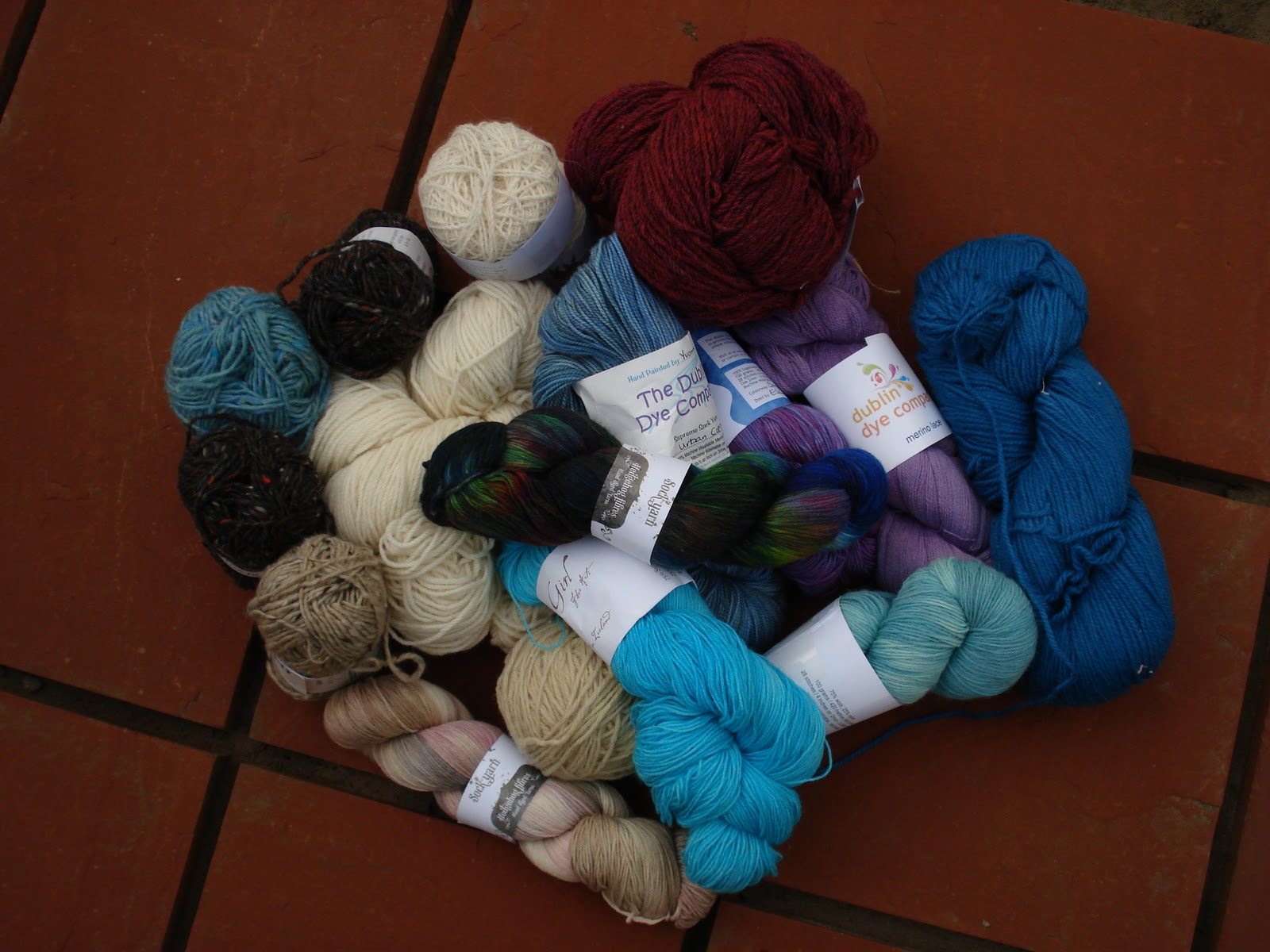 To the left you can see some of the yarn I have accumulated over the years, much of it is used in this book, all either spun or dyed in Ireland! There is some that's a bit rarer that isn't mentioned (like the Kerry Alpaca I picked up on holidays, which is only done in very small batches) Some of this is quite modern yarn, some of it older but this book would allow me to use up some of it!
 I found the patterns to be modern but not without respect to the past. There are some great Aran inspired patterns here with some deft modern touches. Entertainingly the names are places from the areas the yarns come from.
There's some helpful advice on sizing and adapting patterns, many of the patterns are in the round or flat with minimal seaming.
Types of patterns: Cardigans (3); Skirt (1); Children's cardigan (2); child sleeveless top (1); Jumper (3); Hat (3); Blanket (1); Shawl/wrap (2); children's jumper (1); bag (1); cowl (1); Fingerless Mittens (2)
Number of Patterns: 20 (the blanket is a variation on one of the shawls)
Split of patterns: mostly adult with some children's.
Size Range: Women's patterns are 27-51"; men's 37.5-53.5" and she does include the actual sizes the pattern is supposed to come to so that you can adjust for your own style.
Colour/Black & White: Colour photographs; black and white charts
Schematics: yes
Target Audience: Intermediate to advanced, there are no projects without at least a little cabling.
How to knit guide: not really, there are some guides to some of the extra techniques but not the very basics, the book assumes a certain competence with knitting
Experimental/Classical/Modern: Classical with a modern twist.
Comments on patterns (all links to patterns are from Ravelry):
Kerry Woollen Mills:
 |
| (c) Joseph Feller |
Tralee is knit in a DK yarn, this is a skirt mostly knit plain with a cable hiding in the kick pleat. I do like how this looks, not sure it would work for me but it's interesting!
Listowel is a shrug with a heart-motif on the back. This would probably be a great item as a wedding shrug or communion shrug. Knit in Aran weight yarn this would be a pretty quick knit.
Caherciveen hooded sleeveless, children's top, knit in Aran weight yarn.
Cushendale Woollen Mills:
Knockmore is a nice compromise of a man's jumper with enough patterning using twisted stitches to break up the monotonous acres of knitting without offending male sensibility, the only objection my husband had to it was the original colour. Knit in a dk weight.
Ballyragget is an interesting hat knit in DK using the twisted stiches from Knockmore
Dangan is either a baby blanket or a shawl. Knit in a sportweight yarn.
Belville uses the tweediness of the yarn to create a nicely shaped jumper with some colourwork on the yoke, knit in dk weight yarn.
Ballinagree is a sleeveless jumper designed for boys in a DK weight yarn, looks pretty unisex to me!
Kilmanagh uses some colourwork on the flap (a bag with a flap! I'm planning for this one!) and sides. It's interesting and knit in DK weight.
Donegal Yarns
Killybegs is an interesting cardigan with the cables providing some help with shaping. Interesting work. Using Aran weight yarn.
Bundoran
 I liked this one enough I started it (progress pic to the left)! Though I couldn't help messing with it and adding in colourwork. It's not finished because I have to get more of the pale turquoise yarn. I like how the cables interact with the yarn. Knit in Aran weight yarn, using some of the features of the cables from Killybegs.
Ardara is a nice sleeveless cardigan, one on my would like to knit shortlist. Knit in Aran weight yarn.
Glengesh is a wrap in an Aran weight yarn; worked from the bottom up with some shaping provided by short-row shaping.
Straboy is another one that makes my husband mutter noises about wanting one! Knit in an Aran yarn I've seen this in action and it looks well.
Rossbeg is an interesting design, knitting in Aran weight this starts with a yoke and works down, it's an interesting piece.
Hand Dyers:
 |
| (c) Joseph Feller |
Rathcooney Hat and Fingerless Mitts simple elegance, this is an interesting piece the cocoon stitch changes to ribs. It's a worsted weight yarn that has some silk in it. Hence the name!
Buy/Borrow: I have to admit that if I hadn't got a copy, and I had borrowed it from the Libraries I would have bought it. I like it and want to make too many patterns from the book not to want it.
Where found: I got a copy to review from Wiley, Dublin City Public Libraries has some copies in stock
The Blog tour:
15/9/2011 Stephen West
17/9/2011 Hoxton Handmade
21/9/2011 Shannon Okey
23/9/2011 Rosemary Hill
25/9/2011 Ann Kingstone
27/9/2011 Marly Bird
29/9/2011 JC Briar
1/10/2011 Woolly Wormhead
3/10/2011 Anne Hanson
7/10/2011 Stephannie Tallent
11/10/2011 Alice Yu
13/10/2011 Michelle Miller
15/10/2011 Deirdre Thornton
17/10/2011 Ilga Leja
Saturday, 24 September 2011
Startitis
Listening to a podcast earlier today, if I remember correctly it was Just One More Row, they were talking about a month of casting on, where you would cast on a project every day of one month and I gasped and thought that it was a strange thing to do.
And then I thought about it again.
Maybe doing a swatch when you bring the yarn planned for a project the week you get it and casting on the project within a set number of days? I tend to have issues finishing, buttons are my nemesis, so I'm thinking using a lure of allowing myself to cast on only if I sew on a few buttons on an almost finished item.
Why shouldn't I start a tonne of projects? What is my problem? Not enough yarn? HAHAHAHAHAHA! Not enough needles? Not the issue. Not enough project bags, nope, I have a glut of fabric bags due to Ireland's Plastic Bag tax. I'm starting to think that I should maybe have a project on the go for every category I have in my queue.
Is this madness? Could this work?
And then I thought about it again.
Maybe doing a swatch when you bring the yarn planned for a project the week you get it and casting on the project within a set number of days? I tend to have issues finishing, buttons are my nemesis, so I'm thinking using a lure of allowing myself to cast on only if I sew on a few buttons on an almost finished item.
Why shouldn't I start a tonne of projects? What is my problem? Not enough yarn? HAHAHAHAHAHA! Not enough needles? Not the issue. Not enough project bags, nope, I have a glut of fabric bags due to Ireland's Plastic Bag tax. I'm starting to think that I should maybe have a project on the go for every category I have in my queue.
Is this madness? Could this work?
Friday, 23 September 2011
entreKnits review
EntreKnits from Interweave Knits
 PC Version
Mac Version
Ravelry Link
Impressions: This is an enhanced ebook. Well designed. You can flick through the book page by page or use the index to go to what you're looking for. There are portions of the pages that are interactive, videos, and some horizontal scrolling on some pages so if basically it's like chapters that you then can go down rather than having to flick through something you're not quite interested in to get to a more interesting chapter. Also usefully, if you're navigating by arrow, when you go left or right it brings you to the top of the next page. You can resize the pages, useful when I was looking at my small screen netbook for this review.

Mac Version
Ravelry Link
Impressions: This is an enhanced ebook. Well designed. You can flick through the book page by page or use the index to go to what you're looking for. There are portions of the pages that are interactive, videos, and some horizontal scrolling on some pages so if basically it's like chapters that you then can go down rather than having to flick through something you're not quite interested in to get to a more interesting chapter. Also usefully, if you're navigating by arrow, when you go left or right it brings you to the top of the next page. You can resize the pages, useful when I was looking at my small screen netbook for this review.
It starts with a section on storage, where you can open the items to see what they're like, and click through to the company's website, usefully using the default browser on your machine.
Next up is a yarn review, the initial page is the swatches, done in diamonds, and you can scroll through or click whichever one catches your fancy, the quick reviews talks about usefulness for entrelac knitting.
Now a Book review, where they look at some books, patterns and dvds with some modular/entrelac designs
Now the meat starts; Annie Modesitt talks about maths and kniting and about befriending maths, this will probably be a chapter I return to again.
next up is a pattern, the Turn About Wrap

Modular is the next section where Jenna Wilson (the Girl from Auntie) looks at the history of modular knitting and patents
Soap Bubble hat by Norah Gaughan comes next, an oversized hat
Vivian Hoxbro looks at 3D Domino knitting and provides a pattern for a folded domino bracelet
The penultimate page has resources where you can find all the websites in one place.
To finish (and I almost overlooked it! due to the last page) Knitter and photographer Maryse Roudier takes some images and knits them, a very interesting section of inspiration
Overall I think it's an interesting magazine with a lot of samples of the kind of different modular and entrelac forms, it's a good introduction to the methods and some of the big-name designers in the field.

The next section is Entrelac - Meg Swansen gives a guide to blemish-free blocks; and talks about knitting backward, while Eunny Jang shows in a video how it's done. A pattern called Cochin Shrug is next (photograph to left)
Then they have some links to some Interweave Knits entrelac and other modular knitting
Quilt Inspired is the next section; starting with the Sweet Hexagon Cowl, an oversized pieced cowl where they're all linked as you go. The Lancaster Blanket is a blanket inspired by quilts, made modular.
Modular is the next section where Jenna Wilson (the Girl from Auntie) looks at the history of modular knitting and patents
Soap Bubble hat by Norah Gaughan comes next, an oversized hat
Vivian Hoxbro looks at 3D Domino knitting and provides a pattern for a folded domino bracelet
The penultimate page has resources where you can find all the websites in one place.
To finish (and I almost overlooked it! due to the last page) Knitter and photographer Maryse Roudier takes some images and knits them, a very interesting section of inspiration
Overall I think it's an interesting magazine with a lot of samples of the kind of different modular and entrelac forms, it's a good introduction to the methods and some of the big-name designers in the field.
Colour/Black & White: All colour
Target Audience: Intermediate to advanced knitters
Comments on patterns:
The Turn about Wrap creates a square wrap out of three triangular units with an two-colour iCord edging
The Turn about Wrap creates a square wrap out of three triangular units with an two-colour iCord edging
Cochin Shrug is an interesting shrug made from various sized blocks.
The Sweet Hexagon Cowl is an interesting draped cowl, not really what I need in a cowl (I need something a little tighter for under my motorbike jacket), tempting though!

Soap Bubble Hat is an oversized hat using bubbleshapes and designed by Norah Gaughan. Very oversized, if you're fond of that style it might appeal but it's not my type of thing.
Vivian Hoxbro provides a Folded domino bracelet. A different pattern, not really my style but an interesting method of design.
Buy/Borrow: it's a bit of an ARGH! Because my primary machine is Ubuntu this is a little awkward to access, and part of the reason it took me a while to get around to reviewing it, which would probably be a barrier to my actually considering buying it, but I do like it and would have bought it if I could have easily accessed it. (It requires Adobe Air to be installed - if you can get it working on your machine you should be able to get the Windows version to work, my computer is just not playing ball.)
Where found: Interweave Knits gave me a free copy for review, weeks ago.
The Cover Photograph is from Interweave Knits Website and the two pattern photographs are from Ravely and copyright their originators.
The Cover Photograph is from Interweave Knits Website and the two pattern photographs are from Ravely and copyright their originators.
Friday, 16 September 2011
Review of Crocheted Wraps & Throws
Ravelry Link
Published in the UK as Crocheted Throws and Wraps and the US as Crocheted Afghans
Impressions: Meh overall. Some of the pieces aren't bad but they're really not making me want to crochet them. Soem of them look rather insubstantial and wouldn't appeal to me for throws or shawls. Overall it didn't speak to me. I think part of the problem may have been the photography and settings.
Types of patterns: Piecework in crochet.
Number of Patterns: 25
Colour/Black & White: Colour
Schematics: no
Target Audience: it all looks like pretty basic stuff, the advantage with this sort of thing is that once you get the single blocks or the length roughly correct you can just make it bigger or smaller to suit.
How to crochet guide: yes, but the difference between UK and US terms isn't explained
Experimental/Classical/Modern: Pretty classical pieces
Comments on patterns: The first chapter is Vintage Style and they start with a Cream Comforter, pictured on a table, not what I'd use for a table is a piece with raised pieces. Made in Debbie Bliss Rialto DK (11 balls).
The Pale Green Textured Blanket is pretty simple, crocheted in one piece, with puff stitches, made in Debbie Bliss Como (22 balls).
The Circular Coverlet is first show as a shawl on a model, inspired by a vintage Doily. Made in Debbie Bliss Cashmerino Aran (19 balls).
The Shetland-Style Shawl uses the shetland idea and makes a shawl with it in crochet. You could probably knit the center and crochet the outside, it's an interesting take on the Shetland blanket style. Knit in Baby Alpaca or Pure Wool DK (7x50g)
Puffs Baby Blanket - many, many puffs joined to make a blanket, the baby blanket requires 35g of colour A; 60g of colour B & C; 45g of colour D, E & F and 50g of G in 4ply. It notes that for every 10 puffs you will need 20g of yarn.
Argyll Afghan - worked initially like a parge colourwork granny square style affair from side to side with applied overchecks. This needs 9x 50g balls of Sirdar balmoral in 4 colours.
Gingham Blanket - a dense baby blanket worked in three colours and then edged, 8 x50g balls of Sublime Extra Fine Merino DK
Chapter 2: American Dream
Shaker-Style Throw - now the yarn isn't identified but it's a Silk Mohair and Wool Mix Aran weight in Random Shaded Grey (7x50g balls) and my mind is suggesting Noro. While this is an interesting homespun look, it doesn't say quaker to me, it isn't dense or practical enough. Also the squares aren't joined as you go but joined at the end.
Navajo Blanket center star and radiating saw-tooth borders. Inspired by Navajo design this one needs 18 balls of pure aran wool weight yarn in 6 different colours, done in pieces that are fastened together.
Seminole-Style Blanket - two strips that are then joined together; needs 14 balls of pure wool dk.
Sunshine & Shadow Throw, working in alternative squares of bright dark and light colours in a diamond pattern and then a plain border this usess dk yarn (wool rich); 270g of a, 65g of b, h; 50g c, e, g; 100g d, f; 200g I it would be aproximate though you could work with scraps of yarn depending on how much you had and work with filling in with approximate colours.
Log Cabin Coverlet - an interesting lesson in colour use and how to change colours in a round uses DK cotton yarn, 100g of A; 30g of B & C; 40g in D & E; 50g in F&G
Crazy Patchwork throw. Flowers are made square - about 170g of dk yarn in a mix of colours, this one could use up a lot of leftovers.
Chapter 3: Outside Inside
Rainbow Baby Blanket - strips joined and then with a rainbow sequence edging. - dk yarn 60g of A&B (red & Orange); 40g of (C, D, F) Yellow; Green & Violet; 90g in shades of blue (E) and 100g in Navy which is used as the edging.
Flower Garden Throw - Aran yarn made in hexagonal flowers and then joined - 11 x 50g balls in a variety of colours
Wild Flower Throw - flowers made from triangles and then set into squares and then worked together. Done in DK weight yarn with a single background colour and could be used to use up almost matching reds and pinks.
Roses and Daisies Throw - this one could be used to use up scraps with a solid background. 400g of a mix of dk yarn and 8x50g of background yarn.
Seascape Wall Hanging - this is a brown and blue hanging that echoes a seascape, as it's a hanging you could use any sort of yarn for this.
Landscape Play Blanket - a patchwork blanket
making fields, hills and sky for children to play with animals with. Done in a variety of dk greens with some yellow and blue scattered in.
Chapter 4 is Around the World
Tartan Blanket - bands of colour with grids of holes to weave contrast colours through. Done in DK yarn with 11 balls of dk yarn this could be one to for those who follow their clan tartan
African Beads Circular throw - inspired by tribal circular beadwork patterns. USing a contrast background to highlight the pseudo-beads, done in aran weight yarn, you would need 10 balls of yarn for this.
Scandinavian Sampler Throw - a red and white throw is cross stitched with red; 7 balls of 50g dk yarn
Aran-style throw - all in cream this is actually done in Aran Weight yarn - you will need 7x100g balls. There is a mock fringing which is quite effective.
Kelim Carpet runner - this makes me think more of New Mexican designs rather than more Turkish designs but we have here eight pointed stars in octagons joined in a strip. Aran yarn and you would need 7x100g balls for this, split over 5 colours
Indigo Ikat Throw - diamonds in the centre with chevrons coming off them in strips. a variety of blues, whites and creams dk weights
Buy/Borrow: I was a little underwhelmed; but this would be a great stashbusting book. Several of the designs look more ornamental than warming to me, I'd borrow to see what you think.
Where found: Dublin City Public Libraries has copies.
Published in the UK as Crocheted Throws and Wraps and the US as Crocheted Afghans
Impressions: Meh overall. Some of the pieces aren't bad but they're really not making me want to crochet them. Soem of them look rather insubstantial and wouldn't appeal to me for throws or shawls. Overall it didn't speak to me. I think part of the problem may have been the photography and settings.
Types of patterns: Piecework in crochet.
Number of Patterns: 25
Colour/Black & White: Colour
Schematics: no
Target Audience: it all looks like pretty basic stuff, the advantage with this sort of thing is that once you get the single blocks or the length roughly correct you can just make it bigger or smaller to suit.
How to crochet guide: yes, but the difference between UK and US terms isn't explained
Experimental/Classical/Modern: Pretty classical pieces
Comments on patterns: The first chapter is Vintage Style and they start with a Cream Comforter, pictured on a table, not what I'd use for a table is a piece with raised pieces. Made in Debbie Bliss Rialto DK (11 balls).
The Pale Green Textured Blanket is pretty simple, crocheted in one piece, with puff stitches, made in Debbie Bliss Como (22 balls).
The Circular Coverlet is first show as a shawl on a model, inspired by a vintage Doily. Made in Debbie Bliss Cashmerino Aran (19 balls).
The Shetland-Style Shawl uses the shetland idea and makes a shawl with it in crochet. You could probably knit the center and crochet the outside, it's an interesting take on the Shetland blanket style. Knit in Baby Alpaca or Pure Wool DK (7x50g)
Puffs Baby Blanket - many, many puffs joined to make a blanket, the baby blanket requires 35g of colour A; 60g of colour B & C; 45g of colour D, E & F and 50g of G in 4ply. It notes that for every 10 puffs you will need 20g of yarn.
Argyll Afghan - worked initially like a parge colourwork granny square style affair from side to side with applied overchecks. This needs 9x 50g balls of Sirdar balmoral in 4 colours.
Gingham Blanket - a dense baby blanket worked in three colours and then edged, 8 x50g balls of Sublime Extra Fine Merino DK
Chapter 2: American Dream
Shaker-Style Throw - now the yarn isn't identified but it's a Silk Mohair and Wool Mix Aran weight in Random Shaded Grey (7x50g balls) and my mind is suggesting Noro. While this is an interesting homespun look, it doesn't say quaker to me, it isn't dense or practical enough. Also the squares aren't joined as you go but joined at the end.
Navajo Blanket center star and radiating saw-tooth borders. Inspired by Navajo design this one needs 18 balls of pure aran wool weight yarn in 6 different colours, done in pieces that are fastened together.
Seminole-Style Blanket - two strips that are then joined together; needs 14 balls of pure wool dk.
Sunshine & Shadow Throw, working in alternative squares of bright dark and light colours in a diamond pattern and then a plain border this usess dk yarn (wool rich); 270g of a, 65g of b, h; 50g c, e, g; 100g d, f; 200g I it would be aproximate though you could work with scraps of yarn depending on how much you had and work with filling in with approximate colours.
Log Cabin Coverlet - an interesting lesson in colour use and how to change colours in a round uses DK cotton yarn, 100g of A; 30g of B & C; 40g in D & E; 50g in F&G
Crazy Patchwork throw. Flowers are made square - about 170g of dk yarn in a mix of colours, this one could use up a lot of leftovers.
Chapter 3: Outside Inside
Rainbow Baby Blanket - strips joined and then with a rainbow sequence edging. - dk yarn 60g of A&B (red & Orange); 40g of (C, D, F) Yellow; Green & Violet; 90g in shades of blue (E) and 100g in Navy which is used as the edging.
Flower Garden Throw - Aran yarn made in hexagonal flowers and then joined - 11 x 50g balls in a variety of colours
Wild Flower Throw - flowers made from triangles and then set into squares and then worked together. Done in DK weight yarn with a single background colour and could be used to use up almost matching reds and pinks.
Roses and Daisies Throw - this one could be used to use up scraps with a solid background. 400g of a mix of dk yarn and 8x50g of background yarn.
Seascape Wall Hanging - this is a brown and blue hanging that echoes a seascape, as it's a hanging you could use any sort of yarn for this.
Landscape Play Blanket - a patchwork blanket
making fields, hills and sky for children to play with animals with. Done in a variety of dk greens with some yellow and blue scattered in.
Chapter 4 is Around the World
Tartan Blanket - bands of colour with grids of holes to weave contrast colours through. Done in DK yarn with 11 balls of dk yarn this could be one to for those who follow their clan tartan
African Beads Circular throw - inspired by tribal circular beadwork patterns. USing a contrast background to highlight the pseudo-beads, done in aran weight yarn, you would need 10 balls of yarn for this.
Scandinavian Sampler Throw - a red and white throw is cross stitched with red; 7 balls of 50g dk yarn
Aran-style throw - all in cream this is actually done in Aran Weight yarn - you will need 7x100g balls. There is a mock fringing which is quite effective.
Kelim Carpet runner - this makes me think more of New Mexican designs rather than more Turkish designs but we have here eight pointed stars in octagons joined in a strip. Aran yarn and you would need 7x100g balls for this, split over 5 colours
Indigo Ikat Throw - diamonds in the centre with chevrons coming off them in strips. a variety of blues, whites and creams dk weights
Buy/Borrow: I was a little underwhelmed; but this would be a great stashbusting book. Several of the designs look more ornamental than warming to me, I'd borrow to see what you think.
Where found: Dublin City Public Libraries has copies.
Thursday, 15 September 2011
Irish Patchwork
Impressions: This is a book that accompanied an exhibition of Irish Patchwork. A useful place to start if you want to look at the traditions of Irish Patchwork. It's an interesting peek into times gone by. There were three main methods. Mosaic, Log Cabin and Applique. Applique seems to be in the majority. She defines Mosaic as small pieces of cloth sewn together, while log cabin is where strips are sewn to a square. This shows how some women took what they had available and made something out of it. Patchwork was never, apparently, seen as commercial so this was a domestic task only, so people made them as gifts or for themselves.
Colour/Black & White: All colour
Target Audience: visitors to the exhibition
Comments on patterns: This would be useful if you're doing Log Cabin or other forms of pieced knitting, in making you look again at the concept and perhaps finding a different sequence you could take the piece in. The Cover map of Ireland is also interesting as a concept piece.
Buy/Borrow: I'd borrow, finding copies could be interesting as the exhibit was in 1979. I've seen copies pop up
Where found: Dublin City Public Libraries has copies in stock
Wednesday, 14 September 2011
Knitting & Crochet Bible
Impressions: Take the Knitting Bible add the Crochet Bible, bind for cheaper than the two separately, et voila. I'm not really going to review this one as I have both and plan to review them separately. I didn't see any new patterns and the copyright information didn't mention any revision details only published and dates.
Buy/Borrow: If you want both books but didn't get them separately
Where found: Dublin City Public Library has copies in stock
Buy/Borrow: If you want both books but didn't get them separately
Where found: Dublin City Public Library has copies in stock
Sunday, 14 August 2011
some wardrobe advice
(I'm going to cross post this to my blog, but I think it will get a better variety of comment here!)
So I've been looking at some of the advice presented about knitting to fit and choosing patterns that suit and I thought that they missed on a few details. Using your own wardrobe to see what suits you.
To start you will need some paint chips, those strips of colour available free; and a notebook or camera.
Now you root around in your wardrobe.
First you need to take an overall look at your wardrobe. Split it into the basic four themes. Work; Leisure; formal and other. Look at what they're composed of, how do the garments flow? More flowing garments are better complemented by finer gauge yarns. You also need to look at the gaps in your wardrobe, where would there be space for knits and what would add usefulness to things? Make notes as you go.
You need to examine the garments and see what it is about the garment you like, put it on and see what you think about it and why you like it. Is it the colour? The shape? The fabric? Use the paint chips in your notes to colour match things that you like the colour of and that you get compliments about. You will probably see that there are themes running through your wardrobe. The colour chips also come in useful, particularly if you get a good variety, in seeing complimentary colours, colours that would suit what is there already.
Now look at the items you don't wear. Why not? Ill fitting? note what's bad about them, note what attracted you in the first place to them. Colour? A single detail? Sketch or photograph them and be honest with yourself, do you really need them? If they're all bad, note it, note what doesn't suit it's often as important as what does suit and get rid of them. I have one main rule about outfits, if you have to tug on it beyond the Picard Manoeuvre to rearrange your garment after sitting, then there is something wrong about it. Examine what makes your uncomfortable about it. You may be able to change the garment a little to fix it, all those pretty knitted and crocheted edgings might come into use.
I know folks have rules about how long since you wore something that suggests when you should get rid of something. However you should remember that there are some things you may want to hold on to, beyond the regular spacings. A good interview outfit that fits is important but ensure it still fits well and is complete.
Now what you need to do is get a measuring tape and either use someone else to help and measure yourself or conduct a cheats method; take some items you like the look of on you and measure them flat. Note good lengths on you, note what makes you comfortable again.
How deep is good for v-necks, how deep do you like round necks, do you like collars?
Where does waist shaping look good on you, do you need it?
Do you like crop tops? Where should they hit? They are often the same length as shrugs. How low looks good on you? Don’t dismiss them, just because you don’t wear cropped tops, Boleros are another short length.
Waist length tops are another length that can look good and bad on people. Decide if you want it and where is good. Some jackets work at this length.
Next length is the hip length on you, for most if not all people this is a point below the widest part of the waist, often just below crotch length
The last usual length is a long tunic length. Usually this is where the end of your fingers come when you put your hands straight down by your side.
Now there is also the consideration of lifestyle. A lot of top lengths for me are dictated by the fact that many of them have to fit under a biker jacket, so while the length mightn’t be ideal as a look on me it’s more important for me to be warm on the bike!
This is only the start of some thoughts about this topic, here's hoping someone will find use from it.
So I've been looking at some of the advice presented about knitting to fit and choosing patterns that suit and I thought that they missed on a few details. Using your own wardrobe to see what suits you.
To start you will need some paint chips, those strips of colour available free; and a notebook or camera.
Now you root around in your wardrobe.
First you need to take an overall look at your wardrobe. Split it into the basic four themes. Work; Leisure; formal and other. Look at what they're composed of, how do the garments flow? More flowing garments are better complemented by finer gauge yarns. You also need to look at the gaps in your wardrobe, where would there be space for knits and what would add usefulness to things? Make notes as you go.
You need to examine the garments and see what it is about the garment you like, put it on and see what you think about it and why you like it. Is it the colour? The shape? The fabric? Use the paint chips in your notes to colour match things that you like the colour of and that you get compliments about. You will probably see that there are themes running through your wardrobe. The colour chips also come in useful, particularly if you get a good variety, in seeing complimentary colours, colours that would suit what is there already.
Now look at the items you don't wear. Why not? Ill fitting? note what's bad about them, note what attracted you in the first place to them. Colour? A single detail? Sketch or photograph them and be honest with yourself, do you really need them? If they're all bad, note it, note what doesn't suit it's often as important as what does suit and get rid of them. I have one main rule about outfits, if you have to tug on it beyond the Picard Manoeuvre to rearrange your garment after sitting, then there is something wrong about it. Examine what makes your uncomfortable about it. You may be able to change the garment a little to fix it, all those pretty knitted and crocheted edgings might come into use.
I know folks have rules about how long since you wore something that suggests when you should get rid of something. However you should remember that there are some things you may want to hold on to, beyond the regular spacings. A good interview outfit that fits is important but ensure it still fits well and is complete.
Now what you need to do is get a measuring tape and either use someone else to help and measure yourself or conduct a cheats method; take some items you like the look of on you and measure them flat. Note good lengths on you, note what makes you comfortable again.
How deep is good for v-necks, how deep do you like round necks, do you like collars?
Where does waist shaping look good on you, do you need it?
Do you like crop tops? Where should they hit? They are often the same length as shrugs. How low looks good on you? Don’t dismiss them, just because you don’t wear cropped tops, Boleros are another short length.
Waist length tops are another length that can look good and bad on people. Decide if you want it and where is good. Some jackets work at this length.
Next length is the hip length on you, for most if not all people this is a point below the widest part of the waist, often just below crotch length
The last usual length is a long tunic length. Usually this is where the end of your fingers come when you put your hands straight down by your side.
Now there is also the consideration of lifestyle. A lot of top lengths for me are dictated by the fact that many of them have to fit under a biker jacket, so while the length mightn’t be ideal as a look on me it’s more important for me to be warm on the bike!
This is only the start of some thoughts about this topic, here's hoping someone will find use from it.
Sunday, 17 July 2011
Working on versus in progress
I've been looking at my blog and playing a little with it. I do know that it's not the most exciting look but I prefer the background to the others offered.
One of the things I got rid of was the Blog Roll. I don't use it honestly and found myself a little upset recently when someone else didn't list me on their blog roll, so realised that I didn't list folks I read because they link to their blog posts on their twitter feed or I get them through the Irish Knitting Blogs list. So it's gone.
I also took a look at What's on my Needles and realised that while yes, those projects are technically not finished, and I do want to finish them there's something in the way. I think it was all precipitated by a project that I've been working on, the Roundabout Leaf Tank. I finished the main body yesterday and pulled it on.
Oh dear. It's too tight on the bottom, too loose at the top and I don't think that working on it any more will make it any better. I will rip it, but I'm holding on to it for the moment, I'm not through the mourning period for it yet.
What I am working on is Ivory, Copper & Gold; a cotton t-shirt in the same yarn as failed me before, I have a lot of this and will probably be able to finish it before needing to rip the Roundabout Leaf Tank.
I'm working on a pair of Eagle's Flight Socks for my husband, I wasn't sure how he would take them when I had got a little bit in, but he likes them, which is good.
I'm also occasionally working on Sagrantino Shawl these three form the bulk of my knitting these days.
I really have to get the zip into my pseudo-Biker Jacket but I have zip fear. I also have to add a lot of buttons onto my Purple Versatility and the sleeves need to be ripped out wholesale from the cardigan I've been working on.
What would be a good first moment would be to get some measurements of ME and use them to fix some pieces. That or bribe someone to do the finishing for me!
One of the things I got rid of was the Blog Roll. I don't use it honestly and found myself a little upset recently when someone else didn't list me on their blog roll, so realised that I didn't list folks I read because they link to their blog posts on their twitter feed or I get them through the Irish Knitting Blogs list. So it's gone.
I also took a look at What's on my Needles and realised that while yes, those projects are technically not finished, and I do want to finish them there's something in the way. I think it was all precipitated by a project that I've been working on, the Roundabout Leaf Tank. I finished the main body yesterday and pulled it on.
Oh dear. It's too tight on the bottom, too loose at the top and I don't think that working on it any more will make it any better. I will rip it, but I'm holding on to it for the moment, I'm not through the mourning period for it yet.
What I am working on is Ivory, Copper & Gold; a cotton t-shirt in the same yarn as failed me before, I have a lot of this and will probably be able to finish it before needing to rip the Roundabout Leaf Tank.
I'm working on a pair of Eagle's Flight Socks for my husband, I wasn't sure how he would take them when I had got a little bit in, but he likes them, which is good.
I'm also occasionally working on Sagrantino Shawl these three form the bulk of my knitting these days.
I really have to get the zip into my pseudo-Biker Jacket but I have zip fear. I also have to add a lot of buttons onto my Purple Versatility and the sleeves need to be ripped out wholesale from the cardigan I've been working on.
What would be a good first moment would be to get some measurements of ME and use them to fix some pieces. That or bribe someone to do the finishing for me!
Wednesday, 13 July 2011
Some finished socks
I've been a bad blogger and forgot to update my finished objects so I'm going to do a cluster of them spaced over a few days. Hopefully I won't leave so long between updates next time. The Last Item I finished was the Canal de Midi Socks.
I made some Bartholomew's Tantalising Socks from Cat Bordhi's New Pathways for Socks Knitters
I also made some Fawkes a free pattern from ravelry
I currently have a pair of socks for Mac on the needles. A pair of Eagle's Flight in Regia 4-ply Line Steps Colour
I also abandoned a pair of Widdershins I had them almost finished when I realised that they were too tight and weren't going to work, so another knitter took them off my hands and plans to finish them. They were going to be my pair of knee socks for this year but every inch I knit it seemed to get shorter.
I made some Bartholomew's Tantalising Socks
from Cat Bordhi's New Pathways for Socks Knitters I also made some Fawkes
a free pattern from ravelryI currently have a pair of socks for Mac on the needles. A pair of Eagle's Flight in Regia 4-ply Line Steps Colour
I also abandoned a pair of Widdershins I had them almost finished when I realised that they were too tight and weren't going to work, so another knitter took them off my hands and plans to finish them. They were going to be my pair of knee socks for this year but every inch I knit it seemed to get shorter.
Subscribe to:
Comments (Atom)