Showing posts with label crochet. Show all posts

Thursday, 15 October 2015

Crochetopedia review


The edition to hand was the UK edition as per the Dublin City Public Libraries edition.

Dublin City Public Libraries
Ravelry

The first thing that I really like about this book is that it's spiral bound, great for a reference book.  Starts with a history of Crochet.  It then moves onto a discussion of yarns and fibres, with a piece on yarn weights, equipment etc.  It even has a mention of where to measure a crochet hook.  Yarn labels are examined, yarn substitution and care are all covered, as are blocking and reading patterns.  The How-to even mentions left-handed crocheting (the advice of using a mirror is used), there is also a mention that this book is UK terminology and what the US terms are.  The descriptions of methods and stitches are detailed using drawings with supportive photographs.  There are almost 100 pages of introduction before any projects are discussed.  The words Worsted and Aran seem to be used interchangeably with some of the yarns.

The only way I think this book could be improved would be to have the page numbers associated with the skills alongside the skills list on the projects, and a bibliography.

Is it the only reference you will ever need? No. There is no one book that can offer everything, but it's a solid beginners book with a lot of jumping off points for a lot of techniques.  I would recommend it to beginners.

Projects are divided into Simple, Intermediate and advanced.  Each pattern comes with stitches and skills, yarn, measurement, notions and yarn alternatives.
The simple projects are
Square Pot Holder - could be done in a single colour but two colour allows you to hearn how to work with multiple colours.  Made in an Aran medium weight yarn.
Beanie Hat with Pom-pom - again some minor colourwork (I would use some of the alternative colour in the pom-pom myself.  This is pretty simple and easy enough, uses a worsted weight yarn.
Bow Headband - quite simple but can give a sense of pride, made in a worsted-weight yarn
Fingerless Gloves - made from side to side these have texture and are made in worsted/Aran yarn
Phone Cosy - made in worsted yarn, it's a chance to practice stripe colourwork.
Bobble Scarf - a chance to try texture, aran yarn
Baby Booties - this is a make a square and seam it for the shape, the original is in a DK yarn.
Motif decoration - another project that could be in any yarn, dependent on hook.  Original is in Worsted.
Arm Warmers - with the fashion for 3/4 length sleeves these are a useful bridge between bottom of sleeve and wrist made in a worsted weight yarn.
 
Flower Brooch - a felted project in a worsted weight wool
Amigurumi Russian Dolls - not nested dolls but like the nested dolls, enhanced with embroidery. Made in Sport-weight yarn these would be a good introduction to amigurumi.


Intermediate
Sampler Baby Blanket - Play with practice swatches using some of the patterns from the book or other books, make squares, join them together, use a single yarn to join, this is a good project to use up practice squares or spare yarn.  It uses worsted weight yarn but any yarn would do.  With some squares you might have to work it a few times to get the proper tension but with only about 20-22 stitches per square this isn't too hard.  The only thing not noted is to ensure that you don't mix yarn types, like pure wool and pure acrylic for ease of washing.
Chevron Rug - looks impressive, made in super bulky yarn and it does suggest using a hardwearing yarn, contrasting stripes.
Intarsia Cushion - a good learning tool to working in Intarsia, and pretty quick in a worsted weight yarn. Very Mondrian.
Lacy Beret - this one hits a bit of a button, it isn't very lacy, it starts with a small lacy motif and then works down in a solid pattern, which reduces the usefulness of the hat.  It's worked in a DK yarn.
Lace Scarf - worked to the middle and seamed, so both ends match, uses sportweight yarn
Starry Night place mat Plain worked mat with surface crochet on top. Uses worsted yarn.  While pretty I sometimes question the practicality of non-flat place mats.
Slippers - worked in worsted yarn, I would add a tip to research non-slip grips for painting or sewing on.
Felted Tote Bag - I am a big bag person, but this one is quite big. Also features no zip or closing mechanism, I'd be inclined to make the half-granny into a full granny and use half as a flap.
Honey Cat - worsted weight stuffed toy.
Little Hen - DK weight stuffed toy


Advanced Projects
Broomstick Lace Clutch - worsted weight, this is lined.
Beaded Earrings - with a bead this is a delicate piece and rather fun
Hairpin lace mobius wrap - made in a light or medium weight yarn this will expand the hairpin lace skills.
Lacy Cardigan - simple repeated clusters for this v-necked light cardigan.  Uses DK yarn.
Shell Top - small amount of shaping for this DK weight sleevless t-shirt.
Toe-up lacy socks - done in sock yarn.
Swirl thread bowl - spray starch is used to make this with 3ply yarn, you will also need a bowl form to finish.
Filet thread runner - has several elements of filet crochet in 3-ply yarn.
Tunisian Neck Warmer - two button to fasten bulky weight yarn using the Tunisian diagonal stitch.
Child's Unisex sweater - in the main quite basic but the contrast stripe features cable stitches to learn the technique.  Made in DK yarn.


The book closes out with a stitch directory, which isn't exhaustive but a good set of begining stitches.  It also has some motifs. 

They do mention Ravelry in the resources.  Many of the mentioned yarns are US brands.

Wednesday, 15 July 2015

Crochet with Flowers review

Cute and Easy Crochet with Flowers

Dublin City Public Libraries
Ravelry

This is an interesting idea, using floral motifs to create projects.

The book starts with section on how to crochet, which doesn't have a section on left-handedness and also appears to neglect to mention the difference between US and UK terminology.  It's divided in three sections: Starting out; Practice makes Perfect and Confident Crocheting.  There are basically two types of use of Floral motifs, applique and as part of the stitch.

Chapter 1: Starting Out.
Poppy Purse - a purse with a poppy motif in Aran yarn.

Kindle Cover - crocheted flat, seamed and lined with flower appliques, in sportweight yarn

Tote Bag - made in pieces, seamed and with appliqued flowers.  Aran weight yarn.

Rose Headband - this has been in and out of fashion and it's an Aran Weight, with an applied Rose.

Baby Beanie Hat - Another pattern with applied flowers in a 4 ply yarn.

Ear Flap Hat - small earflaps on this aran-weight hat with applied flowers and a contrast trim, this one is quite pretty.

Fingerless Gloves - fingerless gloves with a small trim of flowers in a contrast colour around the wrist.  Worked in Aran-weight yarn.

Bunting - triangular bunting in a DK yarn with a floral centre and linked by flowers.

Egg Cosies - again with applied flowers. worked in DK weight yarn.

Floral-edged Jam Pot Covers worked in DK yarn this is quite ornamental and would be suitable for gifts.

Pin Cushions nested flowers stuffed in DK yarn.

Hexagon Flower Throw work multiple hexagons in DK yarn this could be a good use of leftovers.

Pansy and Kittens - Cat toys with flowers applied.


Chapter 2: Practice Makes Perfect
Butterfly and Blossom Key Ring- worked in Cotton Glace this is a set of key-ring charms.

Blossom Necklace a fine necklace worked in DK yarn that is reminiscent of Daisy chains.

Flower Garland - a series of flowers on a chain in DK

Shelf Edging - a shelf edging with flowers along it in a 4-ply yarn.

Floral Shell Stitch Cushion Cover - fairly simple cushion with bouquet of flowers in the centre in Aran yarns.

Tablecloth - flowers are used as weights in each corner, DK yarn.

Lido Swimming Cap Tea Cosy Aran weight yarn used double for the body and then decorated with multicoloured Flowers, just like an old-fashioned swimming cap.

Crown-edged Cushion Cover it's like a granny square but with multicoloured centre and plain around until the edging which is in a crown-like edging.

Place Mats - using a heavy cotton yarn these circular mats have applied flowers in a finer yarn.

Oven Cloths - floral centres on these lined oven cloths.

Buggy Blanket squares created and then connected together, done in dk weight yarn.

Chevron and Daisy Scarf - Rows of colour interrupted with a few rows of a contrast and then embellished with flowers, made in an Aran weight yarn.

Beaded Craft Kit Roll - Catherine Wheel stitch in two colours with beading in a DK weight yarn.

Baby Blanket a shell stitch blanket in a dk weight yarn with an edging embellished with flowers.

Chapter 3: Confidence Crocheting

Brooch - a flower made into a brooch made in a dk yarn.

Floral Bag - multiple flowers make up this bag that's then lined.  Made in DK yarn.  The flowers are each created separately before, making it easy to connect them.

Daisy Scarf - worked in squares in a sportweight yarn and then joined.

Floral Lace Scarf - a flower edged shawl worked in a fine mohair yarn.  Edged with flowers in a variety of sizes.

Vintage-style Vase Coaster - doileys worked in dk weight yarn. in multiple colours.

Round Rose Cushion - multiple roses worked in Aran-weight yarn and then attached to a croceted backing.

Gypsy Queen Throw - DK weight yarn in multiple colours, worked in squares and crocheted together with a loop edging.

Wash Cloths - floral centered wash cloths in DK cotton yarn. There are three, a Blossom Burst Cloth; Flower Square Cloth (with a 3-d flower); and a Petal edged circle, which is both centered with a flower and edged with a petal like edging.

It's a good book of designs which aren't too complex but do have a good result, many of them involve a lot of finishing. Many of them are too flouncy for my taste but they're quite nicely done if that's your taste and you're happy with a fair amount of sewing.

As usual this was borrowed from Dublin City Public Libraries who offer no inducement to write these others than supply plus my wage.

Sunday, 29 March 2015

Monday, 15 September 2014

Hook, Yarn and Crochet review

Hook Yarn and Crochet

Dublin City Public Libraries

Ravelry

This book starts with a description of how-to crochet, UK terms, I didn't see a US conversion list. There was also nothing I could see about left-handed crochet (which is how I roll)

The patterns are divided in three sections: Accessories; Homewares and Gifts and Decorations  

Accessories
The patterns start with Boot Toppers in a DK weight yarn.
Pompom Hat is next in Chunky yarn
A Shells Collar in 4-ply yarn.
Covered Bangles in a 4-ply yarn.
More 4-ply yarn in the Wavy Scarf, a good use for three shades of a 4-ply yarn
Wrist warmers in a worsted yarn have a contrast edging.
A chunky yarn Tablet case is relatively simple and would be a good padded cover and would be easily adapted for size.
The Jute shopper is a useful hand-held bag, I prefer my shopping bags to have longer handles but this looks useful. A cotton edging on the handle might be useful to protect hands.

Homewares
Clock - crocheted in rounds in two shades of 4-ply yarn
Pot Stand - in Jute twine
Drum Lampshade - in a DK cotton yarn
Storage Basket in a super-chunky yarn
Granny Throw in 4-ply yarn using multiple shades work 4 rows each with the final row in black sewn together and then edged in black.
Tea-light cuffs worked in 4-ply cotton yarn covers for tea-light holders
Pebbles - covers on pebbles worked in 4-ply as decorations.

Gifts and Decorations
Daisy Chain a decorative, very spring-like garland worked in 4-ply yarn
Bunny Toy 4ply yarn makes a bunny
Star Garland more 4-ply makes an 8pointed star garland, could be very Christmassy
Snowflakes 4 ply yarn again, good as gifts and as decorations.
Love heart a stuffed heart.

an interesting set of patterns that would be quite good for a beginner as many of them aren't really dependent on tension so would be useful practice.

As usual, I got this book in Dublin City Public Libraries who offer me no inducement to write these other than providing me with books and a salary.

Friday, 19 July 2013

Review of Crochet Unravelled


Book Depository Link; Ravelry Link; Dublin City Public Libraries

Claire Bojczuk

This is a very good, ambidexterous guide to Crocheting.  The instructions are clearly done for both left and right handed crocheters, side by side, down to a clearly illustrated granny square done by both left and right-handed crocheters.  A breath of fresh air for those of us who need instructions for left-handed use (now if she'd only shown crab stitch, trying to work that out left-handed was a head-wrecker.

The book is divided into two parts, the instructions and the projects, and the projects are simple and good starter pieces.  Usefully, right beside the illustrations of the projects in the centre of the book you have instructions for reading charts on one side and UK/USA terminology and hook size with suggested yarn weight alongside.

Projects include a Bracelet, (illustrated inside the cover) simply made with a plaited edge, the instructions are both written and charted.

Hair Scrunchie (also illustrated inside the cover)- again written and charted instructions

Bottle Bag (also illustrated inside the cover)- another one charted and written

A Daisy Facecloth is a modification to a granny square with a picot edging, charted except the centre, also written.

Love Heart Soap Sachet - charted and written

Traditional booties - charted and written

Cobweb Cover is a blanket and is written and charted.

Flower Cushion  - motifs sewn together to create a cushion.  Could be made in two sets of colours for variety. - charted and written

Chevron Scarf - is a pretty scarf that would lend itself well to all sorts of yarn - charted and written

Skullcap, a hat that starts from the centre and works down so would be adaptable for a variety of yarns and adaptable to make it bigger if necessary.  Again charted and written.

Tee-shirt edgings uses beeds and is edging that could be used anywhere.

It's a good basic starter book and also would be useful as a reference for more experienced crocheters, a worthwhile book for most crocheters libraries.

I got this copy from Dublin City Public Libraries where I work, who don't offer me any inducement other than access to the titles and my wages.

Friday, 5 July 2013

Tunisian Crochet book review

Book Depository; Ravelry Link

This is quite a good book on the topic of Tunisian Crochet with clear photographs about the methods and a lot of projects, it is one that I will seriously consider buying for myself.

It starts out with a basic crochet skills section and then a very clear section on the techniques of Tunisian Crochet with very clear photographs, there possibly should be a few very simple dishcloth patterns in here to gell the techniques but the projects following are quite interesting.

The first project is Chain Mail Scarf   using two strands of yarn held together and tunisian purl stitch throughout.

Wild and Woolly Wrap uses a thick and thin yarn and a bias style to create a wrap, an interesting blend of pattern and yarn

Honeycomb Skirt uses a cotton/viiscose yarn in a multicolour blend to create an interesting skirt.

Shimmer Shawl blends tunisian crochet and other techniques to create an interesting shawl that has open and more closed spaces.

Ivory Shell is a simple sleeveless top with a waist tie and a textured stitch

Ladders and Lattice Duster is an open cardigan with more open sleeves, the sleeves are worked from the top down.  It's an interesting piece

Felted clutch introduces felting to the mix.

Warmhearted vest is what folks this part of the pond would call a tank top, with a simple v-neck this looks knitted

Hug-a-licious Jumper is a girls overdress, gym slip style, sleeveless. Meant for small girls.

Big Sister Sweater is a jumper done in Tunisian Net Stitch, which looks very interesting.

Toben's Pillow is a simple tunisian simple stitch cushion

Sweet Dreams Baby Blanket is an interesting textured blanket

Frosted Stitch Afghan is another interesting use of stitches to create an interesting pattern

Have it both ways pillow is a cushion with two sides which are slightly different

Foam Follows Function Ottoman Cover uses a super bulky yarn used three strands at a time and a 22mm needle!

Mardi Gras Placemats uses different stitch patterns and colourwork to create a variety of mats, from simple to complicated.  Interesting work.

The book finishes up with the Yarn standards sizing and yarn weights guidelines and some resource information.

Overall a good book for people wanting to explore Tunisian Crochet more.  I would be tempted to buy it.

This book was obtained from South Dublin Public Libraries via Borrowbooks into Dublin City Public Libraries where I work.  Dublin City Public Libraries pay my wages but offer me no inducements to write these reviews.

Wednesday, 20 March 2013

Review: Cool Stuff: Teach me to Crochet

Book Depository, Dublin City Public Libraries, Ravelry

Cool Stuff: Teach me to Crochet by Leisure Arts Originally published in 2002 and aimed at the Teen/Children audience.

The book opens with some very clear photographs of how to proceed with left-handed instructions.
They start with some Daisies after learning how to do chains and suggest some uses.  This is a fairly simple, nicely done.

 Next project is a loopy hair scrunchy. Simple and straightforward.

 Spiral coaster comes next which shows how to count stitches and using a stitch marker/

 Expanding from the Spiral coaster there's a soft drink cozy, all of these are worked with single crochet.

 Half double crochet is introduced and a Round Pillow project.

A Ruffled Hair Scrunchie helps to introduce double crochet.

A curlicue key chain helps expand skills.

 A striped scarf uses only the chain and single crochet and hides the ends with a fringe.

 A floppy hat is the next project, this introduces the importance of gauge.

 A dog's toy ball is next up, in different sizes.

A Cat's Toy fish is up next

 A cotton dishcloth starts small and increases.

 A CD Holder or small bag is next.

 A Ripple Lap Warmer is the last project

 There are some pages at the back with US vs UK terms and US hook sizes vs Metric. There are also some reminders about the stitches with some very clear photographs, again with clear left-handed instructions. The back cover of the book also features a ruler.

For a beginning kid this isn't a bad book at all, in fact it's not a bad book for many ages. Teens may find it a bit kiddish but overall it's a good gentle introduction to crochet.

 Obtained from Dublin City Public Libraries who pay me my wages but offer no inducement to write these.

Wednesday, 13 March 2013

Review: the Cool Girl's guide to Crochet

Book Depository; Dublin City Public Libraries; Ravelry

By Nicki Trench
9781405473187

This one is aimed at teenagers and folks in their 20's opening with a chapter entitled New-age Crochet.  Much talk about it no lomger being associated with black-clad grannies of Southern Europe. This leads into a section on how it's now hip and cool and if you're a man you can use it to pick up girls. Can you see the eye-roll that induced? Then "crochet is so much easier than knitting" and I started to realise that this really wasn't being marketed at me. The closing quiz is full of puns.

Rapidly leaving that chapter I flicked through the what you need and what to do with it chapter which has a pretty good run-down of yarns and what they're good for, apart from the slightly smug "if you buy a woollen garment that has been hand knitted or crocjeted in South America, it is sometimes rough on the skin and may even have bits of wood and straw tangled up in it that haven't been removed at the fleece combing stage; it seems the South Americans are less concerned with the roughness of some garments, maybe because they use these as jackets or over-garments and wear something else underneath them." or maybe it's all they have and can afford? Or maybe they keep the nicer stuff for themselves and sell what the tourists are willing to buy...

First steps in crochet are covered with a right-hand assumption there is no mention of the possibility of left-handed knitting that I noticed. There is a mention of the differences between UK & US terms.  There's plenty of good photographs of techniques here.

Part three are patterns with a preamble talking about them and how they could be adapted.

First up is a beanie hat using three basic stitches it's a pretty good beginner piece. Worked in an Aran yarn with a 4.5mm hook

A flower throw is up next using a granny-square variation, seamed with a double crochet seam, worked in an aran-weight yarn with a 6mm hook

Next is a simple shawl in Rowan Kid Silk Haze and a 3.5mm hook

A pet's playmat is up next with a fringe, in aran-weight yarn and a 4.5mm hook

Summer flower camisole has simple appliqued flowers sewn on after making this garment that's worked in pieces and then seamed. Worked in 4ply cotton

A stripy dog blanket worked in an Aran-weight yarn and a 5mm hook would make a great stashbuster.

Striped hairbands have a tie fastener worked in Rowan Handknit Cotton and a 3.75mm hook

A bag made with debbie bliss cotton dk and colinette point five, a mesh bag that some may want to line, uses 3 & 5mm hooks.

A tie bolero is up next in debbie bliss baby cashmerino and 2.5, 3.25 & 3.5mm hooks, made in pieces.and sewn this can be tied around or in the front.

flower power beaded belt links flowers with robust beads and ties with a ribbon, worked in Dk cotton and 4.5mm hook

Summer brimmed hat is a floppy hat with an applique flower and contrast trim, Rowan handknit cotton with a 4mm hook and cotton glace and a 2mm hook for the flower, I suppose, check for errata on this one.

Daisy cashmere scarf uses granny-square variations sews them together and adds pompoms. Debbie Bliss baby cashmerino and a 3.25mm hook

Fingerless gloves in Debbie Bliss Alpaca Silk Dk and a 3.75mm hook

Beaded purse uses aran yarn and a 3mm hook. It has a contrast frill and handle

Ribbon slippers have a ribbon threaded through the top and flowers sewn on. Worked in a chunky yarn for the body with 4.5mm hook and a dk yarn and 3.25mm hook for the flower.

Hot water bottle cover is pieced, in big wool and a 5.5mm hook, personally I'd be inclined to work it in the round.

Cushion cake two worked pieces, joined with a frill and decorated with s flower. Worked in aran-weight yarn and dk for the flower and 5mm & 3.25mm hooks.

Loopy cushion is worked in aran-weight yarn with a plain back and some contrast stripes, worked in pieces using a 5mm hook

Clutch bag with bow is worked in dk yarn with a 4mm hook and lined. Note the lining isn't included in the materials list

Last pattern are placemat and coaster worked in cotton with 5mm hook

The book finishes with a love questionnaire, to which I have to ask why? Also knitty magazine makes an appearance in the useful websites list but not ravelry and a quick look at the copyright page reveals that it was originally published in 2006, this edition is 2011, so double check the resources.

I wasn't terribly impressed, but then I'm not the market for this, which also would mean that it probably would be short-lived in someone's collection.

I got this from Dublin City Public Libraries who pay my wages, but have offered no other inducement to reviewing this book. Many thanks to the Cataloguers who pass Knitting and Crochet books on to me.

Monday, 28 January 2013

Review: Simply Crochet

So I picked up a copy of the latest Crochet Magazine on the UK market, Simply Crochet. Surprisingly Easons had it in stock, they're legendary for not getting in crochet magazines.  Very sparse Ravelry Page.

I have to preface this by saying that I actually do like their website.  It's quite cool.  Food for creative thought.

The magazine itself is along the same lines as Molly Makes, more matt than most magazines in this sector, it looks very slick.

It opens with a few pages of inspiration and trends, the first section is about Bedroom ideas.   After some atmospheric pictures there are the patterns for that set.  First A Bright Blanket; then pillowcase edgings;  then cool cushions in a granny square stripes; some bunting; a hanger cover, frames, Granny Square Lampshade, all multi-coloured and probably great stashbusters.

Some Amigurumi lovebirds are next, an extract from teeny tiny crochet

Lecchi Blanket is next, a mellow blend of colours

Magical Circles is a scarf with links, interesting construction.

You're Collared a cute collar with buttons to decorate by Jane Crowfoot

Jane Crowfoot talks about inspiraton.

Pearly Queen is in a silk and mohair yarn and over 1,000 beads to add to this soft piece, something like an old-fashioned bed jacket. Designed by Nicki Trench

A discussion of Amigurmi is followed by a cute dragon and then by an interview with Stephanie Lau

Carol Meldrum offers a mock cable cowl

Sounds Like love is a heart headphones cover by Brenda K B Anderson

Nicki Trench's Comfort Blanket is largely plain with some border detail.

Then because it's February there are hearts, a plain heart pattern; set of hearts; heart corsage, cards and gift tie; mirror hanging; heart sachets; cute bookmark.

There are some yarn reviews followed by a how to get started section. Which includes how to work left-handed

Some Bracelets are followed by an interesting hat using granny squares; Hip to be Square by Lisa Gentry

A small baby cardigan by Sirdar is pretty simple and open.

Flower Power is a motif pattern

Heart & Home is a backing for a hook board, a different piece, from the book Granny Squares by Barbara Wilder, Melanie Sturm and Stephanie Gohr

There are some reviews of Craftsy and Etsy, followed by a quick interview with four women who have make crafting their living.

Strangely there's another Crochet essentials set of pages with no left-handed information.  This feels like duplication.

It's an interesting magazine that I'll be keeping an eye on; most of the patterns in this issue weren't really my aesthetic but there were a few that caught my attention, it shows potential and I wish it well in the future.


I bought a copy for myself from Easons.

Saturday, 12 January 2013

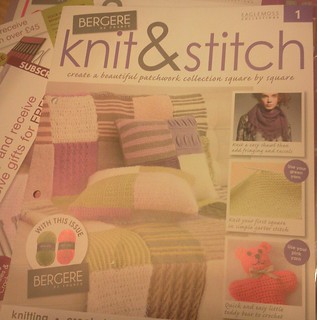
Bergere de France Knit & Stitch Volume 1 review


Yes, I have poor impulse control when it comes to buying this sort of thing.  I usually buy at least issue 1.  This is the latest offering from Eaglemoss as a part-work.  Now I hope Eaglemoss have improved their deliveries because the last few times I subscribed to something from them it resulted in blood-pressure heightening phone calls to try to sort out issues about missing shipments.

The bumpf does mention free shipping in the UK but doesn't mention what the cost would be to Ireland (or Eire as they style it).  This issue is 1.99 (UK 99p) the second will be 3.99 (UK £2.50) and subsequent issues will be 6.99 (UK 4.50), this price works out pretty well to Eason's current 7.49 for a £4.99 magazine.  You might think about using something like Parcel Motel to ship to Belfast if that would work out cheaper, you get the magazines in lots of 4. So you will be waiting anyway.

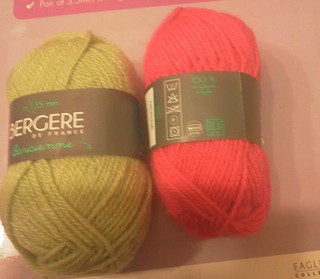
yarn from new magIssue 1 comes with two balls of acrylic yarn, Bergere de France's Barisienne, issue 2 will be offering the same, issue 3 will be Eclair yarn.  Now somehow I don't think you'll be getting some of the Alpaca yarn mentioned in the guide to yarns used in this collection but I could be proven wrong.

It also comes with some 3.5mm needles, the recommended size for the yarn, a how-to-knit DVD and the magazine, along with the guide to the yarns, which I would carefully store for substitution purposes, as well as a lot of bumpf on the series.

knit & stitch coverThis part-work promises to cover not only knitting and crochet but also tapestry, crewelwork and felting.  They say that there will be needles and crochet hooks with the series and binders along the way.
Part 1 starts off with how to cast-on, using the thumb or long-tail cast-on.
A plain garter stitch is the first square, using one of the balls, the squares are 20cm each and while tension isn't terribly important, it is a good thing to practice how to achieve tension on.  Cleverly they suggest labelling the square with an ID number.
There's also a fringed shawl knit project, using a slightly fuzzy yarn, an increase on the rs row until x number of stitches are achieved and then decrease back down to the original number of stitches, unhelpfully it's not diagrammed.

The next project is a cuddly teddy, crocheted using the other ball of yarn, this does have a schematic.

A Classic V-necked jumper for kids from 4-16 is next, schematic included, this is knit in pieces and has a simple rolled neck edge.  A good plain jumper.

A squared cushion is a tapestry piece inset into a cushion.  

Next up is a know-how piece on reading a pattern card and what their measurments are for each size etc.  Seeing as they use the French and European number sizing this is going to be useful if you're going to use this series at all.  They also include a list of reference abbreviations, I'd be inclined to get this laminated, or buy a second copy to do up a laminated version of this one and have it at the front of the collection.

Crochet basics are done as well, right-handed of course.  To round out the magazine there's a basic guide on Tapestry basic half-cross stitch and tent stitch. Both of which look the same on the front but there's a bit of a difference on the back.

So will I be buying it? The jury is still out, I'll probably buy the first three to see what happens, and to have the binder in case I impulse buy some more.  I do like the idea of one ball for the throw and one for another project.  This could be an interesting series to watch.

Wednesday, 9 January 2013

Beginner's Guide to Needlecrafts - review

Beginner's Guide to Needlecrafts - Charlotte Gerlings

Book Depository, Dublin City Public Libraries

This book covers Knitting, Crochet, Cross Stitch, Patchwork and sewing.

The First Section is on sewing and more specifically sewing with a sewing machine. There's a good piece on fabric and how it works and also on the basics of how a sewing machine works, and about how to choose one for you.

There are some projects and it's not a bad introduction to sewing, there's also a bit on how to read sewing patterns.

The next Section is on patchwork, again with ideas and advice with some projects and some patterns.

Cross stitch is next, again with some patterns and ideas and details some of the trick and tips of the trade.

Last section is Knitting & Crochet, starting with tools, then yarn, then reading knitting and crochet patterns, gauge or tension squares, a how to calculate quantity, a quick how-to (English style with no mention of continental style)

First project is a Toddler's Ribbed hat with turn-up and pompom (knit flat and seamed)
The emphasis in this section is in the basics but doesn't mention where you can go for patterns (well not that I noticed in a slightly quick flick through the book)

The crochet is the same, basics followed by two projects, a diagonal shell pattern and a granny square cushion.

Each section starts with tools of the trade and the fabric needed

This book would be good for someone looking to explore the basics of these different disciplines and would probably serve as a good quick reference book.  A new knitter or crocheter would probably outgrow it pretty quickly, if you want to investigate sewing though, the guide on using a machine is pretty good.

Sunday, 2 December 2012

Rowan Crochet Workbook review


Crochet Workshop - Rowan (Book Depository Link)
Ravelry Link
Dublin City Public Libraries have copies which is where I picked up my copy

Text links are to the patterns on Ravelry.
The presentation of this book is quite good, spiral bound makes it easier for beginners, however it's not a book for left-handed crocheters.  Right-handedness is assumed and there's no real mention of using a mirror or that it's possible to crochet left-handed.

The edition I read is the one on the Amazon.co.uk site and it was in UK crochet terms with a note about the US terms and conversion notes.

Workshop one takes you through some stitches like slip-stitch, double, half-treble, trebles and double trebles you then have a four-stitch coaster practice piece.

Workshop 2 - Stripes are explained next followed by a mixed-yarn striped scarf

Edgings are explored, with some simple patterns, a discussion of edging other fabrics with crochet.

Seaming comes up next, with a patchwork cushion cover to practice crochet seams.

Workshop 3 brings in shaping and working in the round, and some simple flowers. Project four is a Cloche hat with a flower.

Afghan Squares are explored with a couple of different types, often referred to as Granny Squares.  Project five is a Wagon wheel throw, with 188 motifs needing sewing up afterwards.

Workshop 4 takes you through creating textures, lace and some colourwork.  Project six is a crochet belt, covered in crocheted flowers.  Colourwork is used in some variety for the felted pots.

Workshop 5 is about garments and finishing. Project eight is a Baby Matinee Jacket, project 9 is a baby dress. After a piece about finishing with crochet button techniques and pocket techniques there's a woman's cardigan in a very simple stitch.  Short sleeved and made in pieces.

Workshop 6 is about embelishing crochet. Beads, felting and embroidering.  Project 11 is a crocheted necklace with beads. Project 12 is a felted bag with corsage, sewn after felting.

Most of the yarns used in the projects are dk or lighter.

Apart from the caveat about left-handed crocheters it's not a bad book, if you were looking to get into crochet it would be a good lead-in and after doing the projects you would have a good idea of what you were doing with a hook.  The photographs are clear but I don't think that they use enough of how Crochet can be done three-dimensionally, seams are ever-present where perhaps they aren't absolutely necessary.

Wednesday, 18 July 2012

This week's pretties and huh's

I'm going to start doing a new pretties and huh's hopefully weekly post.  I've been doing it on twitter occasionally but I think it would be nice to make the links a bit more permanent.

Pretties needs no explanation, huh's are those patterns that are not my aesthetic.  Your mileage may vary on both.  I'm going to try to explain what I like or dislike about it.

Pretties:

Raindrops, an apt pattern for the weather that's in it!  Love the water drops and thanks to the designer for permission to feature the picture


Rosewood Cardigan - now while this suffers from one of my pet hates, calling the pattern after the colour you designed it in, I love the way the cable twists around, it would be a great pattern for a tweedy yarn.

Chalet is another pattern with a lot of plain stocking stitch and some nice little details, yes I like v-necked cardigans, I find them more wearable for me.  I'm also a fan of pockets.  I'd be tempted to lengthen the body, or at least to see where it would hit and adapt if necessary to make it come down to the top of my legs.

I have a fondness for modular pieces and Taku looks interesting.

Vivika looks like my kind of winter jumper, not rounded neck, comfortable looking with multiple cables

I'm torn when it comes to heavier yarns in wools and fabrics that are more open for practical reasons, however I kinda like this one Sunray Medallion Tunic

Ivy - a scarf inspired by Art Nouveau ticks a few buttons for me, I'm a huge fan of Mucha and most Art Nouveau and this is a nice tribute to it.

Huh?

Ruffled Sparks Clutch now I will admit that clutches aren't my thing, I like bags with shoulder straps, I don't like carrying things around (and my hands dislike it too) and ruffles make me twitch, so this just isn't my thing

I know owls are popular but this doesn't really appeal to me.  Give a Hoot Crochet Owl Hat oh man, not my idea of pretty.

Saturnalia should be my kind of thing, but there's something about it that just doesn't gel with me.  I keep looking at it and wondering.  I think it might be the band, tweaking it might make it work.

Now I like the actual garment but file this one under Photographs make a difference, Ombre Dyed sweater and also it feeds a minor pet hate, it's a cardigan, to me sweaters don't have an open front.

Nice Idea for a pattern, Woman's Sideways Cabled Cardigan but it's a bit too bulky, bulky yarn plus cables = huge bulk, it's not flattering if you have weight.

I am a fan of waistcoats, but this Lets Go Loopy Waistcoat made me shudder

I think I've done enough here for this go-around.


Wednesday, 11 July 2012

My first design

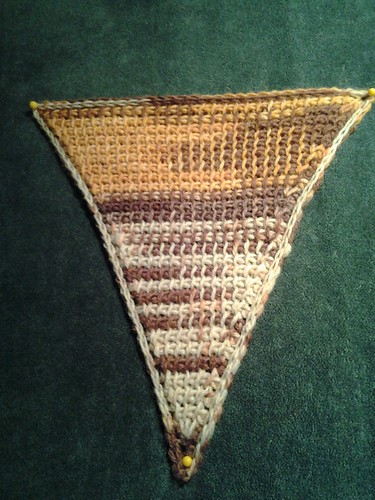
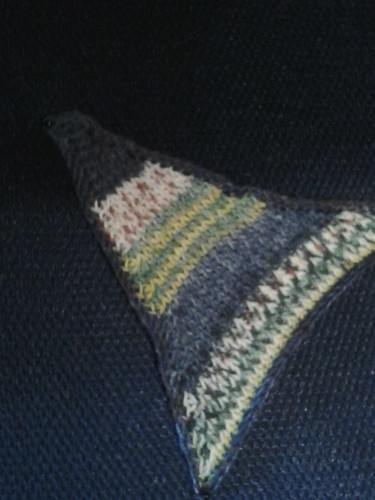
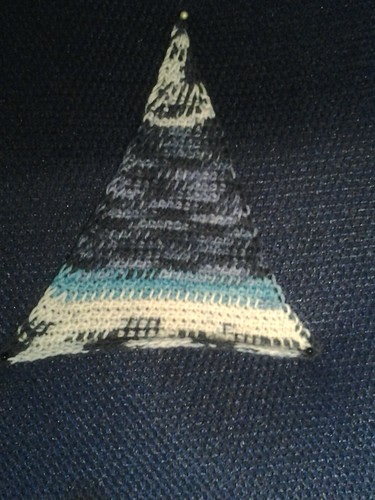
After doing some of the crochet recently, I got interested in Tunisian Crochet and it's possibilities. Then I was asked for some Bunting for an event I'm attending later this year and I thought to myself that I could do it in Tunisian Crochet, I knew the basics from doing several of the shawls, like decreases, this wasn't going to be complicated. Surely someone would have done this? Not that I could find, so I decided to do it, and then I decided that I could write it and offer it for free. So I did several iterations, after ripping out several false starts.

tunisian bunting
to the left  was the first one. I didn't like the edges, it had ended up being quite stepped and the two sides didn't match.

bunting no 2Then I did the next one (the brown one) I wasn't really happy with the slip stitch edging, you could see some of the edging through it, but it wasn't bad, it was just not quite right.
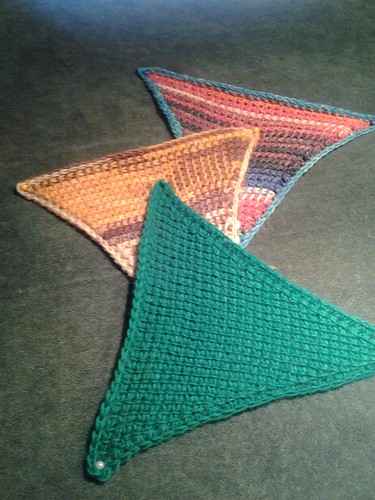
variations

Then I tried the green one
and when I was finished with it it was what I wanted.


tunisian knit stitch So then I made a few more.

  I even experimented with Tunisian knit stitch and the edges just didn't quite work either It might be the fact that this was the first time I had used that stitch.


variations
helpful blues So now I have six and the pattern is available through Ravelry for free

Monday, 28 May 2012

Crochet, crochet and more crochet

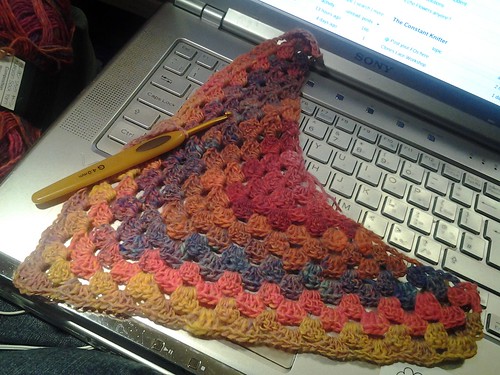
My right hand inflamed at the base of the thumb and I couldn't knit for a while, what to do? Crochet. This weekend had some beautiful weather where drying stuff outdoors was almost compulsory. So I have some finished items.  Pattern links are to Ravelry.

 I started with a Pax by the talented Aoibhe Nipax finished 

then I started a half-granny shawl... I got a little further than this start of half granny square
 but I can't find the second ball of Noro

 Then a chenille shawl
  chenille shawl


 Then I started into Argo, again by Aoibhe Ni
  one ball of noro
and the other ball of Noro can't be found (my house seems to eat noro!) there may have been some swearwords

 So then Venus another Aoibhe Ni Pattern

  venus blues

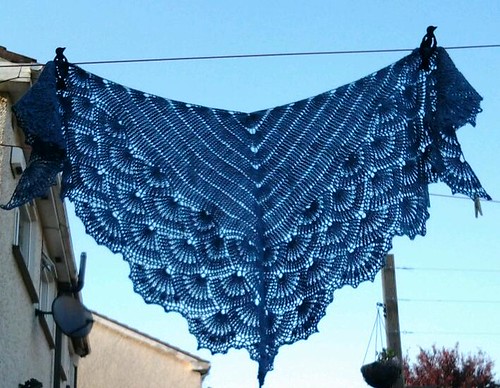
I stopped two sets of scallops before the pattern was supposed to end, I was running out of yarn and while I possibly could have finished up another round but the pattern ended that side.  This was the sky yesterday evening and I love the blue against the blue.  The clothes pegs we picked up in London at the Victoria and Albert Museum.

Monday, 19 March 2012

Lucky Finds

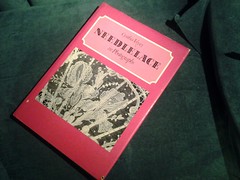
I collect knitting and crochet books and sometimes I find things that surprise me.  One day I was in an Oxfam and I found a book that kinda interested me, so I flicked through it.

Needlace bookInteresting but perhaps not completely my thing, wondering was there anything on Irish Lace I opened it up...


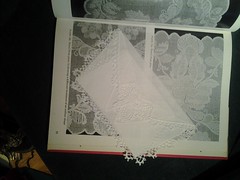
Needlelace 2
Needlelace 3wondering how the heck the loose crochet, and it's terribly fine crochet, stayed in.  I kept going, there were a few things as bookmarks including this, I suspect handkerchief holder with some very fine crochet edging.


I was also reminded me of a lucky find in a Society of St Vincent de Paul shop in Phibsboro.

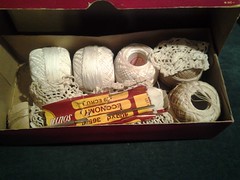
Svdp 1 Looking at it, I was curious.
The side says 1 euro each.... Svdp 2

I think I gave them more than they quoted me.
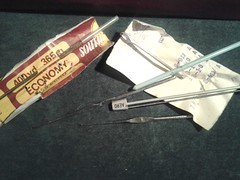
These are the non-ball items.  I suspect that the blue crochet hook is early plastic, and is cut according to my husband rather than moulded as you tend to get today, and there's a very fine but very pitted hook among the items (size 4 Cross Fox Brand), it almost looks like it has been made by a blacksmith.  The Aero Stitch holder suggests that this fine crocheter was also a knitter.
Svdp 4 Svdp 3
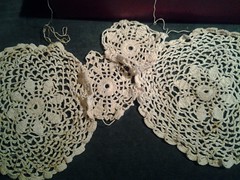
I'm going to have to reverse engineer the motifs, or see if they're in one of my crochet books and try to finish what this crocheter started, or possibly just fasten them off and have them mounted in some way but I suspect they were going to be something and that would be more what the artist would have liked.

These aren't my only charity shop finds but the two of them have a special place in my heart.

Wednesday, 23 November 2011

Gentle Art of Knitting Review

Book Depository Link: Ravelry Link

Impressions: Apparently her blog Yarnstorm (the posts about yarn/knitting) is quite popular, it now appears to be more about photography and food than knitting.  Her philosophy of Gentle knitting is mostly mindless knitting, the kind of knitting that you can put your brain in idle for.  And sometimes that's perfect knitting.  It's the knitting you do when your brain is working overtime and needs to focus on what it's thinking of rather than knitting but the knitting helps keep you distracted.  On the other hand, it's also an easy place to stay and not stretch your wings occasionally.  She talks about unfinished objects sitting in black plastic bags in her attic that are wrong, this can happen and I've sometimes thought in despair about never knitting another garment but if you don't learn from your mistakes then they're wasted energy, learning is what's important.

This is a 102 book, or maybe a 201 book (101 being basic starter stuff); some of these patterns would be some challenge for a beginner but many of them are pretty basic.  The bibliography, though is quite good.  It's scattered throughout the book and often related to the text.  Also note that measurments throughout are in cm.

Types of patterns: mostly accessories

Colour/Black & White: Colour photographs, colour charts, no charting for anything else.

Schematics: no

Target Audience: Intermediate to almost intermediate knitters

How to knit guide: No

Experimental/Classical/Modern: Fairly classical.

Comments on patterns:

Red Wine and port socks are socks with cables running down the leg and along the top of the foot, the heel is a plain knit heel.  They're not bad socks.  Knit in Madeline Tosh "Tosh Sock" on 2.75mm needles

Plaited Bread Cables - 3 pieces a Blanket knit in a chunky yarn with blanket stitch edging this is a nice piece and fairly fun.  Knit in Blue Sky Alpacas Bulky with a contrast edging, with 15mm needles.  A Rug knit in Cascade Magnum with a 15mm needle and lastly a cushion, knit in Cascade Magnum too with 12mm needles.

Big Woolly Jumper is a ragland shaped jumper  knit in pieces with a reverse stocking stitch bottom edge and cuffs and a floppy neck.  Knit in Debbie Bliss Donegal Luxury Tweed Chunky and not worn in the book.  I'm not sure about the Collar, I'd knit it in the round, actually I'd knit the whole thing in the round, possibly from the top down.  Seams? Who needs them for this sort of thing.  This has a lot of ease.  A friend pointed out that in fact this isn't designed by her, it's designed by an unnamed friend.

Simple Squishy slouchy hats two hats, knit flat with seams, one with a single reverse stocking stitch detail the other with 10 rows each of stocking stich and reverse stocking stitch.  Both in Blue Sky Alpacas Melange with 3.75mm needles.

Literary Hotties  Inspired by vintage Penguin Paperbacks these are hot-water bottle covers. Knit in Aran (Debbie Bliss Cashmerino Aran) with 6mm needles.

Buttercup and mustardseed fluted rib scarves  The scarves are basically the same scarf but with a minor variation, using a small amount of contrast yarn to edge and then a double sided pattern one with 35 stitches and another with 43 stitches.  Knit with 5mm  or 6mm needles.

Simple, plain dishcloth - a garter stitch dishcloth started and finished with a contrast yarn.  DK cotton yarn with 4mm needles.

Soft facecloths - 5mm needles and garter stitch with stripes make this up, originals knit in Blue Sky ALpacas Worsted Cotton in two colours.

Natural Linen Aprons:Striped Apron Checked Apron  Using linen yarn for the striped apron (Euroflax Linen) with 3.25mm needles with a moss stitch border for stability, this is pretty nice.  The Checked Apron is in Rowan Cotton Glace in 3.25mm with a broken checkered stripe.  Could be adapted. I'd make sure it's in washable yarn.

Toothpaste and toothbrush washbag with Blusher and Mascara Bag.  Small bags for holding whatever, knit in DK Cotton (Debbie Bliss Cotton DK) with 3.75mm needles in a variety of sizes, seamed along the side.

Floral Tea Cosy and Tea Cosy hat - The Tea cosy is knit in Aran-weight yarn, with 4.5mm needles. The hat is a Brioche Stitch hat that almost looks like a tea cosy but is knit with only one seam to be fully closed.  I would be inclined to knit the hat in the round.

Five stripy Tea Cosies the traditional style of the three-d ribbed style with dark contrast, the smaller ones are done with just a garter stitch stripe.

Faberge Egg Cosies - decorated with beads, this is a ribbed cosy, and could be used for the Innocent Smoothies! DK or 4ply weight yarn with 3.25 or 4mm needles.

Green and blue finger gloves - the only real difference is the decoration.  Knit with Cashmerino with 3mm and 3.25mm needles.

Wheel of colour cushion - using short rows to create wedges and with a contrast yarn between each wedge this is a DK yarn and knit with 3.25 and 3.75mm needles.  You could use a variety of yarns to make it.

Covered clothes hangers - two diferent covers, one in garter stitch  and another with a fancier pattern that would be nice with lingerie.  Knit in DK yarn with 4mm needles.

Bunting pennants made and connected with a ric-rac ribbon.  Dk yarn with 4mm needles.

Stripy socks Using self-striped yarn, back of heel knitted plain, top down, with tapered toe and three-needle bind-off.  Knit in sock weight yarn with 2.5mm needles. To be honest this isn't really colourwork, this is using already coloured yarn in a plain pattern, nothing wrong with this, but nothing earthshaking and readily available online.

Sea Glass Chevron scarf (she has another Sea Glass Scarf on Ravelry that isn't this pattern) - knit a chevron pattern with DK yarn with 4 rows of a neutral yarn and 2 of a different colour, the original is in shades of blue for the stripes and cream background.

Planets cushion uses hand-painted yarn against a contrasting yarn to create splashes of colour, based on her earlier jelly-bean cushion pattern.  This is knit in DK yarn with 4mm needles.

Crochet starburst flower square Crochet squares with a variety of colours, aran weight yarn and a 5mm hook, you could probably use left-overs and build it over time, provided you got a lot of the edge colour

School colours scarf and blanket, by knitting scarves, you would eventually knit enough of them to knit a blanket worth.  Knit in Double Moss Stitch in Aran weight or DK weight with 4.5 or 4mm needles. Has a bobble edging.

Art deco crochet blanket - chevron patterned, aran weight with 4.5mm needles. You could make it with different widths but you could vary this depending on your yarn.

String of purls cushion using ususual pattern to create some unusual patterning without having any yarn carrying over.  Buttoned in the back.

Life on the open wave scarves using an openwork pattern to create an interesting pattern.  Drapy yarns suggested.  Using a 4.5mm needle or 5mm needle depending on the yarn used, original yarns were Habu Lamb/Linen or Tilli Thomas Disco Lights.

Moss stitch scarf a moss stitch and stripes biased scarf. in Aran Weight yarn with 5mm needles or DK with 4mm

Chanel-Style Bag a moss stich aran (used double) or chunky yarn used together with Kidsilk Haze with 6.5mm needles and a moss sitch pattern.  Small bag using plastic needles

Buy/Borrow: It's a particular aesthetic, and not a bad book for beginners or intermediate knitters, nothing is all that complicated but I have other books that have pretty much the same patterns, so it wouldn't be a useful addition to my library, your mileage may vary.

I've been talking about it with some friends, there are a few issues that I didn't really think about when I was reviewing it.  Thinking back part of my "not for me" was her lifestyle assumptions.  Needled's review struck a nerve and I have to say that yes, sometimes reading books like this make me break out in a feeling of being not quite female/womanly/domestic/content enough.  

I suppose it's an attitude of mind that leads to this.  I'm an advocate of sometimes allowing yourself to read/knit/cook where your brain is mostly in idle.  But sometimes you also need to break yourself out of the comfort zone and try something that makes you twitch, swear and break complacency.  You should be asking yourself why your knitted garments don't fit instead of allowing yourself to ignore it as a problem.

Where found: Dublin City Public Libraries has copies.

I have updated this post, please see the bold and italicised text as updated text today 27th November 2011.

Friday, 16 September 2011

Review of Crocheted Wraps & Throws

Ravelry Link


Published in the UK as Crocheted Throws and Wraps and the US as Crocheted Afghans

Impressions: Meh overall.  Some of the pieces aren't bad but they're really not making me want to crochet them.  Soem of them look rather insubstantial and wouldn't appeal to me for throws or shawls.  Overall it didn't speak to me.  I think part of the problem may have been the photography and settings.

Types of patterns: Piecework in crochet.

Number of Patterns: 25

Colour/Black & White: Colour

Schematics: no

Target Audience: it all looks like pretty basic stuff, the advantage with this sort of thing is that once you get the single blocks or the length roughly correct you can just make it bigger or smaller to suit.

How to crochet guide: yes, but the difference between UK and US terms isn't explained

Experimental/Classical/Modern: Pretty classical pieces

Comments on patterns: The first chapter is Vintage Style and they start with a Cream Comforter, pictured on a table, not what I'd use for a table is a piece with raised pieces.  Made in Debbie Bliss Rialto DK (11 balls).

The Pale Green Textured Blanket is pretty simple, crocheted in one piece, with puff stitches, made in Debbie Bliss Como (22 balls).

The Circular Coverlet is first show as a shawl on a model, inspired by a vintage Doily.  Made in Debbie Bliss Cashmerino Aran (19 balls).

The Shetland-Style Shawl uses the shetland idea and makes a shawl with it in crochet.  You could probably knit the center and crochet the outside, it's an interesting take on the Shetland blanket style.  Knit in Baby Alpaca or Pure Wool DK (7x50g)

Puffs Baby Blanket - many, many puffs joined to make a blanket, the baby blanket requires 35g of colour A; 60g of colour B & C; 45g of colour D, E & F and 50g of G in 4ply.  It notes that for every 10 puffs you will need 20g of yarn.

Argyll Afghan - worked initially like a parge colourwork granny square style affair from side to side with applied overchecks.  This needs 9x 50g balls of Sirdar balmoral in 4 colours.

Gingham Blanket - a dense baby blanket worked in three colours and then edged, 8 x50g balls of Sublime Extra Fine Merino DK

Chapter 2: American Dream

Shaker-Style Throw - now the yarn isn't identified but it's a Silk Mohair and Wool Mix Aran weight in Random Shaded Grey (7x50g balls) and my mind is suggesting Noro.  While this is an interesting homespun look, it doesn't say quaker to me, it isn't dense or practical enough.  Also the squares aren't joined as you go but joined at the end.

Navajo Blanket center star and radiating saw-tooth borders.  Inspired by Navajo design this one needs 18 balls of pure aran wool weight yarn in 6 different colours, done in pieces that are fastened together.


Seminole-Style Blanket - two strips that are then joined together; needs 14 balls of pure wool dk.

Sunshine & Shadow Throw, working in alternative squares of bright dark and light colours in a diamond pattern and then a plain border this usess dk yarn (wool rich); 270g of a, 65g of b, h; 50g c, e, g; 100g d, f; 200g I it would be aproximate though you could work with scraps of yarn depending on how much you had and work with filling in with approximate colours.

Log Cabin Coverlet - an interesting lesson in colour use and how to change colours in a round uses DK cotton yarn, 100g of A; 30g of B & C; 40g in D & E; 50g in F&G

Crazy Patchwork throw. Flowers are made square - about 170g of dk yarn in a mix of colours, this one could use up a lot of leftovers.


Chapter 3: Outside Inside
Rainbow Baby Blanket - strips joined and then with a rainbow sequence edging. - dk yarn 60g of A&B (red & Orange); 40g of (C, D, F) Yellow; Green & Violet; 90g in shades of blue (E) and 100g in Navy which is used as the edging.

Flower Garden Throw - Aran yarn made in hexagonal flowers and then joined - 11 x 50g balls in a variety of colours

Wild Flower Throw - flowers made from triangles and then set into squares and then worked together. Done in DK weight yarn with a single background colour and could be used to use up almost matching reds and pinks.

Roses and Daisies Throw - this one could be used to use up scraps with a solid background. 400g of a mix of dk yarn and 8x50g of background yarn.

Seascape Wall Hanging - this is a brown and blue hanging that echoes a seascape, as it's a hanging you could use any sort of yarn for this.

Landscape Play Blanket - a patchwork blanket
 making fields, hills and sky for children to play with animals with.  Done in a variety of dk greens with some yellow and blue scattered in.

Chapter 4 is Around the World
Tartan Blanket - bands of colour with grids of holes to weave contrast colours through.  Done in DK yarn with 11 balls of dk yarn this could be one to for those who follow their clan tartan

African Beads Circular throw - inspired by tribal circular beadwork patterns.  USing a contrast background to highlight the pseudo-beads, done in aran weight yarn, you would need 10 balls of yarn for this.

Scandinavian Sampler Throw - a red and white throw is cross stitched with red; 7 balls of 50g dk yarn

Aran-style throw - all in cream this is actually done in Aran Weight yarn - you will need 7x100g balls.  There is a mock fringing which is quite effective.

Kelim Carpet runner - this makes me think more of New Mexican designs rather than more Turkish designs but we have here eight pointed stars in octagons joined in a strip. Aran yarn and you would need 7x100g balls for this, split over 5 colours

Indigo Ikat Throw - diamonds in the centre with chevrons coming off them in strips. a variety of blues, whites and creams dk weights

Buy/Borrow: I was a little underwhelmed; but this would be a great stashbusting book.  Several of the designs look more ornamental than warming to me, I'd borrow to see what you think.

Where found: Dublin City Public Libraries has copies.

Sunday, 14 August 2011

some wardrobe advice

(I'm going to cross post this to my blog, but I think it will get a better variety of comment here!)
So I've been looking at some of the advice presented about knitting to fit and choosing patterns that suit and I thought that they missed on a few details.  Using your own wardrobe to see what suits you.

To start you will need some paint chips, those strips of colour available free; and a notebook or camera.

Now you root around in your wardrobe.

First you need to take an overall look at your wardrobe.  Split it into the basic four themes.  Work; Leisure; formal and other.  Look at what they're composed of, how do the garments flow?  More flowing garments are better complemented by finer gauge yarns.  You also need to look at the gaps in your wardrobe, where would there be space for knits and what would add usefulness to things?  Make notes as you go.

 You need to examine the garments and see what it is about the garment you like, put it on and see what you think about it and why you like it.  Is it the colour? The shape? The fabric?  Use the paint chips in your notes to colour match things that you like the colour of and that you get compliments about.  You will probably see that there are themes running through your wardrobe.  The colour chips also come in useful, particularly if you get a good variety, in seeing complimentary colours, colours that would suit what is there already.

Now look at the items you don't wear.  Why not? Ill fitting? note what's bad about them, note what attracted you in the first place to them.  Colour? A single detail? Sketch or photograph them and be honest with yourself, do you really need them?  If they're all bad, note it, note what doesn't suit it's often as important as what does suit and get rid of them.  I have one main rule about outfits, if you have to tug on it beyond the Picard Manoeuvre  to rearrange your garment after sitting, then there is something wrong about it.  Examine what makes your uncomfortable about it.  You may be able to change the garment a little to fix it, all those pretty knitted and crocheted edgings might come into use.

I know folks have rules about how long since you wore something that suggests when you should get rid of something.  However you should remember that there are some things you may want to hold on to, beyond the regular spacings.  A good interview outfit that fits is important but ensure it still fits well and is complete.

Now what you need to do is get a measuring tape and either use someone else to help and measure yourself or conduct a cheats method; take some items you like the look of on you and measure them flat. Note good lengths on you, note what makes you comfortable again.
How deep is good for v-necks, how deep do you like round necks, do you like collars?
Where does waist shaping look good on you, do you need it?
Do you like crop tops? Where should they hit? They are often the same length as shrugs. How low looks good on you? Don’t dismiss them, just because you don’t wear cropped tops, Boleros are another short length.
Waist length tops are another length that can look good and bad on people. Decide if you want it and where is good. Some jackets work at this length.
Next length is the hip length on you, for most if not all people this is a point below the widest part of the waist, often just below crotch length
The last usual length is a long tunic length. Usually this is where the end of your fingers come when you put your hands straight down by your side.

Now there is also the consideration of lifestyle. A lot of top lengths for me are dictated by the fact that many of them have to fit under a biker jacket, so while the length mightn’t be ideal as a look on me it’s more important for me to be warm on the bike!

This is only the start of some thoughts about this topic, here's hoping someone will find use from it.


Friday, 29 April 2011

Crocheting for Dummies (2nd Edition)

Ravelry Link (actually for the first edition but the patterns look the same); Book Depository Link

Impressions: While it uses US terms it does note the difference between US and UK terms.  This book concentrates on the basics, there aren't very many garments here but there are a lot of other patterns, the basics and this is where this book is quite good.  The diagrams are clear and I would think that this would be a valuable basic knowledge book for Crochet.  There's a guide to crochet stitch diagrams as well, that takes you through simple to more complicated.

Types of patterns: hats, bags, scarves, dishcloths, jumpers, amigurumi, cushions, blankets, towel and accessories to name a few.  It has several basic patterns that would lend themselves to experimentation.  Sadly while it does list a few variations on crochet it lacks a bibliography that would allow you to move on.  The back lists ravelry, Crochetme and Crochetville and lists Crochet! magazine and Interweave Crochet and the Crochet Guild of America but lists very few non-US sources.

Colour/Black & White: mostly black and white with a colour insert with most of the patterns.

Schematics: yes for the garments

Target Audience: beginners and I could also see it being a useful as a reference work.  I have several others that would do the same job but I was starting out again this would be high on my to buy list.

How to Crochet guide: yes

Experimental/Classical/Modern: mostly classical stuff.

Comments on patterns: The book teaches you some basics and then offers up some projects, like dishcloths, that would be pretty easy as starters and then works it's way up to garments, which are worked in one piece

Buy/Borrow: It would be a useful reference work for most folks, particularly if you plan to design for the US market.  It's pretty basic though, so if you already have a work that fills this gap, I'd borrow first before buying.  It's biased towards the US so don't rely on it for Yarn sources, magazines or associations.

Where found:  Dublin City Public libraries has a few copies.