Knit to Flatter by Amy Herzog
1617690171 / 9781617690174
Now I have read the introduction to this before, on Amy Herzog's blog, and yes, it's packed full of useful and interesting information about fit and how to find patterns that will flatter you.
And by flatter she has a set of criteria and I did like how many of the models looked in their sweaters. Your mileage may vary.
She also has an interesting piece on changing an existing pattern to make it work more for your size and what parts are easiest to change (set-in-sleeves are unsurprisingly hard to change)
She divides shapes into three basics, Top-heavy, bottom heavy and proportional with another chapter about other issues, like larger busts, smaller busts and on the straight. Curvy waists get a mentionand longer or shorter torsos get a look in.
It's the kind of book you need to sit down with and work with and maybe you don't like the patterns, but the information is sound and merits application.
Starting with the Top-Heavy patterns, and all patterns have some suggestions for modifications, the First pattern is the Draper vest/cardigan is an almost waterfall style cardigan that's more fitted.
The Cypress Cardigan has a scooped neck and lace to break up the monotony
The Eloria Turtleneck has cables and bell sleeves with some of the cabling incorporated. If I was knitting it myself I would lose the cowl neckline.
The Oceanic Skirt seems almost out of place in a book that's talking about sweaters...
Next up Bottom Heavy patterns. The Striper wrap has some colourwork detail on the sleeve and shoulders, which makes this wrap into an interesting pattern.
The Flutter pullover has short wide sleeves with some cable detail on them, and cables down the sides.
Andies cardigan is a round necked cardigan with short sleeves.
Stoker Cowl has 3/4 length sleeves and a large cowl.
Next we have proportional shapes, the Classic Pullover is cropped with cables and has a crew neck.
The Holloway Pullover has some lace to the side and a wide collar
The Squared Cardigan features an unusual squared necklone and some textured stitches at the hem and sleeve to give it some interest. Loved the yarn too.
Coin Cable Cardigan, single button at the bust trimmed with a cabled pattern
The other issues start with the Dorica Hoodie, some minor patterning again breaks up the plainness and makes it an interesting design
The Delish cardigan has an interesting textured pattern a pattern I liked
The Dansez pullover has a lacy hem and a deep scoopneck, the lace is repeated on the 3/4 length sleeves.
The Minx Tank has a high neckline and cables along the length.
The Chimera cardigan is a roundnecked cardigan with some cables down the sides, pattern is for both the long-sleeved and a short-sleeved version.
The Enrobed wrap would be a great pattern to use a tweedy yarn, as shown. Miles of stocking stitch tho.
Overall the book is interesting and useful and I am tempted to pick it up.
I got the copy from Wexford County Libraries via the Borrowbooks scheme, thanks to Dublin City Public Libraries where I work, but have no influence on my opinion on this book.
Showing posts with label knitting advice. Show all posts
Showing posts with label knitting advice. Show all posts
Saturday, 7 February 2015


Sunday, 15 July 2012
Knitters Home Companion Review
Book Depository Link, Ravelry Link
I got a free time limited copy of this title from the publishers, Open Road Media, via Net Galley in exchange for a review.
This is more a book about knitters than knitting. I found it quite a quick read and while it's not really the kind of book I would add to my collection it's a book I would have happily read from the library.
There are several patterns in the book but they are more background than foreground. There are also recipes and book suggestions included in the book. I was actually surprised when I saw how many patterns there were in the book because they didn't really make as much an impact as the text and story of Michelle Edwards' life and experience with knitting. It falls into the same category as some of Elizabeth Zimmermann or The Yarn Harlot's books, only in Michelle's own style.
An interesting video here on the publisher website
It's an interesting read and an interesting look into a life with fibre.
There are some errata available for some of the patterns
Zigzag Baby Blanket - a two colour blanket with some interesting garter stitch in it, it's pretty plain but interesting.
Playtime Cape - a cape for kids to play in, with pompom details on the bottom and an i-chord or french knit tie. (I have to admit that I was wondering about upscaling it...)
Clutch of Inspiration - intended to be a portable holder of some inspirational bits and pieces to raise someone's spirits.
Quick and Easy first socks (aka Gussies) - knit with 5mm needles using a bulky yarn, these are more house-socks than anything else and would be good first socks to get some of the concepts.
Good Karma Slippers - t/hese would be the pattern I would be most likely to knit from this book. Not just the pattern but the story behind them intrigued me.
Lacy Scarf - an interesting scarf worked in a bulky yarn, but like any scarf could be knit in whatever yarn you really want by adding more stitches into the pattern.
Chicken Egg Warmers - chicken shaped egg cosies.
Quick and Easy Mittens (aka Pearl) - knit in a similar way and in the same weight yarn as the socks you can change your mind when you reach the heel or thumb.
Updated Ripple Afghan - working a garter zig-zag pattern this is a nice afghan knit in an acrylic yarn in a few colours though you could knit it in as many or as few colours as you'd like.
Victory Scarf and Wristers - inspired by war knitting, these are intended as a gift to someone undergoing strife. They say wristers I say fingerless mitts as they have a thumb.
Trio of Lacy Washcloths - three different patterns for three washcloths, they're nice and look very serviceable.
Genie's Hat - a hat with some embelishment
Michelle Edwards designed most of the patterns but Theresa Gaffey designed the Lacy Scarf; Trio of Lacey Washcloths; and Updated Ripple Afghan
I got a free time limited copy of this title from the publishers, Open Road Media, via Net Galley in exchange for a review.
This is more a book about knitters than knitting. I found it quite a quick read and while it's not really the kind of book I would add to my collection it's a book I would have happily read from the library.
There are several patterns in the book but they are more background than foreground. There are also recipes and book suggestions included in the book. I was actually surprised when I saw how many patterns there were in the book because they didn't really make as much an impact as the text and story of Michelle Edwards' life and experience with knitting. It falls into the same category as some of Elizabeth Zimmermann or The Yarn Harlot's books, only in Michelle's own style.
An interesting video here on the publisher website
It's an interesting read and an interesting look into a life with fibre.
There are some errata available for some of the patterns
Zigzag Baby Blanket - a two colour blanket with some interesting garter stitch in it, it's pretty plain but interesting.
Playtime Cape - a cape for kids to play in, with pompom details on the bottom and an i-chord or french knit tie. (I have to admit that I was wondering about upscaling it...)
Clutch of Inspiration - intended to be a portable holder of some inspirational bits and pieces to raise someone's spirits.
Quick and Easy first socks (aka Gussies) - knit with 5mm needles using a bulky yarn, these are more house-socks than anything else and would be good first socks to get some of the concepts.
Good Karma Slippers - t/hese would be the pattern I would be most likely to knit from this book. Not just the pattern but the story behind them intrigued me.
Lacy Scarf - an interesting scarf worked in a bulky yarn, but like any scarf could be knit in whatever yarn you really want by adding more stitches into the pattern.
Chicken Egg Warmers - chicken shaped egg cosies.
Quick and Easy Mittens (aka Pearl) - knit in a similar way and in the same weight yarn as the socks you can change your mind when you reach the heel or thumb.
Updated Ripple Afghan - working a garter zig-zag pattern this is a nice afghan knit in an acrylic yarn in a few colours though you could knit it in as many or as few colours as you'd like.
Victory Scarf and Wristers - inspired by war knitting, these are intended as a gift to someone undergoing strife. They say wristers I say fingerless mitts as they have a thumb.
Trio of Lacy Washcloths - three different patterns for three washcloths, they're nice and look very serviceable.
Genie's Hat - a hat with some embelishment
Michelle Edwards designed most of the patterns but Theresa Gaffey designed the Lacy Scarf; Trio of Lacey Washcloths; and Updated Ripple Afghan
Saturday, 12 November 2011
Now I've read a lot of books about knitting, many of them are the 101 types. They often talk about essential equipment.
Here's my list of the essentials

Yarn: before you start knitting you will need at least a little bit of this. Why do I start here? Well what yarn you choose will depend on the needles you need for it. Fine yarn can be fiddly and you won't see much progress but a very thick yarn can be clumbsy and the needles feel big in your fingers. Most people in Ireland started on Aran weight or DK weight yarns. Don't start with black yarn. Experienced knitters swear at black yarn, don't weigh the odds against you. Find a yarn that you like the texture of and is cheap, but not the cheapest acrylic you can find, you will want to like doing this, texture can be important. However, try to use a smooth yarn for your first moment out. You will want to be able to see what the knitting looks like. Try not to fill your bag with yarn, trust me, you mightn't like knitting.
Next up you'll need needles. Look at the yarn, there should be a symbol with a grid on it with a pair of needles underneath, or needles and crochet hook, it will have various numbers on it, usually one has mm after and one will have US after it, that's the needle size. If the needlsize is a range, pick something in the middle of the range. If 4mm falls somewhere in your range pick that one. You can get kids 4mm needles in metal for very cheap, they're short like pencils, and they're a bit rough but I use them regularly for knitting facecloths.
Things that would be useful at this stage: tape measure, well a ruler will do too, the tape measure is useful when you move to making garments, so you can check your measurments, but when you're first out a ruler will do, and if you can get a short one, even better! They fit nicely in knitting bags.
A blunt-ended yarn needle is probably a good investment too, you'll need it to finish off a piece, even if it is a washcloth.
A reasonably good scissors - actually the kids craft scissors is really useful for a carry around, you won't get poke-through on your project bag. You will eventually need more scissors than you think. They're up there with tape measures for getting lost and forgotten.
Now you can knit: Washcloths, plain scarves and many other things.
Next up:
first I'd get: Pins (when you start doing gauge or pinning out stuff these are essential) knitters pins can make counting gauge easier but they're not essential.
A Cable needle (or 3, they often come in sets of 3) will be useful if you start doing cables, I've also used the blunt ended needle, paperclips and other things to do this job. There are folks who can do cables without needles, I can, I still prefer using the tool.
Needle Gauge. Oh yeah, the needles will say something, DON'T trust them. There are folks who use micrometers to fine tune their gauge, my tip? Once you get gauge, check what size you're using and if you break a needle or the sofa eats it double check that the needle you're replacing it with matches as closely as possible. Note the size down somewhere, ravelry, on the pattern, on a postit stuck to the pattern, somewhere!
If you're working with metal needles you now need to go out and buy some plastic and some wooden needles. Compare and contrast these, seriously, they do make a difference. I have some of all of the above. There are advantages and disadvantages to them all. If your lips start tingling that could be the finish, I have some older aluminium needles that I have no problem with and the knitpicks metal dpns make my lips tingle every time. Speaking of knitpicks they have a entry-level set of their inter-changables that feature a metal, wood (laminate) and plastic needle in different sizes, useful for this.
Circular needles and double pointed needles are essential when you start into knitting more stuff. Many folks with hand issues use circular needles for everything, back and forth. They're also used for knitting in the round. Socks, jumpers, gloves etc. And Medalion knitting.
Bobbins- only if you get into colourwork, and then they can be made from cereal boxes if you're stuck.
Ring Stitch Markers - can also be made from a knotted loop of contrast yarn, or a straw. They're useful, come in a lot of varieties and you'll probably collect a nice collection over time, which make pretty ornaments... You can also get some that are like little coilless safety pins. These are amazing little things - that dropped stitch, put it into this until you get to it to fix it; use it to count stitches when you're casting on; mark the front of a project; pretty much anywhere you need a mobile marker.
Stitch Stoppers. Essential if you have too many stitches on a needle or putting something away for a while, and when I say essential, I mean I have some I rarely use. I've pulled needles out of projects more often than I want to think about, I probably should use these, you can live without them.
Row Counter - there are several variants on this theme, this can also be replicated with a notepad or postits (postits can be useful for sticking to the right place in a pattern) and a pencil or pen.
Crochet Hook - well you might want to try crochet too and this can be essential for helping you pick up stitches. When picking up stitches it can be useful to use a hook a size (or two) smaller than the needle size you're working with.
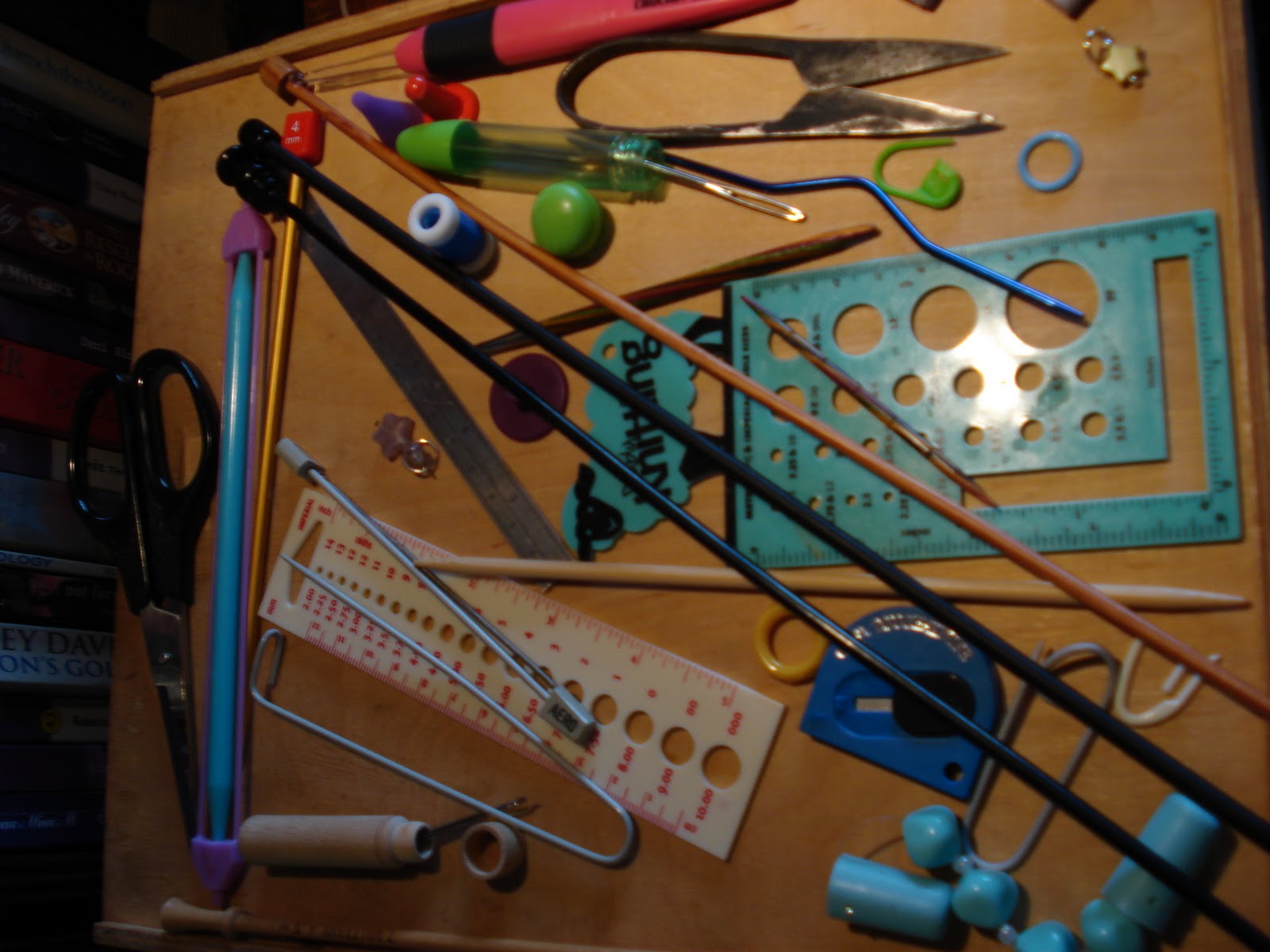
This is a selection of my knitting gadgets. Many of which are complete garnish.
Garnish: Not necessary but can be so good.
Posh dressmaking scissors and or embroidery scissors. Yeah, these can be useful later. Steeking may happen, buttonholes may be needed, felt may need to be cut, good quality scissors will make this easier.
Safety snips - for travelling on airplanes, they're quite useful to put into your project bag so you don't forget and then lose a good scissors to the airport security. Some folks have suggested unwaxed dental floss holders. The cutter on it is useful and the unwaxed floss can be used for lifelines or provisional cast-ons.
Knitting Bag - I have one, I also use a tonne of cloth bags I got over time buying stuff in Ireland (we have a plastic bag tax and almost everywhere has these bags) and I have a cosmetics bag that is a perfect portable socks project bag (though failing these days)
A large white lint-free towel - for blocking purposes, and for drying woolens. To be carefully cleaned and kept for this. It won't transfer colour to elsewhere.
A sweater dryer/rack - I have one that goes on the bath, it's really useful for drying socks too!
Blocking boards - something you can pin your finished job to, I have some large padded floor tiles that I use. Many friends use children's play tiles, damp a white/pale cloth, pin it to the tiles when you get them and check that they won't run.
A folder for storing patterns, you'll probably start with only one.
You'll need an ironing board and iron. Sometimes things need to be pressed before moving on, a good ironing board can be used to block small items too, or even to block something in stages.
Sunday, 14 August 2011
some wardrobe advice
(I'm going to cross post this to my blog, but I think it will get a better variety of comment here!)
So I've been looking at some of the advice presented about knitting to fit and choosing patterns that suit and I thought that they missed on a few details. Using your own wardrobe to see what suits you.
To start you will need some paint chips, those strips of colour available free; and a notebook or camera.
Now you root around in your wardrobe.
First you need to take an overall look at your wardrobe. Split it into the basic four themes. Work; Leisure; formal and other. Look at what they're composed of, how do the garments flow? More flowing garments are better complemented by finer gauge yarns. You also need to look at the gaps in your wardrobe, where would there be space for knits and what would add usefulness to things? Make notes as you go.
You need to examine the garments and see what it is about the garment you like, put it on and see what you think about it and why you like it. Is it the colour? The shape? The fabric? Use the paint chips in your notes to colour match things that you like the colour of and that you get compliments about. You will probably see that there are themes running through your wardrobe. The colour chips also come in useful, particularly if you get a good variety, in seeing complimentary colours, colours that would suit what is there already.
Now look at the items you don't wear. Why not? Ill fitting? note what's bad about them, note what attracted you in the first place to them. Colour? A single detail? Sketch or photograph them and be honest with yourself, do you really need them? If they're all bad, note it, note what doesn't suit it's often as important as what does suit and get rid of them. I have one main rule about outfits, if you have to tug on it beyond the Picard Manoeuvre to rearrange your garment after sitting, then there is something wrong about it. Examine what makes your uncomfortable about it. You may be able to change the garment a little to fix it, all those pretty knitted and crocheted edgings might come into use.
I know folks have rules about how long since you wore something that suggests when you should get rid of something. However you should remember that there are some things you may want to hold on to, beyond the regular spacings. A good interview outfit that fits is important but ensure it still fits well and is complete.
Now what you need to do is get a measuring tape and either use someone else to help and measure yourself or conduct a cheats method; take some items you like the look of on you and measure them flat. Note good lengths on you, note what makes you comfortable again.
How deep is good for v-necks, how deep do you like round necks, do you like collars?
Where does waist shaping look good on you, do you need it?
Do you like crop tops? Where should they hit? They are often the same length as shrugs. How low looks good on you? Don’t dismiss them, just because you don’t wear cropped tops, Boleros are another short length.
Waist length tops are another length that can look good and bad on people. Decide if you want it and where is good. Some jackets work at this length.
Next length is the hip length on you, for most if not all people this is a point below the widest part of the waist, often just below crotch length
The last usual length is a long tunic length. Usually this is where the end of your fingers come when you put your hands straight down by your side.
Now there is also the consideration of lifestyle. A lot of top lengths for me are dictated by the fact that many of them have to fit under a biker jacket, so while the length mightn’t be ideal as a look on me it’s more important for me to be warm on the bike!
This is only the start of some thoughts about this topic, here's hoping someone will find use from it.
So I've been looking at some of the advice presented about knitting to fit and choosing patterns that suit and I thought that they missed on a few details. Using your own wardrobe to see what suits you.
To start you will need some paint chips, those strips of colour available free; and a notebook or camera.
Now you root around in your wardrobe.
First you need to take an overall look at your wardrobe. Split it into the basic four themes. Work; Leisure; formal and other. Look at what they're composed of, how do the garments flow? More flowing garments are better complemented by finer gauge yarns. You also need to look at the gaps in your wardrobe, where would there be space for knits and what would add usefulness to things? Make notes as you go.
You need to examine the garments and see what it is about the garment you like, put it on and see what you think about it and why you like it. Is it the colour? The shape? The fabric? Use the paint chips in your notes to colour match things that you like the colour of and that you get compliments about. You will probably see that there are themes running through your wardrobe. The colour chips also come in useful, particularly if you get a good variety, in seeing complimentary colours, colours that would suit what is there already.
Now look at the items you don't wear. Why not? Ill fitting? note what's bad about them, note what attracted you in the first place to them. Colour? A single detail? Sketch or photograph them and be honest with yourself, do you really need them? If they're all bad, note it, note what doesn't suit it's often as important as what does suit and get rid of them. I have one main rule about outfits, if you have to tug on it beyond the Picard Manoeuvre to rearrange your garment after sitting, then there is something wrong about it. Examine what makes your uncomfortable about it. You may be able to change the garment a little to fix it, all those pretty knitted and crocheted edgings might come into use.
I know folks have rules about how long since you wore something that suggests when you should get rid of something. However you should remember that there are some things you may want to hold on to, beyond the regular spacings. A good interview outfit that fits is important but ensure it still fits well and is complete.
Now what you need to do is get a measuring tape and either use someone else to help and measure yourself or conduct a cheats method; take some items you like the look of on you and measure them flat. Note good lengths on you, note what makes you comfortable again.
How deep is good for v-necks, how deep do you like round necks, do you like collars?
Where does waist shaping look good on you, do you need it?
Do you like crop tops? Where should they hit? They are often the same length as shrugs. How low looks good on you? Don’t dismiss them, just because you don’t wear cropped tops, Boleros are another short length.
Waist length tops are another length that can look good and bad on people. Decide if you want it and where is good. Some jackets work at this length.
Next length is the hip length on you, for most if not all people this is a point below the widest part of the waist, often just below crotch length
The last usual length is a long tunic length. Usually this is where the end of your fingers come when you put your hands straight down by your side.
Now there is also the consideration of lifestyle. A lot of top lengths for me are dictated by the fact that many of them have to fit under a biker jacket, so while the length mightn’t be ideal as a look on me it’s more important for me to be warm on the bike!
This is only the start of some thoughts about this topic, here's hoping someone will find use from it.
Thursday, 10 March 2011
Project Ideas
So I see the question regularly online, what's the best project to start doing a certain type of knitting. I think I'd get shot down regularly for my answer but it would be "whatever makes your heart sing"
Yes. Forget easy, forget what techniques you don't know how to do. If a project makes your heart sing you will work out what needs to be done to make it happen.
What is making you scared of a project?
You don't have the skills? If you know how to knit and purl you know most of knitting. You can use a swatch to try out some of the other issues, to work out if you're happy with the combination of stitch and yarn and needle. If it isn't working out there is nothing wrong with ripping it out and re-purposing it. If you don't get the result the first time you knit something you've still learned something from it. Maybe that you need more practice at it, making it again maybe. Maybe when you're done with the pattern it no longer sings to you and another one speaks out. It's a continuous forward journey this knitting.
I know that sometimes what looks complicated isn't. Sometimes the pattern that makes people gasp and wonder at your mad skillz is in fact pretty easy and the wonder is caused by clever manipulation of stitches. Stitch by stitch it builds. Stitch by stitch it comes together. It sometimes reminds me of Cross Stitch. You start, you stitch and stitch and there comes a moment when it moves from being a mess of stitches to a something. That often happens with a lace pattern too, it starts off being yarn overs and knit stitch togethers and then suddenly it becomes something.
Never feel you can't. You can. You just have to believe in you. Believe that it's possible. And you know if your heart isn't made to sing by jumpers/cardigans/sweaters/large projects then DON'T DO THEM. Always follow your heart with craft, particularly if it isn't your job, because then it will always be something that fills your heart, not something that brings it down. Never feel you should do something. If you really want to know what it's like to knit a particular kind of garment and you're not sure, make it baby sized and give it away as a gift. It won't take long and if it doesn't interest you it will be over soon. Some of my best projects have come from a moment where I've wondered how it was done and my curiosity got the better of me. Allowing a childlike glee loose is sometimes the best thing you can do with craft.
Yes. Forget easy, forget what techniques you don't know how to do. If a project makes your heart sing you will work out what needs to be done to make it happen.
What is making you scared of a project?
You don't have the skills? If you know how to knit and purl you know most of knitting. You can use a swatch to try out some of the other issues, to work out if you're happy with the combination of stitch and yarn and needle. If it isn't working out there is nothing wrong with ripping it out and re-purposing it. If you don't get the result the first time you knit something you've still learned something from it. Maybe that you need more practice at it, making it again maybe. Maybe when you're done with the pattern it no longer sings to you and another one speaks out. It's a continuous forward journey this knitting.
I know that sometimes what looks complicated isn't. Sometimes the pattern that makes people gasp and wonder at your mad skillz is in fact pretty easy and the wonder is caused by clever manipulation of stitches. Stitch by stitch it builds. Stitch by stitch it comes together. It sometimes reminds me of Cross Stitch. You start, you stitch and stitch and there comes a moment when it moves from being a mess of stitches to a something. That often happens with a lace pattern too, it starts off being yarn overs and knit stitch togethers and then suddenly it becomes something.
Never feel you can't. You can. You just have to believe in you. Believe that it's possible. And you know if your heart isn't made to sing by jumpers/cardigans/sweaters/large projects then DON'T DO THEM. Always follow your heart with craft, particularly if it isn't your job, because then it will always be something that fills your heart, not something that brings it down. Never feel you should do something. If you really want to know what it's like to knit a particular kind of garment and you're not sure, make it baby sized and give it away as a gift. It won't take long and if it doesn't interest you it will be over soon. Some of my best projects have come from a moment where I've wondered how it was done and my curiosity got the better of me. Allowing a childlike glee loose is sometimes the best thing you can do with craft.
Monday, 13 September 2010
increases
So I was just listening to a podcast and the knitter was talking about working out how to increase evenly over x stitches and they were saying that you just divide over the number of stitches and do that, but that's not exactly even (unless you're working in the round, for this I'm talking in the flat)
with 4 increases over 20 stitches, - is a stitch V is an increase, in this instance a lifted increase
-----V-----V-----V-----V with an increase at the end of the stitches
now if you divide by five, or number of increases+1 you will have
----V----V----V----V---- still with four increases but this time you have nice, evenly placed across things without an awkward stitch to sew up later!
But, you say, what about awkward numbers of stitches like six increases over 30?
30/7 is 4.2857.... or four stitches and two remaining so I would put five stitches either end and then four between increases
-----V----V----V----V----V----V-----
or put the two extra in the middle
----V----V----V------V----V----V----
or offset
----V----V-----V----V-----V----V----
though the thing to remember this is all dependent on the type of increase you do. If the increase involves the previous stitch, Kf&b for example, the top one would have been k3k1f&b etc.
So how do you cope with increases, with that wonderfully vague increase evenly over the row instructions?
with 4 increases over 20 stitches, - is a stitch V is an increase, in this instance a lifted increase
-----V-----V-----V-----V with an increase at the end of the stitches
now if you divide by five, or number of increases+1 you will have
----V----V----V----V---- still with four increases but this time you have nice, evenly placed across things without an awkward stitch to sew up later!
But, you say, what about awkward numbers of stitches like six increases over 30?
30/7 is 4.2857.... or four stitches and two remaining so I would put five stitches either end and then four between increases
-----V----V----V----V----V----V-----
or put the two extra in the middle
----V----V----V------V----V----V----
or offset
----V----V-----V----V-----V----V----
though the thing to remember this is all dependent on the type of increase you do. If the increase involves the previous stitch, Kf&b for example, the top one would have been k3k1f&b etc.
So how do you cope with increases, with that wonderfully vague increase evenly over the row instructions?
Wednesday, 5 May 2010
Cardigan plans
I have 10 balls of this yarn
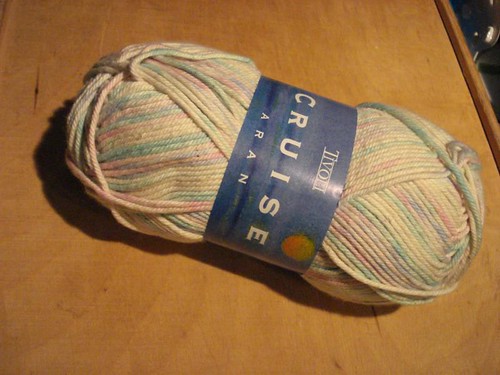
i.e. 1,690m of Aran weight cotton yarn.
I'm thinking about making a cardigan out of it.
I have a long-list, I prefer low necked cardigans and preferably something that looks as good open as shut.
First up is the Ruffled Surplice Ravelry Link it's pretty, but maybe a little too pretty and lacking a bit in the usefulness I need.
There's Ophelia Ravelry Link possibly underusing the yarn, I would be left with a lot of it over.
There's Hey Teach Ravelry Link possibly a bit too girly for me really, again a bit of an underuse
Sitcom Chic Ravelry Link may be a little to short around the shoulders, I wouldn't fasten it up there as well. I could add a row of eyelets underbust to where it would suit me better.
Otis Ravelry Link could be quite nice, fails in the fastening but there are suggestions of different ways to fasten it that would suit me for my more open style
If I make one of the patterns with less yarn I might make this Candy Cardigan Ravelry Link afterwards out of the leftovers
Salt Peanuts (ravelry Link) is also a possibility but I'm not sure that it wouldn't be better in wool.
Nordique Swing(ravelry Link) is also a possibility but with the same reservations as Salt Peanuts and the collar would probably annoy.
Dollar and a half Ravelry Link has possibilities.
Nantucket Jacket Ravelry Link is another possibility.
Buckland Cardigan - PDF Link Ravelry Link has the advantage of being plain to reflect the slightly variegated yarn
Sea Breeze - PDF Link Ravelry Link is interesting. The cable will keep me knitting and keep my interest
Fern - PDF link Ravelry Link is kinda cute but maybe too cute for me and too cute for that yarn.
The Eyelet Cardigan (Ravelry Link) has some interesting structure but I'm not sure that it wouldn't be more ornamental than useful and I'm looking for useful in this.
Que Sera - Ravelry Link Appeals, the neckline is a little open, but I might be able to fix that.
The Java Foldback Placket Ravelry Link is interesting but may be a good forum for using up some left-overs.
Drops Cardigan - Ravelry Link is again fairly plain, the rib has some interesting detailing.
So does anyone have any input? Advice? Opinions?
ETA: Part asking and part collecting the patterns in one place (and closing tabs!)
i.e. 1,690m of Aran weight cotton yarn.
I'm thinking about making a cardigan out of it.
I have a long-list, I prefer low necked cardigans and preferably something that looks as good open as shut.
First up is the Ruffled Surplice Ravelry Link it's pretty, but maybe a little too pretty and lacking a bit in the usefulness I need.
There's Ophelia Ravelry Link possibly underusing the yarn, I would be left with a lot of it over.
There's Hey Teach Ravelry Link possibly a bit too girly for me really, again a bit of an underuse
Sitcom Chic Ravelry Link may be a little to short around the shoulders, I wouldn't fasten it up there as well. I could add a row of eyelets underbust to where it would suit me better.
Otis Ravelry Link could be quite nice, fails in the fastening but there are suggestions of different ways to fasten it that would suit me for my more open style
If I make one of the patterns with less yarn I might make this Candy Cardigan Ravelry Link afterwards out of the leftovers
Salt Peanuts (ravelry Link) is also a possibility but I'm not sure that it wouldn't be better in wool.
Nordique Swing(ravelry Link) is also a possibility but with the same reservations as Salt Peanuts and the collar would probably annoy.
Dollar and a half Ravelry Link has possibilities.
Nantucket Jacket Ravelry Link is another possibility.
Buckland Cardigan - PDF Link Ravelry Link has the advantage of being plain to reflect the slightly variegated yarn
Sea Breeze - PDF Link Ravelry Link is interesting. The cable will keep me knitting and keep my interest
Fern - PDF link Ravelry Link is kinda cute but maybe too cute for me and too cute for that yarn.
The Eyelet Cardigan (Ravelry Link) has some interesting structure but I'm not sure that it wouldn't be more ornamental than useful and I'm looking for useful in this.
Que Sera - Ravelry Link Appeals, the neckline is a little open, but I might be able to fix that.
The Java Foldback Placket Ravelry Link is interesting but may be a good forum for using up some left-overs.
Drops Cardigan - Ravelry Link is again fairly plain, the rib has some interesting detailing.
So does anyone have any input? Advice? Opinions?
ETA: Part asking and part collecting the patterns in one place (and closing tabs!)
Friday, 19 February 2010
Unwound
what once was this
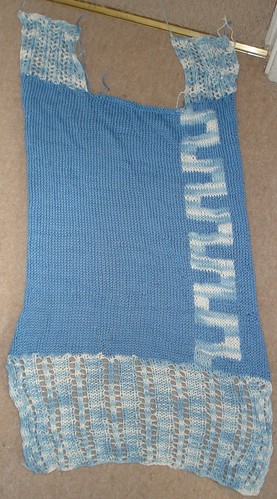
is now this
Aerial Unwind entry.
I was actually looking for the yarn to finish my Art of Knitting Scandinavian throw cause I'm missing the bag of blue yarn. which is somewhere!


Edited to add my medals!
is now this
Aerial Unwind entry.
I was actually looking for the yarn to finish my Art of Knitting Scandinavian throw cause I'm missing the bag of blue yarn. which is somewhere!


Edited to add my medals!
Friday, 5 February 2010
Socks and some thoughts
Yes I knit socks and I usually have a pair on the go. The current pair are Spring Forward from Knitty
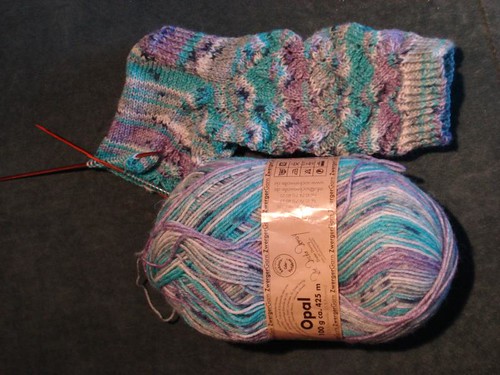
I started them on Monday and they're just flying up which always makes me worried that there's something wrong with them and that they won't fit but a quick check assures me that indeed they do.
I often regard the first sock as a kinda gauge swatch, yes I know I'm tempting fate but at this stage of sock knitting I have a fairly good idea of what will and won't work. I pick the sock pattern based loosely on the gauge on the ballband and often increase the needle size by one because I have big ankles. I also cast on with the cable cast on turn around knit a row and join (how to speak gibberish to non-knitters) this is because I like the look of what would be the inside of the cable cast on if I joined immediately. I have tried other methods of casting on, which all claim to be loose, nope, they don't work for me. That, though, is part of the fun, trying different things.
Currently I prefer knitting socks from the cuff down, yes there is another option, toe up. This won't stop me from trying some more toe-up.
What is it about socks that make them so attractive? They're very portable, everything I need to knit them fits in a medium sized toilet bag, this makes them ideal for bringing with me when I'm going to work. If I'm on the bus I knit, during breaks in work I knit, when waiting for Mac in Blanchardstown, I knit, if I agree to meet someone in town and I'm waiting in a coffee shop, I knit.
The other thing that's interesting about socks is that it's a chance to try out patterns, techniques, and other things with what appears to be a small risk. You can also hide the evidence under shoes and clothing but have that warm feeling that you're hiding bright colour and something you made yourself.
Though the strange looks you get sometimes while you knit in public also have an amusement value!
Things to note about socks:
If you wear ankle-boots or the like you will need about 6 inches of sock before the heel, you will also want some form of reinforced heel, boots rub.
There is something balanced about having the above the heel part about as long as below the heel for me this is also about the 6 inch length.
The average sock pattern is designed for someone for whom where the calf muscle hits is about the same as where the widest part of the foot is. This isn't always true (for me my calf, about 6" above where the heel is is about 12" while the widest part of my foot is 9"). There are a number of ways of fixing this. Another repeat or two is the easiest solution. You can decrease down after the heel, you will be anyway.
When you pick up stitches after the heel you may not have as many as the pattern states, honestly, this doesn't matter, so long as you have the same number by the time you reach the main part and you're happy with the look of the heel, this is what's important, take a deep breath and just knit. Skip the first stitch along the edge and pick up the slipped stitches I usually pick up a bridging stitch between the heel stitches and the top of the foot stitches, this is because I like how it tightens the gap.
A heel usually has as many rows as you have on the needles. You can easily count how many rows you have by counting the loops on the back of the work if you're working a slip stitch heel, if not, it should be approximately square, if you fold it diagonally it should be as wide as it is tall. If you have a deep heel or a short heel adjust for you, ignore the designer if it suits you. Patterns are like recipes, people stress less about substituting in recipes than they do knitting patterns.
If you're doing a short-row heel a quick formula is usually ((stitches on needle)/2)+1 and then ssk & k1 (I regularly substitute knit two to the back of the loop) turn sl 1 k5 p2tog p1, continue slipping the first stitch k or p to the 1st stitch before the gap k or p 2 tog k or p1. Depending on how many stitches you have on the needle you may end up with the last row without the final k or p1's the important thing is balance, it should be the same on both sides.
The decreases on the heel cup don't really matter, honestly, it will probably felt.
Yarn for socks: There are patterns for almost every weight of yarn. Lighter than double knitting will mean that they're more likely to fit in your shoes without warping them beyond use with ordinary socks. If you don't hand-wash you will want to look for superwash wool with some nylon, though not all of it works. It can be useful to have friends with kids who will wear felted socks around the house. Superwash yarn is also good if your feet sweat a lot. No matter how superwash they are there is a high likelyhood that the heels, balls and heel-cup will felt (you really won't see the decreases after a while). Dryers aren't good for socks, trust me.
Another reason for sock knitting is the quantity of yarn it uses, an average pair of socks for me use a bit under 100g of yarn, this is 1-2 balls of wool. For mac it's around 100g and can sometimes be a little over so 1-3 balls. This can be where toe up wins over cuff-down, you can half the amount of yarn and knit until you run out, leaving very little left over and not running out before you finish the sock.
Anyone else have some comments?
I started them on Monday and they're just flying up which always makes me worried that there's something wrong with them and that they won't fit but a quick check assures me that indeed they do.
I often regard the first sock as a kinda gauge swatch, yes I know I'm tempting fate but at this stage of sock knitting I have a fairly good idea of what will and won't work. I pick the sock pattern based loosely on the gauge on the ballband and often increase the needle size by one because I have big ankles. I also cast on with the cable cast on turn around knit a row and join (how to speak gibberish to non-knitters) this is because I like the look of what would be the inside of the cable cast on if I joined immediately. I have tried other methods of casting on, which all claim to be loose, nope, they don't work for me. That, though, is part of the fun, trying different things.
Currently I prefer knitting socks from the cuff down, yes there is another option, toe up. This won't stop me from trying some more toe-up.
What is it about socks that make them so attractive? They're very portable, everything I need to knit them fits in a medium sized toilet bag, this makes them ideal for bringing with me when I'm going to work. If I'm on the bus I knit, during breaks in work I knit, when waiting for Mac in Blanchardstown, I knit, if I agree to meet someone in town and I'm waiting in a coffee shop, I knit.
The other thing that's interesting about socks is that it's a chance to try out patterns, techniques, and other things with what appears to be a small risk. You can also hide the evidence under shoes and clothing but have that warm feeling that you're hiding bright colour and something you made yourself.
Though the strange looks you get sometimes while you knit in public also have an amusement value!
Things to note about socks:
If you wear ankle-boots or the like you will need about 6 inches of sock before the heel, you will also want some form of reinforced heel, boots rub.
There is something balanced about having the above the heel part about as long as below the heel for me this is also about the 6 inch length.
The average sock pattern is designed for someone for whom where the calf muscle hits is about the same as where the widest part of the foot is. This isn't always true (for me my calf, about 6" above where the heel is is about 12" while the widest part of my foot is 9"). There are a number of ways of fixing this. Another repeat or two is the easiest solution. You can decrease down after the heel, you will be anyway.
When you pick up stitches after the heel you may not have as many as the pattern states, honestly, this doesn't matter, so long as you have the same number by the time you reach the main part and you're happy with the look of the heel, this is what's important, take a deep breath and just knit. Skip the first stitch along the edge and pick up the slipped stitches I usually pick up a bridging stitch between the heel stitches and the top of the foot stitches, this is because I like how it tightens the gap.
A heel usually has as many rows as you have on the needles. You can easily count how many rows you have by counting the loops on the back of the work if you're working a slip stitch heel, if not, it should be approximately square, if you fold it diagonally it should be as wide as it is tall. If you have a deep heel or a short heel adjust for you, ignore the designer if it suits you. Patterns are like recipes, people stress less about substituting in recipes than they do knitting patterns.
If you're doing a short-row heel a quick formula is usually ((stitches on needle)/2)+1 and then ssk & k1 (I regularly substitute knit two to the back of the loop) turn sl 1 k5 p2tog p1, continue slipping the first stitch k or p to the 1st stitch before the gap k or p 2 tog k or p1. Depending on how many stitches you have on the needle you may end up with the last row without the final k or p1's the important thing is balance, it should be the same on both sides.
The decreases on the heel cup don't really matter, honestly, it will probably felt.
Yarn for socks: There are patterns for almost every weight of yarn. Lighter than double knitting will mean that they're more likely to fit in your shoes without warping them beyond use with ordinary socks. If you don't hand-wash you will want to look for superwash wool with some nylon, though not all of it works. It can be useful to have friends with kids who will wear felted socks around the house. Superwash yarn is also good if your feet sweat a lot. No matter how superwash they are there is a high likelyhood that the heels, balls and heel-cup will felt (you really won't see the decreases after a while). Dryers aren't good for socks, trust me.
Another reason for sock knitting is the quantity of yarn it uses, an average pair of socks for me use a bit under 100g of yarn, this is 1-2 balls of wool. For mac it's around 100g and can sometimes be a little over so 1-3 balls. This can be where toe up wins over cuff-down, you can half the amount of yarn and knit until you run out, leaving very little left over and not running out before you finish the sock.
Anyone else have some comments?
Subscribe to:
Posts (Atom)