Saturday, 31 March 2018

sometimes socks shrink

Originally these were knit for Mac.  I started them when he was being admitted to the hospital and had them finished in a few days.  Stress does wonderful things to my knitting.  However they're now shrunk in the wash a few times, Mac gave them to me, now they're too small for me either, so into the donate pile.  Someone will get warm socks.

Sadly I didn't knit the knee socks and they have landed in the bin because of holes.

Tuesday, 8 August 2017

Mandalas to Crochet by Haafner Linssen
Interesting exercises in crochet, crocheting in the round with circular motifs, well done but you'd need to have a purpose in mind before starting.  Circles can be a problem for joining as things like throws.  Loved the T-Shirt yarn rug idea.

Sunday, 11 June 2017

interesting quote I found

From “The Aran Islands” by J M Synge (!)

The simplicity and unity of the dress increases in another way the local air of beauty. The women wear red petticoats and jackets of the island wool stained with madder, to which they usually add a plaid shawl twisted around their chests and tied at the back. When it rains they throw another petticoat over their heads with the waistband around their faces, or, if they are young, they use a heavy shawl like those worn in Galway.  Occasionally other wraps are worn, and during the thunderstorm I arrive in I saw several girls with men’s waistcoats buttoned around their bodies. Their skirts do not come much below the knee, and show their powerful legs in the heavy indigo stockings with which they are all provided.

The men wear three colours: the natural wool, indigo and a grey flannel that is woven of alternate threads of the indigo and the natural wool. In Aranmor many of the younger men have adopted the usual fisherman’s jersey, but I have only seen one on this island [he’s on Inishmean].

As flannel is cheap – the women spin the yarn from the wool of their own sheep, and it is then woven by a weaver in Kilronan for fourpence a yard – the men seem to waer an indefinite number of waistcoats and woollen drawers one over the other. They are usually surprised at the lightness of my own dress, and one old man I spoke to for a minute on the pier, when I came ashore, asked me if I was not cold with “my little clothes.” P 14-15 Edited by Robin Skelton, OUP 1979 0192812580

Tuesday, 1 November 2016

Knit Real Shetland Review

Ravelry Link

This is a lovely showcase for Jamieson & Smith yarn, and ironically I just finished watching Shetland the TV series yesterday (which I enjoyed).  After an introduction by the inestimable Kate Davies it launches into the patterns and sadly it features one of my pet hates, garments that aren't modeled by people. Sigh.

Hopefully some day Ravelry will provide pictures.  I live in hope, at the time of writing at least two of the garment projects doesn't feature photographs.  Unusually there's no preamble for the patterns talking about inspiration etc and I found that I kinda missed that.

15 patterns from clothing to tea cozy, this is an interesting inspiration and variety.

The first project is the Wave Cardigan, by Toshiyuki Shimada and Grace Williamson steeked, this features 3 basic colours and then 24 other colours, perfect for if you can't decide which of the 2 ply jumper weight you want.  Round necked cardigan.

Next up are the aran-weight Feathercrest mittens by Jared flood, with a reverse stocking stitch palm. Done in the round.

Next up is probably the pattern that most tempts me, the Peat Hill Waistcoat by Hazel Tindall, steeked again, with rounded edges so I really want to see this on someone, I have never done steeking before and want to know how it will turn out first. Muted colours it really appeals to me.

Cross Tam by Daniel Goldmanto me this looks like sunset, bright orange main colour and blues, the crosses fall down the hat.

Viking Tunic by Sandra Manson, a jumper that echoes Viking dress

Osaka Tea Cosy by Msami Yokoyama features teapots as part of the design and a star tops it, this is charming.

Kergord Scarf by Mary Kay is a delicate lace scarf, worked from both ends and then Kitchenered in the middle.

Melby Jumper Dress by Gudrun Johnston would be a dress for my niece but more tunic for most adults.  Features pockets and stripes.

Wool Brokers Socks by Lesley Smith white and berry tones with striped cuffs and sole. Lush and beautiful

Muckleberry Gloves and hat by Mary Jane Mucklestone complex colourwork in rich reds and blues creating wearable works of art.

Caavie Gansey by Candace Eisner Strick a complex steeked jumper that's full of colour without being overwhelming.

Madeira Lace Shawl by Joyce Ward a triangular lace with a scallop pattern and v-shaped edging.

Buttoned Hat Aka Lexie by Woolly Wormhead made in an Aran weight yarn this is a cloche with buttons that channels a Downton Abbey type of aesthetic and features interesting texture.

Olly's Allover by Jean Moss; cables in the middle with colourwork at the edges this is knit in Aran-weight.

Overall it's an interesting mixture of patterns and full of inspiration.  For a knitter with some experience, worth a look at least.  I borrowed it via Dublin City Public Libraries from South Dublin Libraries.  I would add that some pages fell out although it didn't really have a huge circulation from what I could tell.

Thursday, 22 September 2016

Riders to the Sea

For the sodding record, apparently too many people are actually not bothering to actually read the play Riders to the Sea, and are misquoting it.  It's in the public domain and available online.

I was actually quite shocked recently when I discovered the parallels with my life and that of JM Synge.  I was lucky, I got my Hodgkins Lymphoma almost 100 years later than him, the swelling in my neck went down with Chemotherapy, I didn't die of it.  I found it quite strange to read his biography online and realise how lucky I was.


from Stitches in Time

Stitches in Time
Lucy Adlington
p 289 -290
Guernsey sweaters - also known as ganseys - have long been associated with fishermen and seamen. Fanciful writers say the cable stitch on the gansey was invented to mimic the ropes that played such an important part in the lives of sea faring men. As families and communities evolved the basic pattern into new adaptations, a myth arose that a fisherman pulled from the sea could be identified by his individual sweater. This story was enhanced by the 1904 stage play by J.M. Synge, Riders to the Sea, in which the jumper in question is actually in simple stocking stitch. [gah, misreading of the play] There are no recorded instances of any such identification being made in real life. Ganseys are traditionally dark blue and they have no designated front, the repaired patch could be worn at the back where it would be less noticeable.
Aran sweaters are often an unbleached natural wool colour, patterned with honeycombs, cables and diamonds. Original Aran knits kept the water-resistant natural lanolin, rather than washing it out, making them more practical as outdoor wear.  Far from being an age-old pattern contemporary with the twining artwork of the Book of Kells, as one myth suggests, it is likely that Aran Sweaters really began life as a twentieth-century initiative to boot dwindling household budgets.

From Galway Women in the 19th Century

By Maureen Langan-Egan
P 9 - 10
“The destruction of the textile industries affected Galway, a noted ‘yarn county’, very badly.  Flax, in particular, was a very useful crop on small pieces of ground; no tithes were payable to the Established Church on income from its sales, and it was easier to spin than wool. ‘Bandle-linen’  (a poor-quality fabric) was widely made. Landlords had distributed spinning wheels (tuirni) and reels in Connacht, either free of charge or for a minimum charge.  Their motives were not altogether altruistic, for it was reported that ‘the women in many families spin more than the whole amount of the house and gardens’, which means that the income earned from spinning was greater than that earned from the produce of the gardens and the earnings of other family members; thus, landlords were assured of their rents. The linen industry declined after 1815, which marked the end of the Napeolonic [sic] Wars.  As regards woollen goods, Ireland had been able to supply its requirements in 1800, but by 1830 the industry was in ‘terminal decline’; tariffs were lifted in 1826, allowing cheaper imports.”


P 95-96 “an examination of the Regulations and Curriculum of the Dominican Convent Superior School (A Superior school taught at least one foreign language) in Taylor’s Hill, Galway reveal both its ethos and curriculum.  The Regulations stated:

Each young lady to approach the Sacrament of Penance once a month.
Out of school no pupil is to associate with a companion unless she have the sanction of her parents and the religious.
Each child to be provided with work materials, books, according to the list; and no one is to lend or borrow from another.
Silence to be observed during school hours.
Shoes to be changed before entering the school room and each pupil to be particular in making her salutation. (Polite greetings were the order of the day)
The lessons marked to be well studied at home and music pupils to practice one hour daily.
In 1858, the curriculum was set out as follows:
Daily Duties: Religious Instruction, English Reading, Parsing, Dictation, Needlework, Tables.

Alternate Duties:
Monday,              Grammar, Arithmetic, History
Wednesday,        Chronology French Conversation
Friday:
Tuesday,              Sacred history, Geography, Spelling.
Thursday,            Mythology, French Dictation
Saturday:

Monday               English Letter
Tuesday               Object Lesson
Wednesday         Natural History
Thursday              Astronomy
Friday                   -
Saturday              Long Religious Instruction.

This plan had to be modified, as the pupils were ‘too backward for such a course’. Such a wide-ranging curriculum was rare.  There was an on-going debate about which subjects should be taught to girls, and there was much sex-stereotyping in the curriculum.

P 118
Members of all religious organisations worked actively to obtain relief from abroad, including £24,000 from Calcutta. [in the 1840s]

Sunday, 8 May 2016

WTF Knits

WTF Knits by Gabrielle Grillo and Lucy Sweet, is one of the low-hanging fruit of the knitting book world, sometimes it is easy to mock patterns and to find them ridiculous.  To me some of these fall into 3 categories, Art, actually clever if you think about it and lastly they're strange adventures in using yarn.

It seems to be coming from a place where yarn is only good if it's used for a utiliarian project and not in sculptural projects and as some of the profits from this are going to charity it would have been hard for many of the copyright owners to refuse use of their photos for use here.

Much of it is stuff I'd never knit but I found some of it more clever than WTF.  It did annoy me to see the TitBits in here.  These are pieces knit for women with Breast Cancer as soft, caring, replacement prosthesis while they're healing and need something soft and the idea that someone would do that for me appeals, also the knitted falopian tubes are being used in activism.

Much of the garments are insane and I couldn't see myself wearing or making them but Haute Couture is insane, the yearly fashion design student catwalk is full of garments that will never be worn outside of the runway, but the authors of this choose to mock rather than to ask why fashion is so out of touch with reality, why it's almost compulsary for designers to make garments with no function (though it could also be asked why companies are making fortunes from making shoes that are crippling people more comfortable!).

Overall this book just made me slighly annoyed, yes there are knits in it that I have no idea why they were even conceived but there also knits that I can see could be used for education or entertainment. Kids get fake food toys all the time we don't seem to question it as much when we get it from a shop, or see it in a gallery, but we seem to question it a lot when someone who isn't part of the artistic establishment chooses to make it themselves.

I still don't understand some of them, but I also sometimes don't understand modern art, I wouldn't choose some of it for my house or to knit it myself (unless hugely bribed, and it would have to be huge) but each to their own.

I got this one from the library a while ago. Dublin City public libraries employ me and provided this book, I get no added inducements for doing this above my salary, access and generous lending facilities

Thursday, 7 April 2016

May, Lou & Cass

By Sophia Hillan
The story of Jane Austen's nieces in Ireland.
P. 125 "Despite the personal stress of 1845, by the year's end Lord George [Hill] had published his detailed pamphlet, Facts from Gweedore, an account of the work he had begun in 1838 on his estate. At the same time, Louisa began to work her own mission. Though she had originally come to Ireland to care for the motherless Hill children, she found herself becoming increasingly involved with their father's cause. It became a matter of vital importance for Louisa to publicise her brother-in-law's efforts to improve the lot of his tenants, and she enlisted the willing assistance of Fanny who, in her turn, wrote to her old friend Miss Chapman, asking her to make the work known. This early marketing was quite concentrated: the sisters were determined to raise money through the sale of the book and of hand - knitted garments, mostly socks and stockings, in order to bring Anglicanism to Gweedore. "
p. 134 "Fanny, too, continued on her mission to promote the sale of Facts from Gweedore: 'I am now negotiating the sale of 6,000 pair of Gweedore socks and stockings, which [Lord George] has on hand, knit by his own people, all of which he buys from them and disposes of as he can.'"
p. 156 [Crimea campaign] Lord George, too old to go into battle himself, sent consignments of the hand - knitted socks which his Donegal tenants had made in their homes, and George Billington appears to have been one of the recipients.  His letter from the camp shows how necessary such apparently simple gifts were: in an attempt to keep their packs light and their progress swift, the men had been ordered ashore without tents, ambulances or sufficient protection against the Russian weather: 'I don't know what I would have done without those Irish socks you gave me the last time I was at home,' George Billington wrote. 'Those and the mittens Miss Rice gave me have been of more use than anything I have. I believe they saved me from being frostbitten the other night.'
p. 175 A list in the Garden Book for Christmas 1867 reveals that their provision for the poor included jerseys, blankets, hand-knitted socks, 'linsey gowns' and 'crochet shawls'. Some of these may have been Marianne's own handwork for, like her aunt Jane,  who commended her skill when she was seven years old, Marianne was an expert needlewoman; some of their gifts to the poor may have been the work of Lord George's tenants, as the socks and mittens sent to their family and acquaintance in the Crimea had so often been.
The bold print is all mine, if I come across more I will add to this post.

Sunday, 28 February 2016

Dominitrix Review

 Domiknitrix - Jennifer Stafford


I've got to the stage in my knitting career where I assess books I'm going to buy more on the patterns than the information on how to knit in them.  I have a chunk of books on that topic and I know most of the basics. Yeah, yeah, I know pride goes before a fall and all that, but such is life.  I had dismissed this one before as her aesthetic isn't mine but it turns up on a lot of recommended beginner books so I decided to try it out and I have to apologise to Jennifer Stafford, her book did have a few tips that I hadn't come across before and her well-organised photographs, however goth, are very instructive.  Her reasons to knit a gauge swatch are excellent and made me think a bit more about them.  I'm not sure that clothes should be fitted as well as wearable, my rule would be Clothes should be wearable and make the owner comfortable.

She doesn't do the knitted cast-on, or the cable cast-on, but does offer a lot of other options, I'm not sure that it's one I'd recommend to a rank beginner for these instructions but it's a good set of reminders for people who know some basics and it would make a valuable reference book for a lot of people.

The how-to section is helpfully coloured to the edge in black so it stands out in the book, the white coloured pages are the patterns and as I said before I'm not a great fan of them. Some of them appeal in a "I'd bet a friend or family member would get a kick out of" way but none appeal to me personally to knit for myself.

One of the best things I have seen is an actual bust-waist-hip measuring for what the author means for XS, S, M, L & XL, a quite helpful hint

Thin mint is a scarf that's a tubular knit from the middle and grafted together at the end, knit with 4mm needles in a light dk weight yarn with stripes.

Valentine Candy Pillows, offers heart-shaped cushions in bulky yarn on 6 mm needles with embroidered lettering that doesn't offer a template but gives somewhat vague instructions on spacing and placement.

Flower Pins are lillies, camellia and rose flowers knit in an aran weight yarn (noro kureyon that the author snipped out the sections of 6 balls that she wanted... ) they're felted

Snood Spiral Mesh cap is both a Cap and a Snood, though it doesn't show it being worn as a snood. A open lace cap knit in an acrylic/nylon yarn  in an aran-weight yarn with 5.5mm needles.

Mohawk Hat is basically a close-fitting hat with a mohawk for those people who want one without the career-limiting head-shaving.  Knit in Bulky wool on 5.5mm needles.

Strings of Purls is a set of stuffed spheres along an icord, there are some suggestions for variants.

Homegrown is a hemp yarn handbag using a bamboo placemat and pair of chopsticks for structure. The yarn is DK using 4mm needles and with an icord decoration and closure

Devil & Snow devil hats knit in a bulky-weight yarn with 5.5mm needles.

Star Pillow - a cushion with a pentacle knit on the front in intarsia in a super bulky yarn with 9mm needles

The next chapter are more challenging knits beginning with L'il red riding hoodie, a cardigan with pockets and a zip knit in a bulky yarn and 6.5mm needles.

Big Bad Wolf pullover has an intarsia wolf on it and some suggestions for other pattern ideas.  Knit in a bulky yarn with 6mm needles.

Bob Dobbs & skull vests are a tank top with some intarsia patterns on them knit in a bulky yarn in 5.5mm needles.

The Winged heart bralet is for a or b cup sized women with some colourwork.

Sweetheart is a jumper with a intarsia bow, worked in black for the body and the bow in pink, knit in a dk yarn with 4mm needles

Diva Halter is a halter-neck waistcoat with a zipped front. Knit in two colours in a bulky yarn with 5.5mm needles.  It also has suggestions for a mock-laced-up back.

Swizzle vest is another zipped waistcoat knit in a super bulky yarn with 9 & 10mm needles in two colours.

Next chapter is side to side and on the bias, more difficult projects.

Jughead hat is knit using short-rows in a dk yarn on 5mm needles

The Slink is a top knit on the side with some stitch shaping incorporated, a v-neck and cap sleeves.  Using Crystal Palace shimmer with 5mm and 8mm needles.

The final pattern printed in the book is City Coat which is knit sidewards with a double ended zip or buttons, there's some suggestion for variations under the Mod Coat title, this is a bulky weight yarn knit at a tighter gauge on 5mm needles to try to give it weight and body.

The final project in the book is a teaser for the Elfin Bride & Gothlet pattern which is available on the web site. Free if you have the book.

I got this one from another Irish library via Borrowbooks 

Thursday, 11 February 2016

Some people don't get it

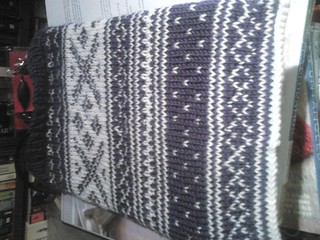
I read a book recently that made me a bit cranky. Craftsman by Richard Sennet,  apart from the view of craftsmanship as being mostly male he also didn't get the concept of mindless crafting. Sometimes mindless crafting is an accompaniment to complex working, but sometimes it's it's own thing.  When you're in a crafting slump or something complex is occupying your brain,  and not necessarily a crafting project, retreating into the simple is actually comforting. When a lace project is in the slog,  why is there no progress stage, a simple dishcloth can be useful,  a sense of accomplishment can be made out of that little thing. Without slogging by assistants there isn't time made for a master.  But also there is the issue that until you understand your material, you can't really explore it's possibilities. Without scales and warmups your hands will suffer on the piano. Also without understanding both your and the materials issues you can't work with them and through them. I will never play some pieces on the piano that require octave stretches, my hands can't do that, but I can work with it, choose the notes that sound the best, the most right.

But what really ticked me off,  as the daughter of a master cabinetmaker and carpenter; sister of a master carpenter; cousin of a master glassworker (not sure of his proper title but he made a glass sword as his masterpiece!) on page 58 when he talked about a chef d'oeuvre éleve I was somewhat annoyed,  it didn't convince me that he knew enough about what he was talking about because that's known as a masterpiece or master piece. And maybe if we regarded those pieces made by more crafters as being as important and we saw the beauty in them and the skill it took to make them like we look at paintings maybe we would start to have a better understanding of how there is more artfulnes in the world than we notice.  That the present by someone that took more effort than a few minutes in a shop actually has worth, and doesn't deserve derision.

Cross posted to my reading blog
Sunday, 31 January 2016

Knockout Knits review

Knockout Knits by Laura Nelkin


Interesting collection of knitwear accessories under three basic themes; wrapped stitches, lace and beading.  I'm not sure why I'm not more impressed with this, it's possibly because it's not quite me.  They're nice but I was looking at it and I wouldn't buy it for me.

It's filled with interesting information, detailed advice on techniques and on swatching and in many ways it's an excellent book, but it's just not me.

Each project has a feature to it to lift it out of the ordinary, several clever ideas and designs.

Wrapped Stitches at Play has several interesting projects:
Wave Cuff - basically an exercise in how to work with wrapped stitches. Done in DK weight yarn on 4.5mm needles.

Prolix Mitts - worsted weight with 4 and 5mm needles, fingerless mitts with a long cuff, the wrapped stitches provide a rouching.

Folly Cloche crossed wrapped stitches pull the band in, very Downton. Knit in worsted yarn with 4 & 4.5mm needles

Laxo Hat - faux cable using wrapped stitches, a fairly unisex beanie hat.  Made in fingering weight yarn on 2.75 & 3.25mm needles.

Bootsy Boot Toppers - knit in bulky yarn with 8mm needles. A good test of the cross stitch method.

Las Cruces Shawl - two mirrored panels with a centre panel knit in a light fingering weight yarn with 4mm needles, sadly the only apparent photograph in the book is of it worn wrapped round someone's neck.

Traversus Socks - top down socks with a crossed stitch pattern down to the heel and along the edge, interesting for very busy variagated sock yarns. Knit in fingering weight yarn with 2.25mm needles.

Crux Cowl - dropped stitches and criss-cross stitch in a DK weight yarn with 4mm needles. Way to open a cowl for me.


Get your lace on features tips and tricks on lace knitting, including lifelines.
Gateway Cuff - something small to learn how to start into lace knitting useful for playing with some laceweight and 2.75mm needles.

Juego Cowl worked flat in a plain and patterned yarn using both slipped stiches and lace, worked flat and then joined. It's worked in sport-weight yarns on 4.5mm needles. With the right yarns this could be spectacular, the designer here uses a Noro yarn and something like that where the yarn play with each other would be amazing.

Fornido Shawlette worked from the bottom in an aran-weight yarn first making the border and then the body with short-rows.  Knit with 5mm needles.

Techo Hooded Scarf a hood with a scarf attached in sport-weight yarn and using 4mm needles.

Quadro Convertable Shrug interesting construction to this sport-weight shrug and shawl/scarf. Buttons enable the arms to be closed or left opened, it works from the centre with a square and then becomes a rectangle. Worked with 4mm needles.

Gyrus Tam - nupps and lace every round, this one would need care and attention.  Worked in fingering weight yarn with 3.5 and 3.25mm needles.

Loco Shawl - top-down lace shawl in laceweight yarn with 3.75mm needles. A central panel with two increasing triangles, somewhat unusual construction again here.


Beaded beauties details several methods of adding beads to a piece.
Bulb Cuff and necklace - again starting with a piece to learn the technique, the necklace fastens with a sew-on snap. Uses fingering weight yarn, size 8 beads and 2.75mm needles.

Hibisco Necklace A more complicated neck-piece this is in laceweight yarn with size 8 beads and 2.75mm needles.

Cha-Ching Tam - coin stitch with an attached bead. Interesting and looks warm uses light fingering-weight yarn and 3.25 an 3.5mm needles.

Cha-Ching Mitts - the gloves that decorate the cover of this edition, to match the tam, if you want, again with light fingering-weight yarn and 2.5 and 2.25mm needles.

Halli Shawl - garter tab shawl worked in lackweight yarn this is an interesting use of an ombre yarn.

Laden Fauxbius - worked flat and then twisted, grafted and anded to hide the seam.  Optional beads here, worked in fingering-weight yarn with 3.75 and 3.5mm needles.

Trapese Scarf - centre out both sides this is in light-fingering weight yarn with 3.5mm needles and size 8 beads.

Reversible Undulating Waves Scarf- a double sided lace that almost looks like entrelac in a fingering-weight yarn and with 6 and 8 beads and 3.75mm needles.

Forza Scarf is a free teaser from the book, included on the Ravelry page, but I don't recall it in the book.

The book closes with basic how-tos and abbreviations etc which is always useful if you need to check something that could be ambivalent. 

It's a book that I probably would have bought earlier in my knitting career but the projects aren't standout enough against the rest of the library for me to get it.  Nice stuff but the book isn't different enough for me to add it to my collection.  I'd say many people I know would really love it.

Thursday, 15 October 2015

Crochetopedia review


The edition to hand was the UK edition as per the Dublin City Public Libraries edition.

Dublin City Public Libraries
Ravelry

The first thing that I really like about this book is that it's spiral bound, great for a reference book.  Starts with a history of Crochet.  It then moves onto a discussion of yarns and fibres, with a piece on yarn weights, equipment etc.  It even has a mention of where to measure a crochet hook.  Yarn labels are examined, yarn substitution and care are all covered, as are blocking and reading patterns.  The How-to even mentions left-handed crocheting (the advice of using a mirror is used), there is also a mention that this book is UK terminology and what the US terms are.  The descriptions of methods and stitches are detailed using drawings with supportive photographs.  There are almost 100 pages of introduction before any projects are discussed.  The words Worsted and Aran seem to be used interchangeably with some of the yarns.

The only way I think this book could be improved would be to have the page numbers associated with the skills alongside the skills list on the projects, and a bibliography.

Is it the only reference you will ever need? No. There is no one book that can offer everything, but it's a solid beginners book with a lot of jumping off points for a lot of techniques.  I would recommend it to beginners.

Projects are divided into Simple, Intermediate and advanced.  Each pattern comes with stitches and skills, yarn, measurement, notions and yarn alternatives.
The simple projects are
Square Pot Holder - could be done in a single colour but two colour allows you to hearn how to work with multiple colours.  Made in an Aran medium weight yarn.
Beanie Hat with Pom-pom - again some minor colourwork (I would use some of the alternative colour in the pom-pom myself.  This is pretty simple and easy enough, uses a worsted weight yarn.
Bow Headband - quite simple but can give a sense of pride, made in a worsted-weight yarn
Fingerless Gloves - made from side to side these have texture and are made in worsted/Aran yarn
Phone Cosy - made in worsted yarn, it's a chance to practice stripe colourwork.
Bobble Scarf - a chance to try texture, aran yarn
Baby Booties - this is a make a square and seam it for the shape, the original is in a DK yarn.
Motif decoration - another project that could be in any yarn, dependent on hook.  Original is in Worsted.
Arm Warmers - with the fashion for 3/4 length sleeves these are a useful bridge between bottom of sleeve and wrist made in a worsted weight yarn.
 
Flower Brooch - a felted project in a worsted weight wool
Amigurumi Russian Dolls - not nested dolls but like the nested dolls, enhanced with embroidery. Made in Sport-weight yarn these would be a good introduction to amigurumi.


Intermediate
Sampler Baby Blanket - Play with practice swatches using some of the patterns from the book or other books, make squares, join them together, use a single yarn to join, this is a good project to use up practice squares or spare yarn.  It uses worsted weight yarn but any yarn would do.  With some squares you might have to work it a few times to get the proper tension but with only about 20-22 stitches per square this isn't too hard.  The only thing not noted is to ensure that you don't mix yarn types, like pure wool and pure acrylic for ease of washing.
Chevron Rug - looks impressive, made in super bulky yarn and it does suggest using a hardwearing yarn, contrasting stripes.
Intarsia Cushion - a good learning tool to working in Intarsia, and pretty quick in a worsted weight yarn. Very Mondrian.
Lacy Beret - this one hits a bit of a button, it isn't very lacy, it starts with a small lacy motif and then works down in a solid pattern, which reduces the usefulness of the hat.  It's worked in a DK yarn.
Lace Scarf - worked to the middle and seamed, so both ends match, uses sportweight yarn
Starry Night place mat Plain worked mat with surface crochet on top. Uses worsted yarn.  While pretty I sometimes question the practicality of non-flat place mats.
Slippers - worked in worsted yarn, I would add a tip to research non-slip grips for painting or sewing on.
Felted Tote Bag - I am a big bag person, but this one is quite big. Also features no zip or closing mechanism, I'd be inclined to make the half-granny into a full granny and use half as a flap.
Honey Cat - worsted weight stuffed toy.
Little Hen - DK weight stuffed toy


Advanced Projects
Broomstick Lace Clutch - worsted weight, this is lined.
Beaded Earrings - with a bead this is a delicate piece and rather fun
Hairpin lace mobius wrap - made in a light or medium weight yarn this will expand the hairpin lace skills.
Lacy Cardigan - simple repeated clusters for this v-necked light cardigan.  Uses DK yarn.
Shell Top - small amount of shaping for this DK weight sleevless t-shirt.
Toe-up lacy socks - done in sock yarn.
Swirl thread bowl - spray starch is used to make this with 3ply yarn, you will also need a bowl form to finish.
Filet thread runner - has several elements of filet crochet in 3-ply yarn.
Tunisian Neck Warmer - two button to fasten bulky weight yarn using the Tunisian diagonal stitch.
Child's Unisex sweater - in the main quite basic but the contrast stripe features cable stitches to learn the technique.  Made in DK yarn.


The book closes out with a stitch directory, which isn't exhaustive but a good set of begining stitches.  It also has some motifs. 

They do mention Ravelry in the resources.  Many of the mentioned yarns are US brands.

Tuesday, 15 September 2015

Tatting Collage review

Dublin City Public Libraries

This isn't my usual type of book but after seeing some fo the amazing things a friend can do with tatting I thought I'd take a look at this one when I came across it.  This is a compact book that has a lot of ideas in it.  Multiple designs for flowers, butterflies and other shapes and then ideas to combine these to create pictures in thread.  Intimidating and inspiring but I'm not sure it's really a beginners book.  I'm still peering at the pictures trying to work out how to do it

Saturday, 15 August 2015

Fitted Knits Review


Stephanie Japel - Fitted Knits

Dublin City Public Libraries
Ravelry

Now this one strikes me like French Girl Knits, the patterns are nice, not me but there are a few that would inspire me to play with them and create something else out of them that would work for me.  Being of a broad shouldered build round neck and boat neck tops don't work on me, I also end up distorting close round necks when I wear them because I spend a chunk of my wearing time tugging at them as they tend to be a wrong fit for me.  This book is mostly populated by patterns of this type.  I'm also broader at the hips (and stomach, yes I admit it) than the bust so long-ribbed jumpers do nothing for me.  She's also fond of horizontal elements that really don't add to my comfort. However this book is full of ideas that make me want to play with the designs and make my own.  I also ain't small and large sized yarn tends not to flatter either.  So maybe sometime in the future I will mesh with this style more than I do now.

This is not to say that this is a book with no redeeming factors.  There are plenty of patterns in this book that are quite good and the introduction about knitting for your build is excellent.

The patterns follow a similar aesthetic with horizontal and vertical elements created by different stitches and there's a lot of fitted styles here.  If you suit that sort of style there's a lot here for you.

It's a book with patterns for women, done from the top down with a lot of visual elements.

After some instructions on how to decide on a size and how to tweak the pattern for your own measurements the first chapter is Tubes, tanks and tees, the first pattern is a split-neckline cap-sleeved tee.  If I was making this for myself it would be a v-neck and I'd eliminate the side fastening, but then again this would change it completely.  Edged in a contrasting yarn this is a fitted tee.  Rated as simple.

Coquette Lace Tube Top, one for the braver than me.  This relies on the stretch of the Tencel/Cotton yarn for staying power, it does suggest single crochet chains for straps, or ribbon or leather lacing. Rated Medium.

Drop Stitch lace tank is a buttoned top with a drop stitch detail, careful choice of underwear needed with this one as it will be on display.  Described as very stretchy it suggests choosing a size 6" smaller than actual bust measurement. Rated Medium.

Spicy fitted v-neck tee is knitted in bulky weight yarn and has a lacy detail running from the neckline down the front and along the sides to the back. Rated medium

Crisp rectangle tunic top is worked side-to-side using short rows for shaping.  It's fastened at the top with buttons. Rated Medium

The next chapter is Shrugs, Cardigans and Wraps.

First up is a Two-tone ribbed shrug, rated simple. A fair bit of picking up of stitches is involved in this and the ribbed edging wraps around the shrug.

Bold and bulky mini-cardi is one that I really wouldn't knit for me, big yarn, big buttons, and it would stop in the wrong place for me.  However it's an interesting piece that would allow you to modify it if you wanted for length.  Rated medium.

Carie Cropped flared-sleeve cardigan, a empire line end point on this, again in a bulky yarn this one would be all sorts of bad on me.  Rated medium.

Cropped cardigan with leaf ties.  A scooped neckline for this one with picot edging this one doesn't appeal to me.

Airy wrap-around lace sweater - This is one I would like more photographs of, particulalry open.  Knit with large needles and a mohair yarn it has decorative cables below the elbows on the sleeves and a tie-front.  The diagram doesn't really tell you much about the actual construction of the garment, I don't think it would be a good look on me but it's an interesting idea.  Rated Challenge.

Puff-sleeved feminine cardigan, a variation on a theme here, the puff sleeves and high neck wouldn't make me want to knit it. Rated Challenge


Short-sleeved cardigan with ribbing. Look at the photo of this one, notice the way the last closed button on the bottom is pulling? if I was going to knit this I'd add some increases at the bottom to help this or go up another needle size for the last half of the rib.  Also I think the waist of this could do with being a little higher for the model. Your mileage may vary, I'd look at the elements of this and pick and choose where things sit.  Rated Medium.

I adore the look of the Elizabeth Bennett Cabled Cardigan, but not on me.  Sadly the photography missed out on the flare on the sleeves but I do like the slight flare in the hips.  Beautiful stuff, if I was going to knit it I would play with the neckline, but I'm not sure that that wouldn't ruin the look.  Rated Challenge.

The next chapter is Sweaters, vests and coats.

Back-to-School U-neck vest.  I like this one, then again I have a weakness for tank tops/vests/whatever you're calling it.  Worked from the hem up for a change. Rated Medium.

Perfect Periwinkle, a turtleneck sleeveless vest. This one has not for me written all over it, to start with I don't have shoulders that need displaying.  Rated Simple.

Keyhole-neck blouse with eyelet details. This is another no, apart from the neckline, the horizontal stripe at the bottom before the rib would fall on the widest part of my stomach, yeah, that would be flattering.  Rated Challenge.

Cozy v-neck pullover with deep ribbing.  Deep, yes, all the way from just above the waist to the bottom. Rated simple.

Boatneck Bluebell sweater, has flared sleeves and some underbust horizontal stripes with stripes at the bottom after some ribbing.  This is a lovely sweater but not my type.  Rated medium.

Textured tunic with side buttons, this one has buttons on the bottom to the side and a button on the side of the neck.  Horizontal stripes above and below the bust with textured knitting along the bust line.  This is an interesting garment, again I like it but the neckline is a problem for me and I'm not sure that I could fix it without ruining the look of the garment.  Rated Medium

Alexandra Ballerina top.  Knit in a bulky yarn this has cables running down the front and breaks up the variagated yarn nicely, the cable runs down the sleeve, though the photos don't really show it.  Rated Challenge.

Thick and thin cardian coat is an interesting use of a thick and thin yarn with contrasting edging and cuffs.  Rated medium

Long coat with chevron lace is pretty simple but the lace adds some interest, knit in a bulky yarn (9mm needles here) it's interesting and would be a quicker knit than most coats.  Rated medium

Dress-up clothes is the next chapter

First up is a skirt and jacket set, tweedy v-neck, that needs better photography, nice cardigan, I could see myself wearing it.  Rated medium.

Saturday in the park perfect dress is a dress with cables and a u-necked front, rated complex this is a nice knee-length dress. The cables wrap around the waist.

I had some frustration with the photographs, sometimes it looked like they were trying to cover up issues with the outfits or were aiming for more artistic than informative, but that's a personal gripe.  Overall not a bad book at all.

Wednesday, 15 July 2015

Crochet with Flowers review

Cute and Easy Crochet with Flowers

Dublin City Public Libraries
Ravelry

This is an interesting idea, using floral motifs to create projects.

The book starts with section on how to crochet, which doesn't have a section on left-handedness and also appears to neglect to mention the difference between US and UK terminology.  It's divided in three sections: Starting out; Practice makes Perfect and Confident Crocheting.  There are basically two types of use of Floral motifs, applique and as part of the stitch.

Chapter 1: Starting Out.
Poppy Purse - a purse with a poppy motif in Aran yarn.

Kindle Cover - crocheted flat, seamed and lined with flower appliques, in sportweight yarn

Tote Bag - made in pieces, seamed and with appliqued flowers.  Aran weight yarn.

Rose Headband - this has been in and out of fashion and it's an Aran Weight, with an applied Rose.

Baby Beanie Hat - Another pattern with applied flowers in a 4 ply yarn.

Ear Flap Hat - small earflaps on this aran-weight hat with applied flowers and a contrast trim, this one is quite pretty.

Fingerless Gloves - fingerless gloves with a small trim of flowers in a contrast colour around the wrist.  Worked in Aran-weight yarn.

Bunting - triangular bunting in a DK yarn with a floral centre and linked by flowers.

Egg Cosies - again with applied flowers. worked in DK weight yarn.

Floral-edged Jam Pot Covers worked in DK yarn this is quite ornamental and would be suitable for gifts.

Pin Cushions nested flowers stuffed in DK yarn.

Hexagon Flower Throw work multiple hexagons in DK yarn this could be a good use of leftovers.

Pansy and Kittens - Cat toys with flowers applied.


Chapter 2: Practice Makes Perfect
Butterfly and Blossom Key Ring- worked in Cotton Glace this is a set of key-ring charms.

Blossom Necklace a fine necklace worked in DK yarn that is reminiscent of Daisy chains.

Flower Garland - a series of flowers on a chain in DK

Shelf Edging - a shelf edging with flowers along it in a 4-ply yarn.

Floral Shell Stitch Cushion Cover - fairly simple cushion with bouquet of flowers in the centre in Aran yarns.

Tablecloth - flowers are used as weights in each corner, DK yarn.

Lido Swimming Cap Tea Cosy Aran weight yarn used double for the body and then decorated with multicoloured Flowers, just like an old-fashioned swimming cap.

Crown-edged Cushion Cover it's like a granny square but with multicoloured centre and plain around until the edging which is in a crown-like edging.

Place Mats - using a heavy cotton yarn these circular mats have applied flowers in a finer yarn.

Oven Cloths - floral centres on these lined oven cloths.

Buggy Blanket squares created and then connected together, done in dk weight yarn.

Chevron and Daisy Scarf - Rows of colour interrupted with a few rows of a contrast and then embellished with flowers, made in an Aran weight yarn.

Beaded Craft Kit Roll - Catherine Wheel stitch in two colours with beading in a DK weight yarn.

Baby Blanket a shell stitch blanket in a dk weight yarn with an edging embellished with flowers.

Chapter 3: Confidence Crocheting

Brooch - a flower made into a brooch made in a dk yarn.

Floral Bag - multiple flowers make up this bag that's then lined.  Made in DK yarn.  The flowers are each created separately before, making it easy to connect them.

Daisy Scarf - worked in squares in a sportweight yarn and then joined.

Floral Lace Scarf - a flower edged shawl worked in a fine mohair yarn.  Edged with flowers in a variety of sizes.

Vintage-style Vase Coaster - doileys worked in dk weight yarn. in multiple colours.

Round Rose Cushion - multiple roses worked in Aran-weight yarn and then attached to a croceted backing.

Gypsy Queen Throw - DK weight yarn in multiple colours, worked in squares and crocheted together with a loop edging.

Wash Cloths - floral centered wash cloths in DK cotton yarn. There are three, a Blossom Burst Cloth; Flower Square Cloth (with a 3-d flower); and a Petal edged circle, which is both centered with a flower and edged with a petal like edging.

It's a good book of designs which aren't too complex but do have a good result, many of them involve a lot of finishing. Many of them are too flouncy for my taste but they're quite nicely done if that's your taste and you're happy with a fair amount of sewing.

As usual this was borrowed from Dublin City Public Libraries who offer no inducement to write these others than supply plus my wage.

Monday, 15 June 2015

Knit Nordic Review

Knit Nordic

Dublin City Public Libraries
Ravelry

 Using a variety of patterns inspired by Nordic traditional jumper patterns creating accessories.  Most of them could be interchanged with each other.  Creating a huge variety of patterns.  I have knit one of them, the iPad cover
FlickrDroid Upload myself as a gift. And I found the instructions clear and simple.  The recipient is happy with it which is a bonus.


Each section covers a particular pattern; Marius; Setesdal; Fana and Voss, there's also a section on techniques and advice on stranded knitting.  She discusses each pattern and it's history in Norway and how it developed.

Marius mostly blue and white with some red highlights.
All-Day Handbag using a chunky yarn in the original the bag has red highlights on the top
Racerback top with a deep rib and patterning above it, then red on the top and along the edging on the top knit in DK yarn
Hotpants - exactly what they imply, red to the bottom.  4ply yarn.
Maurice the Teddy Bear - mostlly blue and white with some red highlights and a red head.  Knit in DK
Christmas Stocking - red heel, toe and some highlights, knit in DK.

Setesdal black and white contrasts, it's an interesting traditional pattern
iPad Cover - see my version above, it's a nice piece, the contrasts make it stand out.  Knit in DK.
Necktie - mostly black with a black and white end.  Knit in DK.
Slippers - the slippers swap the regular pattern exchanging the white and black and Brioche stitch sides and bottom.  Knit in DK.
Wristwarmers - lowering the contrast to grey and cream, knit in DK again.
Beanie Hat - again using the grey and cream, also pictured in white and red.  This is knit in DK.

Fana lowers the contrast yet again to light blue and white, delicate but interesting.
Beret - knit in DK.
Half-sweater - again in DK this is sometimes referred to as a Caplet by many people, it's a shoulder cover that comes just down to the underarms.
Sleeves - could be combined with the half-sweater under or over a coat for added warmth.  Knit in DK again.
Cafetiere cosy - Knit in DK again, this would be a good starter to learn how to do the techniques.
Cup Cosies - also in DK, this uses a variety of the Fana patterns for handle-less cups or tall glasses.

Voss - almost like tiles, patterns are contained within squares.
Toilet Roll Cover - for containing one toilet roll, knit in DK.
Potholder - tiled potholder, knit in 4ply doubled
Snood - a dk neckwarmer.
Cushion Cover - a superchunky cushion cover.
iPhone cover - knit in 4ply yarn

I got this from Dublin City Public Libraries and it's one I'm somewhat tempted to buy.  Its another book that's very useful as inspiration for adapting traditional patterns, it's a book that would encourage looking at traditional patterns and adapting them for new uses.

Dublin City Public Libraries offer me no inducement to write these other than a salary and access to the books.

Friday, 15 May 2015

Review of Pop knitting

Pop Knitting
Dublin City Public Libraries
Ravelry

This is a book to inspire, to expore and work with knitting stitches to create different textures and to play with shapes in your knitting, a book to add to your design library more than a book to just knit from, there is a pattern and some samples but they're just there to help you start.

Many different ideas, some of which were more along the lines of what I wouldn't knit, I don't really like jumpers with holes in, but other people's mileage may vary.

Wednesday, 15 April 2015

Review of Knitter's Book of Wool

Knitter's Book of Wool

Dublin City Public Libraries 
Ravelry Link

  The book starts with a tonne of information about wool and how it's processed to produce the yarn we know and many of us use.  It's interesting and informative and worth the admission price.  It expands quite considerably on the information in the Knitters Book of Yarn.

The patterns are almost an added bonus to the book.

They fall into four categories; Hats, Hands and Feet; Sweaters and Tops; Scarves, Shawls and Stoles and Home and Beyond.  Any patterns without designer attribution are by Clara Parkes

Hats, Hands and Feet
Hill Country Hat - a simple hat with an interesting twist. In a bulky-weight yarn.

Ficka Hat - fairly simple colourwork hat, a band of colourwork, sportweight yarn.  Designed by Shelia January
Sweet Fern Mitts - fingerless mitts with a cable, simple but effective.  Worsted weight yarn.
Risti Mittens - Colourwork mittens with colourful cuffs, designed by Nancy Bush. Fingering weight yarn.
Cabin Socks - lightweight yarn socks with a simple pattern.  Effective and quite beginner or conservative male friendly.
Windjammer Socks - a sock with nice cables and a little lace, designed by Jennifer Tepper Heverly.  In a fingering weight yarn.
Reversing Leaves Socks - a Cat Bordhi pattern with an interesting patterning in a fingering-weight yarn.

Sweaters and Tops
Bella Baby Ensemble - a wrap top for under 2-year-olds, quite sweet, designed by Sandi Rosner, knit in pieces and seamed.  Knit in sportweight yarn.  Also a Bonnet and Booties
The Three Bears Pullovers - designed by Sandi Rosner a set of family jumpers, children and women's jumper features a wide rib, man's jumper is knit plain.  Simple jumpers but well designed.
Comfy Cardigan - in a mediumweight yarn, worked side-to-side on the top and then down from the bodice.  Designed by Pam Allen.
Allegan Cardigan - ribs make this worsted-weight cardigan designed by Sandi Rosner with tapered ribs which make the yoke a feature.  Sleeves and body are worked first and then joined at the yoke
Leafy Glen Shell - has strategically placed lacework, designed by Ilga Leja in lightweight yarn, for me this would need carefully planned underwear, which might negate the airiness of the top.

Scarves, Shawls and Stoles
Nara Scarf - lightweight yarn lace scarf designed by Shelia January
Prairie Rose Lace Shawl - fingering weight shawl by Evelyn A Clark with diamond patterns.  Flower and leaf pattern.
Falling Waters Shawl - designed by Jane Cochran, knit in a lightweight yarn, this is miles of beautiful stole that is begging for a special yarn.
Tibetan Clouds Beaded Stole - fingering-weight yarn lacy shawl with beads, designed by Sivia Harding, knit from the centre and then out the side.
Lillia Hyrna Shawl - 2-ply laceweight yarn, triangular shawl with several motifs designed by Shelia January in two-colours.

Home and Beyond
Frida Pillow - by M. Diane Brown, knit in DK weight yarn, this is a colourful cushion.
Reflecting Pools Bag - knit in fingering-weight yarn, this is an interesting colourwork pattern with flowers and stripes.

The book closes with some advice on washing wool.

Overall the information on Wool itself attracts me more than most of the patterns, it's the shawls and the bag that attracted me most.

I got the book from Dublin City Public Libraries who offer me no inducement to do these other than paying my wage and giving me access to the books.

Sunday, 29 March 2015