New Encyclopedia of Knitting Techniques by Lesley Stanfield and Melody Griffiths.
Inside the cover it states "a comprehensive visual guide to traditional and contemporary techniques" and I would be hard-pressed to disagree. There are no garment patterns in this book, this however is an excellent introduction to knitting and a comprehensive reference to most techniques for knitters. Illustrated with both diagrams and photographs. It's also described as a lightly updated edition of the best-selling "Encyclopedia of Knitting Techniques"
Starting with the basics this book then goes into a variety of cast-ons, and a variety of techniques, along with advice on reading patterns and choosing patterns, though it does only show the threaded on method of adding beads.
There is a section on design that's not comprehensive but good basics.
The second part of the book is a stitch collection, along with most of these there are sample garments for inspiration. All of the stitch collection are charted as well as an explanation of how it works and how the fabric behaves with these patterns. They also provide a key to the patterns at the back, as well as a comprehensive index.
This would be a good book for a beginner or intermediate knitter to expand their repertoire More experienced knitters may also want it but it covers the same territory as a few others in the field. A good book, worth adding to your library as a reference if you need one, if I didn't have a comprehensive library of reference books I'd be buying this one to add to the collection. The only thing really missing is a bibliography or other recommended reading list.
Obtained from Dublin City Public Libraries who pay me my wages but offer no inducement to write these.
Showing posts with label reviews. Show all posts
Showing posts with label reviews. Show all posts
Wednesday, 27 March 2013


Wednesday, 20 March 2013
Review: Cool Stuff: Teach me to Crochet
Book Depository, Dublin City Public Libraries, Ravelry
Cool Stuff: Teach me to Crochet by Leisure Arts Originally published in 2002 and aimed at the Teen/Children audience.
The book opens with some very clear photographs of how to proceed with left-handed instructions.
They start with some Daisies after learning how to do chains and suggest some uses. This is a fairly simple, nicely done.
Next project is a loopy hair scrunchy. Simple and straightforward.
Spiral coaster comes next which shows how to count stitches and using a stitch marker/
Expanding from the Spiral coaster there's a soft drink cozy, all of these are worked with single crochet.
Half double crochet is introduced and a Round Pillow project.
A Ruffled Hair Scrunchie helps to introduce double crochet.
A curlicue key chain helps expand skills.
A striped scarf uses only the chain and single crochet and hides the ends with a fringe.
A floppy hat is the next project, this introduces the importance of gauge.
A dog's toy ball is next up, in different sizes.
A Cat's Toy fish is up next
A cotton dishcloth starts small and increases.
A CD Holder or small bag is next.
A Ripple Lap Warmer is the last project
There are some pages at the back with US vs UK terms and US hook sizes vs Metric. There are also some reminders about the stitches with some very clear photographs, again with clear left-handed instructions. The back cover of the book also features a ruler.
For a beginning kid this isn't a bad book at all, in fact it's not a bad book for many ages. Teens may find it a bit kiddish but overall it's a good gentle introduction to crochet.
Obtained from Dublin City Public Libraries who pay me my wages but offer no inducement to write these.
Cool Stuff: Teach me to Crochet by Leisure Arts Originally published in 2002 and aimed at the Teen/Children audience.
The book opens with some very clear photographs of how to proceed with left-handed instructions.
They start with some Daisies after learning how to do chains and suggest some uses. This is a fairly simple, nicely done.
Next project is a loopy hair scrunchy. Simple and straightforward.
Spiral coaster comes next which shows how to count stitches and using a stitch marker/
Expanding from the Spiral coaster there's a soft drink cozy, all of these are worked with single crochet.
Half double crochet is introduced and a Round Pillow project.
A Ruffled Hair Scrunchie helps to introduce double crochet.
A curlicue key chain helps expand skills.
A striped scarf uses only the chain and single crochet and hides the ends with a fringe.
A floppy hat is the next project, this introduces the importance of gauge.
A dog's toy ball is next up, in different sizes.
A Cat's Toy fish is up next
A cotton dishcloth starts small and increases.
A CD Holder or small bag is next.
A Ripple Lap Warmer is the last project
There are some pages at the back with US vs UK terms and US hook sizes vs Metric. There are also some reminders about the stitches with some very clear photographs, again with clear left-handed instructions. The back cover of the book also features a ruler.
For a beginning kid this isn't a bad book at all, in fact it's not a bad book for many ages. Teens may find it a bit kiddish but overall it's a good gentle introduction to crochet.
Obtained from Dublin City Public Libraries who pay me my wages but offer no inducement to write these.
Wednesday, 6 March 2013
Review of Vintage Knits for Modern Babies
Book Depository; Dublin City Public Libraries; Ravelry
Vintage Knits for Modern Babies
Hadley Fierlinger
1580089607/9781580089609
I will admit that some of these patterns are very cute, and I do agree that good quality yarns are a good thing, particularly if there is a stay-at-home parent with an awareness of yarn (probably another knitter or crafter), but chances are that some parents won't have the mental capacity to launder some of these as they need to. And from what I know of children they will get sick (and do other things) on a lot of things, ensuring it can be cleaned can be very important. On the other hand some of the garments would also be great special occasion garments. Hadley also gets some kudos from me for dressing a little girl in blue, loses some for not having schematics and for the addiction to seams, even in hats.
The book starts out with an introduction, an introduction to the background of the author and a run-down of some of the fibers used.
Next we have some Pattern instructions and Special Techniques. The patterns are sized from 0-5 years, she also lists what her experience levels mean.
First pattern up is the Layette Cap, a fairly simple hat, knit flat in Cashsoft Baby DK on 4mm needles, then there's Pompom booties; Tiny Trousers and a Crossover jacket to match, all in the same yarn, all knit flat and seamed.
Next up is a Matinee Jacket, using Debbie Bliss Cashmerino DK this is knit with 2 fronts, a back, sleeves and then joined to knit the yoke. Has some seed stitch details. Honestly, I'd make the body as one piece to the armholes, these are paired with slippers with a "feminine strap"
Nana's Bunnies are a pretty simple toy with minimal shaping, two colours in an organic cotton that uses low-impact dyes to minimise issues with children sucking on them, Blue Sky Alpacas Skinny Organic Cotton and 3.5mm needles for this. If you make a few you can put them on the Bunny Mobile that has a decorated embroidery hoop and some Debbie Bliss Baby Cashmerino trim
Next is a Wavy Cashmere Blanket, knit in 15 balls of Debbie Bliss Baby Cashmerino (which would set you back about €94 in This is Knit - price from website on 25/1/13) with 3.25 mm needles. Done in 3 colours this could also be a great stashbuster for DK weight yarns! Basic Feather and Fan changing colours every 4 rows.
Angora Bolero - knit in pieces, this is knit in Sublime Angora Merino (and my edition has a typo in the number of balls for the pattern in the larger sizes, check before committing with ravelry and publisher errata) this would be ideal for a girl who is going to be involved in a wedding or event.
Organic Heirloom Blanket, a simple eyelet pattern in Blue Sky Alpacas Dyed Organic Cotton and 5mm needles.
A Modern baby Bonnet, in Sublime Baby Cashmerino Silk DK and 4mm needles, uses a button fastening, seamed down the back.
Vintage Pixie Cap, basically a peaked hood in Debbie Bliss Cashmerino DK with 4mm needles and a button fastening. Matching Mittens as well, seamed again.
Anya's Cardigan is an exception to the rule, worked in one piece to the armholes this raglan cardigan is round necked and the eyelet pattern adds interest and could be omitted, a good piece to adapt. Knit in Rowan Wool Cotton with 3.25 and 3.75mm needles.
Cabled Booties in Jo Sharp DK Wool with 3.25 and 4mm needles, this has a plain foot and mock cables along the leg.
Baby Clothes Hanger Covers in leftover light worsted or DK and 5.5 mm needles as you use the yarn doubled and decorate with buttons.
The Apron Dress is cute, fastening with buttons, this is loose and can go from dress to tunic. Knit in Sublime Cashmere Merino Silk this is knit flat and has a pocket.
Ballet Blossom Cardigan is knit in RYC Baby Alpaca DK and 3.25 and 3.75mm needles. A wrap cardigan with a flower detail.
Charming Raglan Pullover is a pretty plain raglan jumper knit in pieces it has buttons at the back opening, knit in Jo Sharp DK Wool with 3.25 and 3.75mm needles.
Double Breasted Car Coat, knit in RYC Cashsoft DK with 4mm needles, this is an a-line coat with a large collar and pockets. There's a Petite Beret to match with a contrasting i-cord that threads through.
Lavender Sachet has embroidery applied and a ribon to hang it with, knit in Blue Sky Alpacas Skinny Organic Cotton with 3.25mm needles.
Birdy Cardigan is a round-necked cardigan with duplicate stitch birds, knit in Debbie Bliss Baby Cashmerino with 3.25 and 3.75mm needles.
The Hooded Caplet is knit in White but admits inspiration from Little Red Riding Hood. Knit in RYC Cashoft Baby DK with 4mm needles. Pompoms decorate the twisted cord ties.
The book also has a useful terms and abbreviations list inside the front cover.
The patterns are pretty and classic, a pretty good book of nice baby patterns, but use the yarn that would suit the parents.
Borrowed from Dublin City Public Libraries who pay my wages but offer no other inducement to write this.
Vintage Knits for Modern Babies
Hadley Fierlinger
1580089607/9781580089609
I will admit that some of these patterns are very cute, and I do agree that good quality yarns are a good thing, particularly if there is a stay-at-home parent with an awareness of yarn (probably another knitter or crafter), but chances are that some parents won't have the mental capacity to launder some of these as they need to. And from what I know of children they will get sick (and do other things) on a lot of things, ensuring it can be cleaned can be very important. On the other hand some of the garments would also be great special occasion garments. Hadley also gets some kudos from me for dressing a little girl in blue, loses some for not having schematics and for the addiction to seams, even in hats.
The book starts out with an introduction, an introduction to the background of the author and a run-down of some of the fibers used.
Next we have some Pattern instructions and Special Techniques. The patterns are sized from 0-5 years, she also lists what her experience levels mean.
First pattern up is the Layette Cap, a fairly simple hat, knit flat in Cashsoft Baby DK on 4mm needles, then there's Pompom booties; Tiny Trousers and a Crossover jacket to match, all in the same yarn, all knit flat and seamed.
Next up is a Matinee Jacket, using Debbie Bliss Cashmerino DK this is knit with 2 fronts, a back, sleeves and then joined to knit the yoke. Has some seed stitch details. Honestly, I'd make the body as one piece to the armholes, these are paired with slippers with a "feminine strap"
Nana's Bunnies are a pretty simple toy with minimal shaping, two colours in an organic cotton that uses low-impact dyes to minimise issues with children sucking on them, Blue Sky Alpacas Skinny Organic Cotton and 3.5mm needles for this. If you make a few you can put them on the Bunny Mobile that has a decorated embroidery hoop and some Debbie Bliss Baby Cashmerino trim
Next is a Wavy Cashmere Blanket, knit in 15 balls of Debbie Bliss Baby Cashmerino (which would set you back about €94 in This is Knit - price from website on 25/1/13) with 3.25 mm needles. Done in 3 colours this could also be a great stashbuster for DK weight yarns! Basic Feather and Fan changing colours every 4 rows.
Angora Bolero - knit in pieces, this is knit in Sublime Angora Merino (and my edition has a typo in the number of balls for the pattern in the larger sizes, check before committing with ravelry and publisher errata) this would be ideal for a girl who is going to be involved in a wedding or event.
Organic Heirloom Blanket, a simple eyelet pattern in Blue Sky Alpacas Dyed Organic Cotton and 5mm needles.
A Modern baby Bonnet, in Sublime Baby Cashmerino Silk DK and 4mm needles, uses a button fastening, seamed down the back.
Vintage Pixie Cap, basically a peaked hood in Debbie Bliss Cashmerino DK with 4mm needles and a button fastening. Matching Mittens as well, seamed again.
Anya's Cardigan is an exception to the rule, worked in one piece to the armholes this raglan cardigan is round necked and the eyelet pattern adds interest and could be omitted, a good piece to adapt. Knit in Rowan Wool Cotton with 3.25 and 3.75mm needles.
Cabled Booties in Jo Sharp DK Wool with 3.25 and 4mm needles, this has a plain foot and mock cables along the leg.
Baby Clothes Hanger Covers in leftover light worsted or DK and 5.5 mm needles as you use the yarn doubled and decorate with buttons.
The Apron Dress is cute, fastening with buttons, this is loose and can go from dress to tunic. Knit in Sublime Cashmere Merino Silk this is knit flat and has a pocket.
Ballet Blossom Cardigan is knit in RYC Baby Alpaca DK and 3.25 and 3.75mm needles. A wrap cardigan with a flower detail.
Charming Raglan Pullover is a pretty plain raglan jumper knit in pieces it has buttons at the back opening, knit in Jo Sharp DK Wool with 3.25 and 3.75mm needles.
Double Breasted Car Coat, knit in RYC Cashsoft DK with 4mm needles, this is an a-line coat with a large collar and pockets. There's a Petite Beret to match with a contrasting i-cord that threads through.
Lavender Sachet has embroidery applied and a ribon to hang it with, knit in Blue Sky Alpacas Skinny Organic Cotton with 3.25mm needles.
Birdy Cardigan is a round-necked cardigan with duplicate stitch birds, knit in Debbie Bliss Baby Cashmerino with 3.25 and 3.75mm needles.
The Hooded Caplet is knit in White but admits inspiration from Little Red Riding Hood. Knit in RYC Cashoft Baby DK with 4mm needles. Pompoms decorate the twisted cord ties.
The book also has a useful terms and abbreviations list inside the front cover.
The patterns are pretty and classic, a pretty good book of nice baby patterns, but use the yarn that would suit the parents.
Borrowed from Dublin City Public Libraries who pay my wages but offer no other inducement to write this.
Sunday, 2 December 2012
Rowan Crochet Workbook review
Crochet Workshop - Rowan (Book Depository Link)
Ravelry Link
Dublin City Public Libraries have copies which is where I picked up my copy
Text links are to the patterns on Ravelry.
The presentation of this book is quite good, spiral bound makes it easier for beginners, however it's not a book for left-handed crocheters. Right-handedness is assumed and there's no real mention of using a mirror or that it's possible to crochet left-handed.
The edition I read is the one on the Amazon.co.uk site and it was in UK crochet terms with a note about the US terms and conversion notes.
Workshop one takes you through some stitches like slip-stitch, double, half-treble, trebles and double trebles you then have a four-stitch coaster practice piece.
Workshop 2 - Stripes are explained next followed by a mixed-yarn striped scarf
Edgings are explored, with some simple patterns, a discussion of edging other fabrics with crochet.
Seaming comes up next, with a patchwork cushion cover to practice crochet seams.
Workshop 3 brings in shaping and working in the round, and some simple flowers. Project four is a Cloche hat with a flower.
Afghan Squares are explored with a couple of different types, often referred to as Granny Squares. Project five is a Wagon wheel throw, with 188 motifs needing sewing up afterwards.
Workshop 4 takes you through creating textures, lace and some colourwork. Project six is a crochet belt, covered in crocheted flowers. Colourwork is used in some variety for the felted pots.
Workshop 5 is about garments and finishing. Project eight is a Baby Matinee Jacket, project 9 is a baby dress. After a piece about finishing with crochet button techniques and pocket techniques there's a woman's cardigan in a very simple stitch. Short sleeved and made in pieces.
Workshop 6 is about embelishing crochet. Beads, felting and embroidering. Project 11 is a crocheted necklace with beads. Project 12 is a felted bag with corsage, sewn after felting.
Most of the yarns used in the projects are dk or lighter.
Apart from the caveat about left-handed crocheters it's not a bad book, if you were looking to get into crochet it would be a good lead-in and after doing the projects you would have a good idea of what you were doing with a hook. The photographs are clear but I don't think that they use enough of how Crochet can be done three-dimensionally, seams are ever-present where perhaps they aren't absolutely necessary.
Sunday, 8 July 2012
Cast on, Bind Off review
Book Depository
This book is interesting in that it looks at one topic, cast ons and bind offs, the book is basically divided in two, cast ons and bind offs, starting with cast ons. They're then divided into various headings. Basic, stretchy, decorative, circular, double-sided, multicolour, provisional, tubular and mobius.
Part two is bind-offs, again basic, stretchy, decorative and sewn.
The two column layout in some parts makes reading this as an e-book an exercise in scrolling up and down a few times.
She starts off with some elementary descriptions and some basics. Where she clearly defines some techniques she's going to use later. While a lot of this is very elementary, it is useful to be clear before starting exactly what you mean by something, there are often several meanings for different things in this game.
I loved the section beginning sketches and the photography is very clear. This is one I'd prefer in paper and within a few weeks it would end up festooned with post-its. She's quite clear about the pros and cons of each cast-on and bind off, and also what they're good for.
This is one that's going on my wishlist, and I hope to buy it relatively soon. I used it for a recent project when I was checking on a cast-on and found it very useful.
I got a free time limited copy of this title from the publishers, Storey Publications, via Net Galley in exchange for a review.
This book is interesting in that it looks at one topic, cast ons and bind offs, the book is basically divided in two, cast ons and bind offs, starting with cast ons. They're then divided into various headings. Basic, stretchy, decorative, circular, double-sided, multicolour, provisional, tubular and mobius.
Part two is bind-offs, again basic, stretchy, decorative and sewn.
The two column layout in some parts makes reading this as an e-book an exercise in scrolling up and down a few times.
She starts off with some elementary descriptions and some basics. Where she clearly defines some techniques she's going to use later. While a lot of this is very elementary, it is useful to be clear before starting exactly what you mean by something, there are often several meanings for different things in this game.
I loved the section beginning sketches and the photography is very clear. This is one I'd prefer in paper and within a few weeks it would end up festooned with post-its. She's quite clear about the pros and cons of each cast-on and bind off, and also what they're good for.
This is one that's going on my wishlist, and I hope to buy it relatively soon. I used it for a recent project when I was checking on a cast-on and found it very useful.
Thursday, 3 November 2011
Knits that Fit - Review
Ravelry Link
Impressions: I saw this book and the cover garment looked familiar, and then I looked at the back of the book. "Portions of this work were originally published in the following" Big Girl Knits (the advice on big girl sizing); Knits Three Ways; More Big Girl Knits; Mother-Daughter Knits; Romantic Hand Knits and Runway Knits. Yes, indeed, the garments are mostly recycled. Now if you don't have the books, that's grand but if you already have some you might want to check it out. (all links to the books are to Ravelry)
Types of patterns: Jumper (8); Cardigan (4); shrug (3); shirt (1); top (7)
Number of Patterns: 23
Split of patterns: Women's patterns only
Size Range: 32-52 (not across all patterns, several only go to 38")
Colour/Black & White: Colour photographs, black and white charts
Schematics: yes
Target Audience: Intermediate to advanced
How to knit guide: no, there is a glossary that explains some of the more non-standard techniques but this isn't really one for beginners.
Experimental/Classical/Modern: A lot of the patterns are pretty classical.
Comments on patterns:
Marbled Top by Berta Karapetyan (originally from Runway Knits). Not filling me with glee, horizontal stripes formed by the pleats above your bust would probably be unflattering to some along with the high neck. Not for folks with big boobs really, like me. Knit in a medium/worsted weight yarn.
Roman Candle Pullover by Berta Karapetan (originally from Runway Knits) again high-necked but the basket weave cabling would be figure-hugging. Knit in a light/DK weight yarn.
Dark Victory Sweater by Annie Modesitt (from Romantic Hand Knits) - this has ribbing to the side and an interesting neckline with a small amount of colourwork, this would be a project for a very luxe yarn. It's designed to be skin tight. Knit in a medium/worsted weight yarn
Cecilia's Sweater by Melissa Matthay (from Knits Three Ways) - this has ribs that run vertically and then taper to the neck, you'd have to be careful about placement because if you weren't careful they could form boob frames. knit in a medium/worsted weight
Hourglass Pullover by Lily Chin - it looks like a buttoned cardigan but it's a jumper. Has some reverse stocking stitch to create an hourglass illusion, and also uses the same trick (not quite to the same effect) on the sleeves. Also has shaping. Knit in Light/DK weight yarn.
Flirty Top by Sally Melville (from Mother-Daughter Knits) - I am not a fan of ruffles... this has ruffles on the bottom and sleeves. Knit in Medium/Worsted weight this is definitely one I won't be knitting for me.
Corded Sweater by Berta Karapetyan (originally from Runway Knits). - flares at the waist ans has vertical lines running down the front of the sweater. The sleeves look a little long on the model so you might want to take some care here, also the high neck isn't exciting me. Knit in a bulky weight yarn.
Vintage "Sweater Girl" Cropped Sweater by Lily Chin (also available from the Lily Chin Signature Collection)- it's a fairly plain v-necked jumper where the v is quite wide and it stops on the hips. Not particularly cropped to me, it could be lengthened to taste. Knit in a bulky/chunky weight.
Seashell Cardi by Berta Karapetyan (originally from Runway Knits) - this is an unusual shape, interesting construction but the sleeves look a little off. Knit in Medium/worsted weight
Mrs Darcy Cardigan by Mary Weaver (previously a free pattern but resized and some corrections for this book) - this has a deep v or scoop neck with ribs along the waist and raglan shoulders. Knit in a medium/worsted weight wool in one piece to the armholes.
Cosy Moss Shrug by Berta Karapetyan (originally from Runway Knits) - this is knit in super bulky yarn so a quick knit; ribbed. The photos don't really show the front of the garment well. For me this would be too much weight.
Two-way shrug by Caddy Melville Ledbetter (from Mother-Daughter Knits) - not exactly sure how this is a two-way shrug, I'm sure it's because it can be worn either way up, this is a very short, short-sleeved shrug knit in medium/worsted weight and might be ideal if you have a dress with a special top that you don't want to obscure.
Classic Shirt by Sally Melville (from Mother-Daughter Knits) - the photographs have it pretty much as a see-through shirt. It's a button down shirt knit with fine/sport weight yarn with 3.5mm (US 4) needles One of the variations is more dense. You'd need to play with fabric and gauge to get this one right for you.
Springtime in Paris Shrug by Berta Karapetyan (originally from Runway Knits) - knit in Light-dk weight with two strands of yarn held together in a brioche stitch this looks dense and bulky on the model. The sleeves are done using a single strand and the upper back likewise. Interesting construction.
Sophisticated Hoodie by Sally Melville (from Mother-Daughter Knits) - knit in a light/dk weight yarn this is a light shaped hoodie. Not my thing but not a bad design.
Ruffled Cardigan by Berta Karapetyan (originally from Runway Knits), some minor shaping on the body with a ruffled curved edge and ruffled (optional) edge on the sleeves, This looks like it would be complicated to finish off and I have to say I'm not terribly impressed with the finish on the photographed piece.
Sea Foam Top by Berta Karapetyan (originally from Runway Knits) A summery top that needs lining and has a ruffle along the necline and a partial cap sleeve
Ninotchka Spaghetti-strap Tank by Annie Modesitt (from Romantic Hand Knits) Spaghetti-strap top with a shelf-bra inside. I have Romantic Hand Knits and I do plan to knit this at some stage myself as I spend warmer summer days in tops like this. Lace on the bottom and solid topped.
Sheila's Tank Top by Melissa Mattay (from Knits Three Ways) I'm not really sure where this fails to please me, perhaps it's the way your eye is drawn to the bottom of the bust and you start to see sag lines where there are none due to the chevron patterning. Cleverly there are quite wide straps but this one is a pass.
Notorious low-cut top by Annie Modesitt (from Romantic Hand Knits) Fitted top, which needs a strapless bra for a good fit. I'd invest in one first and organise some of the details of this top around the bra.
Rebecca's Top by Melissa Matthay (from Knits Three Ways) Somehow this lacks balance, I think the model for this has a deeper armscrye than the pattern allows for so a bit of bunching going on at the shoulder and underarm. If I knit this I would leave out the ribbon and perhaps the eyelets for the ribbon. I would also examine the armholes and make sure it fit right. A piece designed to be worn over something or possibly on it's own it deserves a little more tweaking.
Mini Dress by Caddy Melville Ledbetter (from Mother-Daughter Knits). Honestly I wouldn't regard this as a dress, a tunic top maybe. This is one for people whose waist lacks definition, as the horizontal stripe adds this definition. However the placement of this would be all, it needs to be at the waistline. This is knit from the bottom up.
Audrey Pullover by Mary Weaver is a shoulder-fastening piece with a round yoke neckline. A lot of shaping in this one.
Buy/Borrow: If you've fancied the patterns and don't own the books (or fancy the few that aren't in books) this is a useful book. The advice about fitting is comprehensive and overall it's not a bad one.
Where found: Cork County Libraries have copies in stock, I got mine via Borrowbooks.
Types of patterns: Jumper (8); Cardigan (4); shrug (3); shirt (1); top (7)
Number of Patterns: 23
Split of patterns: Women's patterns only
Size Range: 32-52 (not across all patterns, several only go to 38")
Colour/Black & White: Colour photographs, black and white charts
Schematics: yes
Target Audience: Intermediate to advanced
How to knit guide: no, there is a glossary that explains some of the more non-standard techniques but this isn't really one for beginners.
Experimental/Classical/Modern: A lot of the patterns are pretty classical.
Comments on patterns:
Marbled Top by Berta Karapetyan (originally from Runway Knits). Not filling me with glee, horizontal stripes formed by the pleats above your bust would probably be unflattering to some along with the high neck. Not for folks with big boobs really, like me. Knit in a medium/worsted weight yarn.
Roman Candle Pullover by Berta Karapetan (originally from Runway Knits) again high-necked but the basket weave cabling would be figure-hugging. Knit in a light/DK weight yarn.
Dark Victory Sweater by Annie Modesitt (from Romantic Hand Knits) - this has ribbing to the side and an interesting neckline with a small amount of colourwork, this would be a project for a very luxe yarn. It's designed to be skin tight. Knit in a medium/worsted weight yarn
Cecilia's Sweater by Melissa Matthay (from Knits Three Ways) - this has ribs that run vertically and then taper to the neck, you'd have to be careful about placement because if you weren't careful they could form boob frames. knit in a medium/worsted weight
Hourglass Pullover by Lily Chin - it looks like a buttoned cardigan but it's a jumper. Has some reverse stocking stitch to create an hourglass illusion, and also uses the same trick (not quite to the same effect) on the sleeves. Also has shaping. Knit in Light/DK weight yarn.
Flirty Top by Sally Melville (from Mother-Daughter Knits) - I am not a fan of ruffles... this has ruffles on the bottom and sleeves. Knit in Medium/Worsted weight this is definitely one I won't be knitting for me.
Corded Sweater by Berta Karapetyan (originally from Runway Knits). - flares at the waist ans has vertical lines running down the front of the sweater. The sleeves look a little long on the model so you might want to take some care here, also the high neck isn't exciting me. Knit in a bulky weight yarn.
Vintage "Sweater Girl" Cropped Sweater by Lily Chin (also available from the Lily Chin Signature Collection)- it's a fairly plain v-necked jumper where the v is quite wide and it stops on the hips. Not particularly cropped to me, it could be lengthened to taste. Knit in a bulky/chunky weight.
Seashell Cardi by Berta Karapetyan (originally from Runway Knits) - this is an unusual shape, interesting construction but the sleeves look a little off. Knit in Medium/worsted weight
Mrs Darcy Cardigan by Mary Weaver (previously a free pattern but resized and some corrections for this book) - this has a deep v or scoop neck with ribs along the waist and raglan shoulders. Knit in a medium/worsted weight wool in one piece to the armholes.
Cosy Moss Shrug by Berta Karapetyan (originally from Runway Knits) - this is knit in super bulky yarn so a quick knit; ribbed. The photos don't really show the front of the garment well. For me this would be too much weight.
Two-way shrug by Caddy Melville Ledbetter (from Mother-Daughter Knits) - not exactly sure how this is a two-way shrug, I'm sure it's because it can be worn either way up, this is a very short, short-sleeved shrug knit in medium/worsted weight and might be ideal if you have a dress with a special top that you don't want to obscure.
Classic Shirt by Sally Melville (from Mother-Daughter Knits) - the photographs have it pretty much as a see-through shirt. It's a button down shirt knit with fine/sport weight yarn with 3.5mm (US 4) needles One of the variations is more dense. You'd need to play with fabric and gauge to get this one right for you.
Springtime in Paris Shrug by Berta Karapetyan (originally from Runway Knits) - knit in Light-dk weight with two strands of yarn held together in a brioche stitch this looks dense and bulky on the model. The sleeves are done using a single strand and the upper back likewise. Interesting construction.
Sophisticated Hoodie by Sally Melville (from Mother-Daughter Knits) - knit in a light/dk weight yarn this is a light shaped hoodie. Not my thing but not a bad design.
Ruffled Cardigan by Berta Karapetyan (originally from Runway Knits), some minor shaping on the body with a ruffled curved edge and ruffled (optional) edge on the sleeves, This looks like it would be complicated to finish off and I have to say I'm not terribly impressed with the finish on the photographed piece.
Sea Foam Top by Berta Karapetyan (originally from Runway Knits) A summery top that needs lining and has a ruffle along the necline and a partial cap sleeve
Ninotchka Spaghetti-strap Tank by Annie Modesitt (from Romantic Hand Knits) Spaghetti-strap top with a shelf-bra inside. I have Romantic Hand Knits and I do plan to knit this at some stage myself as I spend warmer summer days in tops like this. Lace on the bottom and solid topped.
Sheila's Tank Top by Melissa Mattay (from Knits Three Ways) I'm not really sure where this fails to please me, perhaps it's the way your eye is drawn to the bottom of the bust and you start to see sag lines where there are none due to the chevron patterning. Cleverly there are quite wide straps but this one is a pass.
Notorious low-cut top by Annie Modesitt (from Romantic Hand Knits) Fitted top, which needs a strapless bra for a good fit. I'd invest in one first and organise some of the details of this top around the bra.
Rebecca's Top by Melissa Matthay (from Knits Three Ways) Somehow this lacks balance, I think the model for this has a deeper armscrye than the pattern allows for so a bit of bunching going on at the shoulder and underarm. If I knit this I would leave out the ribbon and perhaps the eyelets for the ribbon. I would also examine the armholes and make sure it fit right. A piece designed to be worn over something or possibly on it's own it deserves a little more tweaking.
Mini Dress by Caddy Melville Ledbetter (from Mother-Daughter Knits). Honestly I wouldn't regard this as a dress, a tunic top maybe. This is one for people whose waist lacks definition, as the horizontal stripe adds this definition. However the placement of this would be all, it needs to be at the waistline. This is knit from the bottom up.
Audrey Pullover by Mary Weaver is a shoulder-fastening piece with a round yoke neckline. A lot of shaping in this one.
Buy/Borrow: If you've fancied the patterns and don't own the books (or fancy the few that aren't in books) this is a useful book. The advice about fitting is comprehensive and overall it's not a bad one.
Where found: Cork County Libraries have copies in stock, I got mine via Borrowbooks.
Saturday, 15 October 2011
Contemporary Irish Knits Review
Book Depository Link; Ravelry Link
(as usual all pattern links are to Ravelry)
Author Interview:
What surprised you about the Irish Yarn Industry?
When I wrote an article about Kerry Woollen Mills for Yarn Forward several years ago, I knew nothing about the Irish yarn industry. I learned a lot preparing that article, both about yarn production in general and the Irish industry in particular, and it sparked a curiosity about the other mills producing hand knitting yarn in Ireland. While travelling around researching the book, I suppose one major surprise for me was how much imported fleece needs to be blended with Irish fleece to produce the wool. It never occured to me that the thriving (lamb) meat industry here in Ireland would mean that sheep were bred for quality of meat rather than fleece, although it makes sense once you think about it! In some cases, the cost of sheering the sheep is not covered by the price you get for it – which really doesn’t encourage sheep farmers to breed sheep for their fleece quality.
Is there a difference between Irish Likes/dislikes in yarn and patterns to the US?
I don’t think there is a huge difference in the Irish and American markets; I suspect we are now such a global community thanks to the Internet that very strong national preferences are no longer as obvious (in knitting at least). I do suspect that Irish knitters would have a little more tolerance for rustic wool, as the durable/rainproof qualities it has are of more advantage to us over here!
Have you been surprised about the ideas about Irish Knitting in the US?
I lived in the US for several years, and have many friends and family still in the US. My general experience is that there is frequently a very romantic, nostalgic vision of Ireland; both Ireland in general and of Irish knitwear (which is generally assumed to mean Aran knitwear) in particular. Aran stitches are beautiful, and are an important part of the knitting repetoire, but I think that it can narrow how knitters view the work of Irish designers. Just as contemporary Ireland is much more than pints of Guinness by a peat fire, I wanted this book to help create a new face for Irish knit design – building on the beauty of Aran stitches but moving them forward for today’s knitter. Hopefully as more Irish designers get their work out in the global market, knitters will develop a broader vision of both Ireland and Irish design.
What would you like to see happening in the Irish Market?
As I discussed in the book and other interviews on the blog tour, there are only a few mills producing yarn for hand knitters, and another handful of hand dyers who have emerged recently. They are all producing a interesting and unique range of yarns, and one thing I’d love to see is more pattern support for these yarns. I really want to keep producing patterns for Irish yarn and I hope that other designers (whether Irish or not) will come join me! New and innovative patterns available for yarns really help rejuvenate how they are viewed by knitters. When knitters get ideas from patterns about what they can do with a yarn, it inspires knitters to use it (whether or not they use the pattern itself).
I would also love if there was a way for Irish farmers to be encouraged (and financially rewarded) for breeding more sheep in Ireland that have fleece suitable for spinning. I’ve heard talk of co-ops and sponsoring so maybe this is something we’ll see in the next few years.
Have you come across any surprises in your research?
To be honest, until I started researching the whole subject of Aran knitwear I knew nothing about the history of the Aran and how relatively recently it came into being! This was a real eye-opener for me. I’d encourage anyone who wants to read further on this subject to take a look at ‘The Aran Sweater’ by Deirdre McQuillan which is a small book with lots of information.
Have you been surprised about reaction to any of the patterns? Positive or negative?
I’ve been really blown away by the (positive) reaction to the book so far! I’m very grateful that knitters are enjoying it so much. The biggest surprise for me is how popular the men’s and girl’s patterns have been, in particular Straboy and Rossbeg. Often women’s garments dominate but I think the full range is holding its own in the book!
Which pattern was the hardest to design?
I think one of the longest pieces to design was the Bundoran hat. I had finished the Killybegs cardigan and wanted to do a hat with the same stitch pattern. I thought it would just fly as I already had the basic concept in mind. It took three hats before it was right! The first one was too cable heavy and dense. The next one was too short and then, the third one was ‘just right’. Sometimes it can take a few run throughs before you get a design to work from concept to reality.
Which one flew off the needles?
The first that comes to mind is the Rathcooney set. While working with the cocoon stitch I started playing around with how it flowed into ribbing. When I went to test the idea in the mittens and hat it worked perfectly first time round and was finished really fast!
Any Surprises in the Blog Tour ?
There have been a couple of book giveaways on the tour and I’ve been amazed at how popular they have been. At last count the comments on the Knitspot giveaway were in the hundreds! I was also very pleasantly surprised at how much fun doing a podcast was with Marly Bird. It was my first time doing a podcast so I was fairly nervous. Fortunately Marly made the whole process a lot of fun. I’d really love to thank everyone who has taken part in the blog tour for doing such a great job, and This Is Knit in Dublin for hosting an amazing launch party last month!
Impressions: Carol talks about Aran Knitting and it's origins (see my post as well on the topic) Starting with reviews and comments about the three remaining working Woollen Mills in Ireland with patterns using the yarns the book finishes with some Irish dyers.
 To the left you can see some of the yarn I have accumulated over the years, much of it is used in this book, all either spun or dyed in Ireland! There is some that's a bit rarer that isn't mentioned (like the Kerry Alpaca I picked up on holidays, which is only done in very small batches) Some of this is quite modern yarn, some of it older but this book would allow me to use up some of it!
I found the patterns to be modern but not without respect to the past. There are some great Aran inspired patterns here with some deft modern touches. Entertainingly the names are places from the areas the yarns come from.
There's some helpful advice on sizing and adapting patterns, many of the patterns are in the round or flat with minimal seaming.
Types of patterns: Cardigans (3); Skirt (1); Children's cardigan (2); child sleeveless top (1); Jumper (3); Hat (3); Blanket (1); Shawl/wrap (2); children's jumper (1); bag (1); cowl (1); Fingerless Mittens (2)
Number of Patterns: 20 (the blanket is a variation on one of the shawls)
Split of patterns: mostly adult with some children's.
Size Range: Women's patterns are 27-51"; men's 37.5-53.5" and she does include the actual sizes the pattern is supposed to come to so that you can adjust for your own style.
Colour/Black & White: Colour photographs; black and white charts
Schematics: yes
Target Audience: Intermediate to advanced, there are no projects without at least a little cabling.
How to knit guide: not really, there are some guides to some of the extra techniques but not the very basics, the book assumes a certain competence with knitting
Experimental/Classical/Modern: Classical with a modern twist.
Comments on patterns (all links to patterns are from Ravelry):
Kerry Woollen Mills:
Killorglin (pictured right) is the cardigan that features on the front of the book, knit in Aran weight yarn, this is the one cardigan that my husband requested I knit him.... I'm sure it would be fine without the shaping!
Tralee is knit in a DK yarn, this is a skirt mostly knit plain with a cable hiding in the kick pleat. I do like how this looks, not sure it would work for me but it's interesting!
Listowel is a shrug with a heart-motif on the back. This would probably be a great item as a wedding shrug or communion shrug. Knit in Aran weight yarn this would be a pretty quick knit.
Caherciveen hooded sleeveless, children's top, knit in Aran weight yarn.
Cushendale Woollen Mills:
Knockmore is a nice compromise of a man's jumper with enough patterning using twisted stitches to break up the monotonous acres of knitting without offending male sensibility, the only objection my husband had to it was the original colour. Knit in a dk weight.
Ballyragget is an interesting hat knit in DK using the twisted stiches from Knockmore
Dangan is either a baby blanket or a shawl. Knit in a sportweight yarn.
Belville uses the tweediness of the yarn to create a nicely shaped jumper with some colourwork on the yoke, knit in dk weight yarn.
Ballinagree is a sleeveless jumper designed for boys in a DK weight yarn, looks pretty unisex to me!
Kilmanagh uses some colourwork on the flap (a bag with a flap! I'm planning for this one!) and sides. It's interesting and knit in DK weight.
Donegal Yarns
Killybegs is an interesting cardigan with the cables providing some help with shaping. Interesting work. Using Aran weight yarn.
Bundoran
 I liked this one enough I started it (progress pic to the left)! Though I couldn't help messing with it and adding in colourwork. It's not finished because I have to get more of the pale turquoise yarn. I like how the cables interact with the yarn. Knit in Aran weight yarn, using some of the features of the cables from Killybegs.
Ardara is a nice sleeveless cardigan, one on my would like to knit shortlist. Knit in Aran weight yarn.
Glengesh is a wrap in an Aran weight yarn; worked from the bottom up with some shaping provided by short-row shaping.
Straboy is another one that makes my husband mutter noises about wanting one! Knit in an Aran yarn I've seen this in action and it looks well.
Rossbeg is an interesting design, knitting in Aran weight this starts with a yoke and works down, it's an interesting piece.
Hand Dyers:
Dalkey Cowl (pictured right) and Mitts combine cables and lace in a fingering weight yarn I have the yarn all wound up to start this one! I love how this looks.
Rathcooney Hat and Fingerless Mitts simple elegance, this is an interesting piece the cocoon stitch changes to ribs. It's a worsted weight yarn that has some silk in it. Hence the name!
Buy/Borrow: I have to admit that if I hadn't got a copy, and I had borrowed it from the Libraries I would have bought it. I like it and want to make too many patterns from the book not to want it.
Where found: I got a copy to review from Wiley, Dublin City Public Libraries has some copies in stock
The Blog tour:
15/9/2011 Stephen West
17/9/2011 Hoxton Handmade
21/9/2011 Shannon Okey
23/9/2011 Rosemary Hill
25/9/2011 Ann Kingstone
27/9/2011 Marly Bird
29/9/2011 JC Briar
1/10/2011 Woolly Wormhead
3/10/2011 Anne Hanson
7/10/2011 Stephannie Tallent
11/10/2011 Alice Yu
13/10/2011 Michelle Miller
15/10/2011 Deirdre Thornton
17/10/2011 Ilga Leja
Impressions: Carol talks about Aran Knitting and it's origins (see my post as well on the topic) Starting with reviews and comments about the three remaining working Woollen Mills in Ireland with patterns using the yarns the book finishes with some Irish dyers.
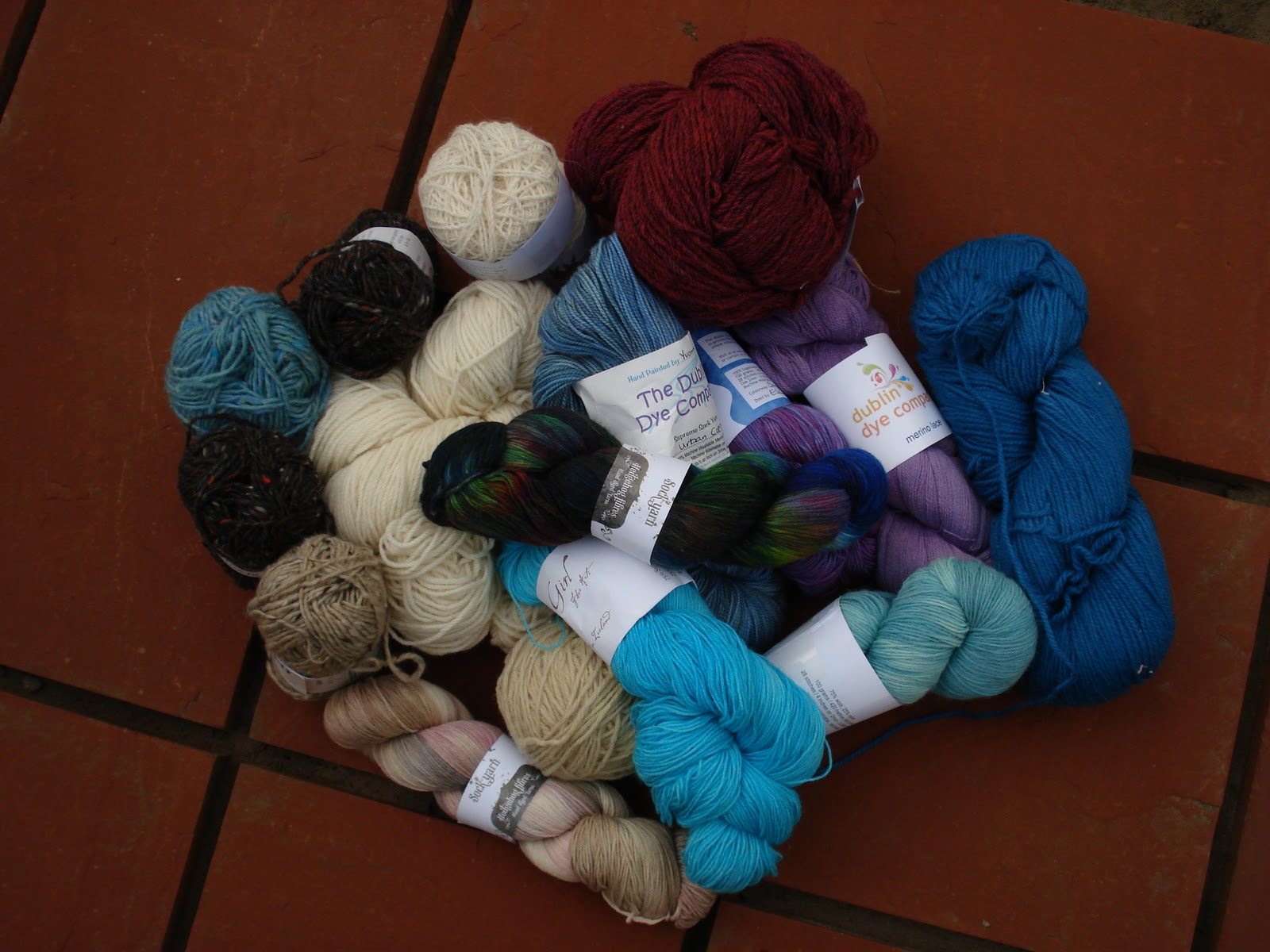 To the left you can see some of the yarn I have accumulated over the years, much of it is used in this book, all either spun or dyed in Ireland! There is some that's a bit rarer that isn't mentioned (like the Kerry Alpaca I picked up on holidays, which is only done in very small batches) Some of this is quite modern yarn, some of it older but this book would allow me to use up some of it!
 I found the patterns to be modern but not without respect to the past. There are some great Aran inspired patterns here with some deft modern touches. Entertainingly the names are places from the areas the yarns come from.
There's some helpful advice on sizing and adapting patterns, many of the patterns are in the round or flat with minimal seaming.
Types of patterns: Cardigans (3); Skirt (1); Children's cardigan (2); child sleeveless top (1); Jumper (3); Hat (3); Blanket (1); Shawl/wrap (2); children's jumper (1); bag (1); cowl (1); Fingerless Mittens (2)
Number of Patterns: 20 (the blanket is a variation on one of the shawls)
Split of patterns: mostly adult with some children's.
Size Range: Women's patterns are 27-51"; men's 37.5-53.5" and she does include the actual sizes the pattern is supposed to come to so that you can adjust for your own style.
Colour/Black & White: Colour photographs; black and white charts
Schematics: yes
Target Audience: Intermediate to advanced, there are no projects without at least a little cabling.
How to knit guide: not really, there are some guides to some of the extra techniques but not the very basics, the book assumes a certain competence with knitting
Experimental/Classical/Modern: Classical with a modern twist.
Comments on patterns (all links to patterns are from Ravelry):
Kerry Woollen Mills:
 |
| (c) Joseph Feller |
Tralee is knit in a DK yarn, this is a skirt mostly knit plain with a cable hiding in the kick pleat. I do like how this looks, not sure it would work for me but it's interesting!
Listowel is a shrug with a heart-motif on the back. This would probably be a great item as a wedding shrug or communion shrug. Knit in Aran weight yarn this would be a pretty quick knit.
Caherciveen hooded sleeveless, children's top, knit in Aran weight yarn.
Cushendale Woollen Mills:
Knockmore is a nice compromise of a man's jumper with enough patterning using twisted stitches to break up the monotonous acres of knitting without offending male sensibility, the only objection my husband had to it was the original colour. Knit in a dk weight.
Ballyragget is an interesting hat knit in DK using the twisted stiches from Knockmore
Dangan is either a baby blanket or a shawl. Knit in a sportweight yarn.
Belville uses the tweediness of the yarn to create a nicely shaped jumper with some colourwork on the yoke, knit in dk weight yarn.
Ballinagree is a sleeveless jumper designed for boys in a DK weight yarn, looks pretty unisex to me!
Kilmanagh uses some colourwork on the flap (a bag with a flap! I'm planning for this one!) and sides. It's interesting and knit in DK weight.
Donegal Yarns
Killybegs is an interesting cardigan with the cables providing some help with shaping. Interesting work. Using Aran weight yarn.
Bundoran
 I liked this one enough I started it (progress pic to the left)! Though I couldn't help messing with it and adding in colourwork. It's not finished because I have to get more of the pale turquoise yarn. I like how the cables interact with the yarn. Knit in Aran weight yarn, using some of the features of the cables from Killybegs.
Ardara is a nice sleeveless cardigan, one on my would like to knit shortlist. Knit in Aran weight yarn.
Glengesh is a wrap in an Aran weight yarn; worked from the bottom up with some shaping provided by short-row shaping.
Straboy is another one that makes my husband mutter noises about wanting one! Knit in an Aran yarn I've seen this in action and it looks well.
Rossbeg is an interesting design, knitting in Aran weight this starts with a yoke and works down, it's an interesting piece.
Hand Dyers:
 |
| (c) Joseph Feller |
Rathcooney Hat and Fingerless Mitts simple elegance, this is an interesting piece the cocoon stitch changes to ribs. It's a worsted weight yarn that has some silk in it. Hence the name!
Buy/Borrow: I have to admit that if I hadn't got a copy, and I had borrowed it from the Libraries I would have bought it. I like it and want to make too many patterns from the book not to want it.
Where found: I got a copy to review from Wiley, Dublin City Public Libraries has some copies in stock
The Blog tour:
15/9/2011 Stephen West
17/9/2011 Hoxton Handmade
21/9/2011 Shannon Okey
23/9/2011 Rosemary Hill
25/9/2011 Ann Kingstone
27/9/2011 Marly Bird
29/9/2011 JC Briar
1/10/2011 Woolly Wormhead
3/10/2011 Anne Hanson
7/10/2011 Stephannie Tallent
11/10/2011 Alice Yu
13/10/2011 Michelle Miller
15/10/2011 Deirdre Thornton
17/10/2011 Ilga Leja
Friday, 23 September 2011
entreKnits review
EntreKnits from Interweave Knits
 PC Version
Mac Version
Ravelry Link
Impressions: This is an enhanced ebook. Well designed. You can flick through the book page by page or use the index to go to what you're looking for. There are portions of the pages that are interactive, videos, and some horizontal scrolling on some pages so if basically it's like chapters that you then can go down rather than having to flick through something you're not quite interested in to get to a more interesting chapter. Also usefully, if you're navigating by arrow, when you go left or right it brings you to the top of the next page. You can resize the pages, useful when I was looking at my small screen netbook for this review.

Mac Version
Ravelry Link
Impressions: This is an enhanced ebook. Well designed. You can flick through the book page by page or use the index to go to what you're looking for. There are portions of the pages that are interactive, videos, and some horizontal scrolling on some pages so if basically it's like chapters that you then can go down rather than having to flick through something you're not quite interested in to get to a more interesting chapter. Also usefully, if you're navigating by arrow, when you go left or right it brings you to the top of the next page. You can resize the pages, useful when I was looking at my small screen netbook for this review.
It starts with a section on storage, where you can open the items to see what they're like, and click through to the company's website, usefully using the default browser on your machine.
Next up is a yarn review, the initial page is the swatches, done in diamonds, and you can scroll through or click whichever one catches your fancy, the quick reviews talks about usefulness for entrelac knitting.
Now a Book review, where they look at some books, patterns and dvds with some modular/entrelac designs
Now the meat starts; Annie Modesitt talks about maths and kniting and about befriending maths, this will probably be a chapter I return to again.
next up is a pattern, the Turn About Wrap

Modular is the next section where Jenna Wilson (the Girl from Auntie) looks at the history of modular knitting and patents
Soap Bubble hat by Norah Gaughan comes next, an oversized hat
Vivian Hoxbro looks at 3D Domino knitting and provides a pattern for a folded domino bracelet
The penultimate page has resources where you can find all the websites in one place.
To finish (and I almost overlooked it! due to the last page) Knitter and photographer Maryse Roudier takes some images and knits them, a very interesting section of inspiration
Overall I think it's an interesting magazine with a lot of samples of the kind of different modular and entrelac forms, it's a good introduction to the methods and some of the big-name designers in the field.

The next section is Entrelac - Meg Swansen gives a guide to blemish-free blocks; and talks about knitting backward, while Eunny Jang shows in a video how it's done. A pattern called Cochin Shrug is next (photograph to left)
Then they have some links to some Interweave Knits entrelac and other modular knitting
Quilt Inspired is the next section; starting with the Sweet Hexagon Cowl, an oversized pieced cowl where they're all linked as you go. The Lancaster Blanket is a blanket inspired by quilts, made modular.
Modular is the next section where Jenna Wilson (the Girl from Auntie) looks at the history of modular knitting and patents
Soap Bubble hat by Norah Gaughan comes next, an oversized hat
Vivian Hoxbro looks at 3D Domino knitting and provides a pattern for a folded domino bracelet
The penultimate page has resources where you can find all the websites in one place.
To finish (and I almost overlooked it! due to the last page) Knitter and photographer Maryse Roudier takes some images and knits them, a very interesting section of inspiration
Overall I think it's an interesting magazine with a lot of samples of the kind of different modular and entrelac forms, it's a good introduction to the methods and some of the big-name designers in the field.
Colour/Black & White: All colour
Target Audience: Intermediate to advanced knitters
Comments on patterns:
The Turn about Wrap creates a square wrap out of three triangular units with an two-colour iCord edging
The Turn about Wrap creates a square wrap out of three triangular units with an two-colour iCord edging
Cochin Shrug is an interesting shrug made from various sized blocks.
The Sweet Hexagon Cowl is an interesting draped cowl, not really what I need in a cowl (I need something a little tighter for under my motorbike jacket), tempting though!

Soap Bubble Hat is an oversized hat using bubbleshapes and designed by Norah Gaughan. Very oversized, if you're fond of that style it might appeal but it's not my type of thing.
Vivian Hoxbro provides a Folded domino bracelet. A different pattern, not really my style but an interesting method of design.
Buy/Borrow: it's a bit of an ARGH! Because my primary machine is Ubuntu this is a little awkward to access, and part of the reason it took me a while to get around to reviewing it, which would probably be a barrier to my actually considering buying it, but I do like it and would have bought it if I could have easily accessed it. (It requires Adobe Air to be installed - if you can get it working on your machine you should be able to get the Windows version to work, my computer is just not playing ball.)
Where found: Interweave Knits gave me a free copy for review, weeks ago.
The Cover Photograph is from Interweave Knits Website and the two pattern photographs are from Ravely and copyright their originators.
The Cover Photograph is from Interweave Knits Website and the two pattern photographs are from Ravely and copyright their originators.
Saturday, 7 May 2011
The Complete Photo Guide to Knitting Review
Book Depository Link; Ravelry Link
Impressions:
It's not a bad introduction to knitting with lots of photographs and guides, it fails to use contrast yarns to make things a bit clearer and apart from cable patterns doesn't use charts. It doesn't have a bibliography for further reading and honestly the garments don't make me anyway excited. It's not a bad beginner or improving beginner book but wouldn't add to my library. It's a US publication so many of the stitch pattern names may be different to the originals. It misses out on more photographs in the Brioche pattern section, the aforementioned charts; a bibliography (apart from in the historical section which references No Idle Hand (sic) by Anne L Macdonald; Wikipedia History of Knitting & A Treasury of Knitting Patterns by Barbara Walker) and a bibliogrphy would have been useful for the last few sections where really they only had the space to bounce off them rather than go into detail. Edited by Margaret Hubert with contributions from Carrie Hammett; Sasha Kagan; Debbie New; Judy Pascale; Beth Brown-Reinsel and Myra Wood; the back of the book has biographies and partial bibliographies of these writers.
Starting with a short history of knitting, where the modern part concentrates on the US experience of knitting, the book then moves to the basics and then some stiches. Once it gets a few past a few knit stitch patterns it gives a pattern, for a simple one-piece garter stitch tunic jumper. Then it moves to light texture stitches; then suggests ornamenting the garter stitch jumper at the neck and sleeve ends, next we move to a sock pattern. Then medium to heavy texture stitch patterns; then a seed checks baby sweater which is worked in one piece to the armholes. Then the stitch patterns move to lace and a lacy sweater. Then it moves to Ribs pattern stitches, then ribbed leg warmers. Next up is the honeycomb and brioche stitches; which explains the how pretty well but doesn't have pictures this section finishes with a honeycomb washcloths. The next section is eyelets, followed by an Eyelet Cloche - which is an open-work hat with a flower and leaf knit motif. The next section is ripples and Chevrons followed by a Parasol Ripples Scarf. Next up are slip stitches, followed by a slip stitch card case.
Next up are Color Combos followed by a two-color toddler hat; then we have motifs which includes a flower, a heart in moss stitch, a mitered square, small fan, large fan, large fan with trinity border, small leaf, large leaf and finishes with leaf coasters which are lined. Cables are up next with clear photographs how to do cables and stitch legends, this is the first chapter that charts make an appearance. The pattern in this section is Double Cables Hat.
Then it moves on to Speciality Knitting Methods - one-piece knitting, starting with the top-down toddler cardigan that goes with the toddler hat; a top-down mock cable pullover. Then moves to simple entrelac, using a bag pattern to introduce the technique. Next up is Freeform knitting; using a freeform knitting bag, fastened to a handbag form, a freeform vest. Then there's Crazy Lace Knitting using a scarf as an example; Knitting with Beads again with a bag as example. Intarsia knitting with an oversized beret; twinned knitting with a pair of mittens and Ouroubous Knitting with a tree-rings jumper
Types of patterns: mostly accessories with a few jumpers and cardigans, quite basic stuff
Number of Patterns: 22
Size Range: 33"-45"
Colour/Black & White: Colour photographs, black and white charts
Schematics: for some garments, not put together but exploded.
Target Audience: Beginners and beginners looking to expand skills
How to knit guide: yes, this is most of what the book is about
Experimental/Classical/Modern: pretty classical.
Comments on patterns:
Garter Stitch Tunic Jumper - one-piece done side-to-side this is quite a simple but effective garment, done in a medium weight yarn on 6mm needles
Garter Stitch tunic sweater with detail - as the first garment but with some stitch detail on the cuffs and neckline.
Spiny Ridges Socks - basic socks with some lacy detail, slip one heel, knit in super fine yarn with 2.75mm needles.
Seed Checks Baby Sweater - knit in one piece to the armholes with stitch details on the bottom; dk yarn on 4mm needles
Lacy Sweater - it's a short-sleeved lacy cardigan, done in pieces and sewn, could probably be knit in one piece to the underarms. dk on 4mm needles.
Legwarmers - using a variety of stitches and stripes, in medium weight yarn using 4mm, 5mm & 5.5mm needles
Honeycomb Washcloth - a washcloth knit in dk weight cotton yarn with 4mm needles.
Eyelet Cloche is a hat that's quite open with a decorative large flower and leaf. Medium weight yarn on 5 & 6mm needles.
The Parasol Ripples Scarf is knit in silk-bamboo lightweight yarn knit (patons Silkn Bamboo is the recommended yarn) with 4mm & 5.5mm needles.
Slip-stitch card case is made in a medium weight yarn on 5mm needles.
The Two-color toddler Hat in medium weight yarn and 4mm & 5mm needles. It has a plain top and a slip-stitch colour pattern on the bottom.
Leaf Coasters - leaf shapes with lining and interrfacing.
Double Cables Hat - it's a hat with cables and a bobble, knit in medium weight yarn with 4mm and 5.5mm needles
Top-down Toddler Cardigan is designed to go with the toddler hat, again in two colours and worked from the top down; knit in medium weight yarn in 4mm & 5mm needles
Top-down Mock Cable Pullover has a drswstring through the neckline and mock cable on the neckline; cuffs and waist. Knit in a dk weight yarn in 4 & 5mm needles
An Entrelac Handbag is used as an intro to Entrelac knitting - knit in two colours of yarn (Patons Decor) with 3.5 & 5mm needles, a simple bag that has bamboo handles
Freeform Knitted bag are shapes sewn to a plastic backing; using 4 & 5mm needles and a variety of yarns.
The Freeform Vest is worked in one piece to armhole in an open mesh with applied motifs on the shoulders, knit in wool ease with 5mm & 6mm needles
Crazy Lace Sampler scarf uses fingering or sock yarn and 4.5mm needles, a variety of yarns and variety of patterns used throughout
Beaded Slip Stich Bag uses the crochet hook method of adding beads (which allows you to add beads without stringing them on beforehand). Knit in Koigu with 2.75mm needles
Queen of Hearts Beret is the introduction to intarsia using in part a self-striping yarn to give it more dimensions. This is knit flat in DK yarn using 3.25 & 4mm needles
Twinned Mittens for Kids - using a light-coloured worsted weight yarn using 4mm needles
Ouroborus knitting - using a tree rings sweater this works in rings from the centre out, getting larger and larger and eventually creating a full garment, this notes that it can be added to to make it bigger. Using Classic Wool and 4.5mm needless
Buy/Borrow: If you're a beginner this one might be a good place for reference. There are some stitches
Where found: Kilkenny County Library via Borrowbooks.ie
Impressions:
It's not a bad introduction to knitting with lots of photographs and guides, it fails to use contrast yarns to make things a bit clearer and apart from cable patterns doesn't use charts. It doesn't have a bibliography for further reading and honestly the garments don't make me anyway excited. It's not a bad beginner or improving beginner book but wouldn't add to my library. It's a US publication so many of the stitch pattern names may be different to the originals. It misses out on more photographs in the Brioche pattern section, the aforementioned charts; a bibliography (apart from in the historical section which references No Idle Hand (sic) by Anne L Macdonald; Wikipedia History of Knitting & A Treasury of Knitting Patterns by Barbara Walker) and a bibliogrphy would have been useful for the last few sections where really they only had the space to bounce off them rather than go into detail. Edited by Margaret Hubert with contributions from Carrie Hammett; Sasha Kagan; Debbie New; Judy Pascale; Beth Brown-Reinsel and Myra Wood; the back of the book has biographies and partial bibliographies of these writers.
Starting with a short history of knitting, where the modern part concentrates on the US experience of knitting, the book then moves to the basics and then some stiches. Once it gets a few past a few knit stitch patterns it gives a pattern, for a simple one-piece garter stitch tunic jumper. Then it moves to light texture stitches; then suggests ornamenting the garter stitch jumper at the neck and sleeve ends, next we move to a sock pattern. Then medium to heavy texture stitch patterns; then a seed checks baby sweater which is worked in one piece to the armholes. Then the stitch patterns move to lace and a lacy sweater. Then it moves to Ribs pattern stitches, then ribbed leg warmers. Next up is the honeycomb and brioche stitches; which explains the how pretty well but doesn't have pictures this section finishes with a honeycomb washcloths. The next section is eyelets, followed by an Eyelet Cloche - which is an open-work hat with a flower and leaf knit motif. The next section is ripples and Chevrons followed by a Parasol Ripples Scarf. Next up are slip stitches, followed by a slip stitch card case.
Next up are Color Combos followed by a two-color toddler hat; then we have motifs which includes a flower, a heart in moss stitch, a mitered square, small fan, large fan, large fan with trinity border, small leaf, large leaf and finishes with leaf coasters which are lined. Cables are up next with clear photographs how to do cables and stitch legends, this is the first chapter that charts make an appearance. The pattern in this section is Double Cables Hat.
Then it moves on to Speciality Knitting Methods - one-piece knitting, starting with the top-down toddler cardigan that goes with the toddler hat; a top-down mock cable pullover. Then moves to simple entrelac, using a bag pattern to introduce the technique. Next up is Freeform knitting; using a freeform knitting bag, fastened to a handbag form, a freeform vest. Then there's Crazy Lace Knitting using a scarf as an example; Knitting with Beads again with a bag as example. Intarsia knitting with an oversized beret; twinned knitting with a pair of mittens and Ouroubous Knitting with a tree-rings jumper
Types of patterns: mostly accessories with a few jumpers and cardigans, quite basic stuff
Number of Patterns: 22
Size Range: 33"-45"
Colour/Black & White: Colour photographs, black and white charts
Schematics: for some garments, not put together but exploded.
Target Audience: Beginners and beginners looking to expand skills
How to knit guide: yes, this is most of what the book is about
Experimental/Classical/Modern: pretty classical.
Comments on patterns:
Garter Stitch Tunic Jumper - one-piece done side-to-side this is quite a simple but effective garment, done in a medium weight yarn on 6mm needles
Garter Stitch tunic sweater with detail - as the first garment but with some stitch detail on the cuffs and neckline.
Spiny Ridges Socks - basic socks with some lacy detail, slip one heel, knit in super fine yarn with 2.75mm needles.
Seed Checks Baby Sweater - knit in one piece to the armholes with stitch details on the bottom; dk yarn on 4mm needles
Lacy Sweater - it's a short-sleeved lacy cardigan, done in pieces and sewn, could probably be knit in one piece to the underarms. dk on 4mm needles.
Legwarmers - using a variety of stitches and stripes, in medium weight yarn using 4mm, 5mm & 5.5mm needles
Honeycomb Washcloth - a washcloth knit in dk weight cotton yarn with 4mm needles.
Eyelet Cloche is a hat that's quite open with a decorative large flower and leaf. Medium weight yarn on 5 & 6mm needles.
The Parasol Ripples Scarf is knit in silk-bamboo lightweight yarn knit (patons Silkn Bamboo is the recommended yarn) with 4mm & 5.5mm needles.
Slip-stitch card case is made in a medium weight yarn on 5mm needles.
The Two-color toddler Hat in medium weight yarn and 4mm & 5mm needles. It has a plain top and a slip-stitch colour pattern on the bottom.
Leaf Coasters - leaf shapes with lining and interrfacing.
Double Cables Hat - it's a hat with cables and a bobble, knit in medium weight yarn with 4mm and 5.5mm needles
Top-down Toddler Cardigan is designed to go with the toddler hat, again in two colours and worked from the top down; knit in medium weight yarn in 4mm & 5mm needles
Top-down Mock Cable Pullover has a drswstring through the neckline and mock cable on the neckline; cuffs and waist. Knit in a dk weight yarn in 4 & 5mm needles
An Entrelac Handbag is used as an intro to Entrelac knitting - knit in two colours of yarn (Patons Decor) with 3.5 & 5mm needles, a simple bag that has bamboo handles
Freeform Knitted bag are shapes sewn to a plastic backing; using 4 & 5mm needles and a variety of yarns.
The Freeform Vest is worked in one piece to armhole in an open mesh with applied motifs on the shoulders, knit in wool ease with 5mm & 6mm needles
Crazy Lace Sampler scarf uses fingering or sock yarn and 4.5mm needles, a variety of yarns and variety of patterns used throughout
Beaded Slip Stich Bag uses the crochet hook method of adding beads (which allows you to add beads without stringing them on beforehand). Knit in Koigu with 2.75mm needles
Queen of Hearts Beret is the introduction to intarsia using in part a self-striping yarn to give it more dimensions. This is knit flat in DK yarn using 3.25 & 4mm needles
Twinned Mittens for Kids - using a light-coloured worsted weight yarn using 4mm needles
Ouroborus knitting - using a tree rings sweater this works in rings from the centre out, getting larger and larger and eventually creating a full garment, this notes that it can be added to to make it bigger. Using Classic Wool and 4.5mm needless
Buy/Borrow: If you're a beginner this one might be a good place for reference. There are some stitches
Where found: Kilkenny County Library via Borrowbooks.ie
Thursday, 28 April 2011
Country Weekend Socks Review
Book Depository Link Ravelry Link
Impressions: This is a book of fairly heavy weight socks, there are a few in 4ply but most of the patterns are in DK or heavier, these are for heavy-weight use and several would be good stashbusters. They look pretty slouchy and several of them don't look well-fitting but that could be styling. I'm not queueing up to buy this though a few of the patterns did attract my attention. Many of the patterns are knee highs but there's no real suggestions of how to adapt for different sized legs or length of leg.
Types of patterns: Socks
Number of Patterns: 25
Size Range: Adult socks
Colour/Black & White: Colour mostly, colour charts but written lace.
Schematics: no
Target Audience: Some are pretty advanced but most are intermediate to advanced.
How to knit guide: Some basic guides and advice included.
Experimental/Classical/Modern: mostly classical but I have a feeling a lot of it will date.
Comments on patterns: Divided into six chapters, the first is Cables; then Stipes and Multicolour; Gansey Stitch Patterns; Fair Isle and Sanquhar; Argyle and Lace Knitting. The Content list also has pictures of the patterns numbered which is useful. The Gansey Stitch with gusset heel; the Traditional shetland pattern socks; the over the knee lacy stockings and the argyle over-the-knee socks caught my eye but really didn't make me want to add them to my queue. Many of them are knit in the flat.
Buy/Borrow: I'm glad I borrowed it first, this will not be added to my library at this time.
Where found: Got via Borrowbooks from Longford Library.
Types of patterns: Socks
Number of Patterns: 25
Size Range: Adult socks
Colour/Black & White: Colour mostly, colour charts but written lace.
Schematics: no
Target Audience: Some are pretty advanced but most are intermediate to advanced.
How to knit guide: Some basic guides and advice included.
Experimental/Classical/Modern: mostly classical but I have a feeling a lot of it will date.
Comments on patterns: Divided into six chapters, the first is Cables; then Stipes and Multicolour; Gansey Stitch Patterns; Fair Isle and Sanquhar; Argyle and Lace Knitting. The Content list also has pictures of the patterns numbered which is useful. The Gansey Stitch with gusset heel; the Traditional shetland pattern socks; the over the knee lacy stockings and the argyle over-the-knee socks caught my eye but really didn't make me want to add them to my queue. Many of them are knit in the flat.
Buy/Borrow: I'm glad I borrowed it first, this will not be added to my library at this time.
Where found: Got via Borrowbooks from Longford Library.
Saturday, 5 February 2011
Baby Knits for Beginners review
BookDepository Link; Ravelry Link (all pattern links are to Ravelry)
Types of patterns: Baby Patterns: Clothing & Accessories
Number of Patterns: 15
Split of patterns: scarf (2); Blanket (1); Sachet (1); Jumper (3); Hat (1); Cushion (1); Cardigan (4); Slippers (1); Dress (1); Socks (1)
Size Range: 3 months to 36 months for some but not all patterns
Colour/Black & White: Colour
Schematics: Surprisingly no.
Target Audience: Beginners
How to knit guide: Yes
Experimental/Classical/Modern: Classical
Comments: This book would be ideal for beginner knitters. Particularly someone who has decided to learn to knit because a family member (or they) are having a baby. The patterns range from very very simple (the Garter Stitch Scarf for example) to more complicated (the V-Necked Sweater with Pockets) but they're all pretty much within the grasp of a relatively new knitter (or a more experienced knitter looking for something quick and simple to make!). All of the patterns use her yarn (to be expected honestly)
The first pattern is the Garter stitch scarf, your basic, learning to knit scarf, but as it's for a baby, fortunately quick. Knit in Aran this uses one ball of her Cashmerino.
Garter Stitch Blanket would be a way of practicing sewing up, she does suggest turning every alternate square through right angles which adds interest to the piece. Knit in garter stitch this could also be a good piece to practice picking up and knitting on, if you wanted to, again knit in her cashmerino Aran.
Sachets: These could be made bigger or smaller and are intended for lavender or small notions. DK Cotton used here. Stocking stitch.
Boat Neck Sweater introduces some minor shaping but it's largely square, knit in Cashmerino Aran
Simple hat - a good practice for learning decreases, this is knit in the flat and seamed (changing it to in the round would be fairly simple, dk in cotton.
Cushions with Buttonholes is pretty simple and making first buttonholes in something like a cushion would mean minor mistakes would be easily glossed over. There are actually two cushions done in chunky yarn. One is in moss stitch, the other in a wide broken rib
Jacket with Moss Stitch Bands. the Button and buttonhole bands are done at the same time. Stitches do need to be picked up for the neck, but it's only a little amount. Knit in Baby cashmerino
V-Neck Cardigan with Contrast Ribs, the buttonbands are worked afterwards for this in a different colour. Stitches are picked up, knit in cotton DK
Moss Stitch shoes are baby booties worked in moss stitch. worked flat and sewn up later knit in wool/cotton
Sweater with Square Set-in Sleeves. This teaches how to work a set in sleeve. A plain and purl effect diamonds decorate it, knit in cotton Dk, I've knit this one myself and it worked quite well in a different DK yarn
Raglan cardigan with fully fashioned shaping. The decreases match along the side. Knit in DK yarn
Dress with eyelets is a sleeveless dress with eyelet detail around the waist knit in wool/cotton
Shawl Collared Jacket uses short rows for the collar, worked in Aran weight yarn
Two-needle socks are worked in the flat and then seamed, magic loop learning potential here! Uses Baby Cashmerino.
Scarf with Pocket - the original uses a contrast colour lining, which is a nice detail. Knit in Aran weight yarn.
V-Neck sweater with pockets is a baby cashmerino jumper with contrast edging.
Overall if you knit each piece as it came you would probably end up with quite a good grounding in knitting. Each piece adds to the skills learned, in a fairly linear manner and makes this quite a good beginners book. My only problem would be the issue with lack of schematics as this would be also a good time to teach someone about how schematics work.
Buy/Borrow: It would be useful if you knit a lot of things for babies. Fairly simple stuff that offers occasional details that make the garments more interesting.
Where found: This is part of a second buy of this book, the first buy got us one copy, there's now 8 copies in stock in Dublin City Council.
Types of patterns: Baby Patterns: Clothing & Accessories
Number of Patterns: 15
Split of patterns: scarf (2); Blanket (1); Sachet (1); Jumper (3); Hat (1); Cushion (1); Cardigan (4); Slippers (1); Dress (1); Socks (1)
Size Range: 3 months to 36 months for some but not all patterns
Colour/Black & White: Colour
Schematics: Surprisingly no.
Target Audience: Beginners
How to knit guide: Yes
Experimental/Classical/Modern: Classical
Comments: This book would be ideal for beginner knitters. Particularly someone who has decided to learn to knit because a family member (or they) are having a baby. The patterns range from very very simple (the Garter Stitch Scarf for example) to more complicated (the V-Necked Sweater with Pockets) but they're all pretty much within the grasp of a relatively new knitter (or a more experienced knitter looking for something quick and simple to make!). All of the patterns use her yarn (to be expected honestly)
The first pattern is the Garter stitch scarf, your basic, learning to knit scarf, but as it's for a baby, fortunately quick. Knit in Aran this uses one ball of her Cashmerino.
Garter Stitch Blanket would be a way of practicing sewing up, she does suggest turning every alternate square through right angles which adds interest to the piece. Knit in garter stitch this could also be a good piece to practice picking up and knitting on, if you wanted to, again knit in her cashmerino Aran.
Sachets: These could be made bigger or smaller and are intended for lavender or small notions. DK Cotton used here. Stocking stitch.
Boat Neck Sweater introduces some minor shaping but it's largely square, knit in Cashmerino Aran
Simple hat - a good practice for learning decreases, this is knit in the flat and seamed (changing it to in the round would be fairly simple, dk in cotton.
Cushions with Buttonholes is pretty simple and making first buttonholes in something like a cushion would mean minor mistakes would be easily glossed over. There are actually two cushions done in chunky yarn. One is in moss stitch, the other in a wide broken rib
Jacket with Moss Stitch Bands. the Button and buttonhole bands are done at the same time. Stitches do need to be picked up for the neck, but it's only a little amount. Knit in Baby cashmerino
V-Neck Cardigan with Contrast Ribs, the buttonbands are worked afterwards for this in a different colour. Stitches are picked up, knit in cotton DK
Moss Stitch shoes are baby booties worked in moss stitch. worked flat and sewn up later knit in wool/cotton
Sweater with Square Set-in Sleeves. This teaches how to work a set in sleeve. A plain and purl effect diamonds decorate it, knit in cotton Dk, I've knit this one myself and it worked quite well in a different DK yarn
Raglan cardigan with fully fashioned shaping. The decreases match along the side. Knit in DK yarn
Dress with eyelets is a sleeveless dress with eyelet detail around the waist knit in wool/cotton
Shawl Collared Jacket uses short rows for the collar, worked in Aran weight yarn
Two-needle socks are worked in the flat and then seamed, magic loop learning potential here! Uses Baby Cashmerino.
Scarf with Pocket - the original uses a contrast colour lining, which is a nice detail. Knit in Aran weight yarn.
V-Neck sweater with pockets is a baby cashmerino jumper with contrast edging.
Overall if you knit each piece as it came you would probably end up with quite a good grounding in knitting. Each piece adds to the skills learned, in a fairly linear manner and makes this quite a good beginners book. My only problem would be the issue with lack of schematics as this would be also a good time to teach someone about how schematics work.
Buy/Borrow: It would be useful if you knit a lot of things for babies. Fairly simple stuff that offers occasional details that make the garments more interesting.
Where found: This is part of a second buy of this book, the first buy got us one copy, there's now 8 copies in stock in Dublin City Council.
Wednesday, 2 February 2011
Purls of Wisdom
Book Depository Link ; Ravelry Link
Types of patterns: accessories and household items
Number of Patterns: Scarf (4); cowl (1); wristwarmers (1); Hat (2); booties (1); baby hat (1); baby blanket (1); Baby Bib (1); Cushion (1); Hot Water bottle cover (1); Tea Cosy (1); Cafetiere cosy (1); Bracelet cover (1); cuff (1); i-pod cosy (1); Laptop cover (1)
Split of patterns:
Size Range:
Colour/Black & White: Colour photos, black and white text with some red enhancement
Schematics: no, then again none of the patterns really need it, there's also no charts for stitch patterns)
Target Audience:
How to knit guide: This book is mostly about how to knit with a few simple projects to get you started.
Experimental/Classical/Modern: classic with some modern twists. I'm not sure some of the cute is going to survive long
Comments: The cover quote from India Knight suggesting that it's "the only book about knitting you'll ever need." made me laugh "Gorgeous and essential" is the other half of the quote, which I would disagree with in part. The author herself nominates Barbara Walkers treasury of Knitting Patterns as her Desert Island Book! Pattern links are to Ravelry
It's one of those hip new knitting books that seem to be proliferating as publishers discover that there's a demand for knitting books. And yes, it's well illustrated (they use three colour printing with red as well as black and white) and several of the projects are challenging, however I would disagree with the ratings given to projects. Seriously, a plain pair of straightforward socks merit an intermediate, not a complicated rating with lots of don't worry's and panic nots in the instructions. I think people often overestimate complicatons and make things much more complicated than they really are. My best instructions to a first-time sock knitter, is to relax, find someone to point you at a simple sock pattern, preferably one that has plenty of people who have knit it and very little or no errata and just follow the pattern. What's the worst that can happen? That you have to rip it? So what. That it turns out with holes? Features I say, features. Trust in the power of the yarn and just knit it.
Deep Breath
The patterns are pretty basic but poorly sorted; "gifts for girls"; "gifts for boys"; "gifts for babies"; "gifts for the home" and "novelty gifts" are the various topics; she does talk about how to adapt the pattern to make it different.
Starting with Gifts for Girls you have a bramble stitch scarf. To my mind a scarf that's more unisex than gendered, the only way to gender it is with colour (and actually the photographs are of a neutral cream)
Lacy Scarf - a fairly regular scarf pattern in this (btw the pattern is written not charted)
Chunky Cowl, knit on 12 mm needles this is a pretty classic piece
Wristwarmers both with and without thumbholes
Classic Beret - actually without blocking on a plate you pretty much get a tam rather than a beret...
Cloud-nine socks - socks with a lacy pattern, she does suggest trying the plain socks first before these but rates them equally hard!
Gifts for boys:
Moss Stitch Scarf - knit on 12mm needles this is pretty unisex
Moss Stitch Tie
Diagonal Knot Stitch Scarf - knit on 5mm needles it's also fairly unisex
Twisted rib Beanie - a basic unisex beanie
Basic Boy Socks - basic anyone plain socks, knit with 3mm needles so pretty useful for any number of elaborate sock yarns.
Gifts for babies:
Mary Jane Booties: cute
Simple Baby Hat - knit in dk on smaller than usual needles (3.5mm)
Born under a star Blanket - knit in bulky yarn (6.5mm needles) this is a fairly repeditive but fairly spectacuar blanket
Bib - knit in dk cotton
Mortimer the Dog - cute but you'd need to make sure that the sewn parts are well anchored
For the Home:
Honeycomb Cable Cushion - good cable practice
Hot water bottle cover - knit in aran with 4.5mm needles
Tea Cosy - bulky knit, a modern take on a classic design
Cafetiere Cosy - again a bulky knit this fits between the top and bottom of the handles of the cafetiere and therefore fails my requirements for a Cafetiere Cosy.
Novelty Gifts - Covered Bangles - belongs with the "gifts for girls" really here. Indeed. Actually the virtue of this one is where the author suggests using a tension swatch and working out how many stitches you need, so a good pattern to start learning about adaptions
Lacy Bracelets - again "girls", these are often referred to as cuffs around the world
I-pod sock - a container for an i-pod
Laptop Case - knit with 10mm needles this is a big bulky cover.
Buy/Borrow: It's aimed at the late teen, early 20's market. If you have mastered the basics it's nothing new (perhaps the resources pages have some more details but apart from that there's really nothing new here) and the patterns aren't a real challenge. The cutesy girl and boy titles and I don't think that a lot of the patterns are as gendered as they are presented. It might be good for a beginner looking to try something new or refresh their mind about the techniques from school. It won't be joining my library.
Where found: Dublin City Public Libraries has copies.
Types of patterns: accessories and household items
Number of Patterns: Scarf (4); cowl (1); wristwarmers (1); Hat (2); booties (1); baby hat (1); baby blanket (1); Baby Bib (1); Cushion (1); Hot Water bottle cover (1); Tea Cosy (1); Cafetiere cosy (1); Bracelet cover (1); cuff (1); i-pod cosy (1); Laptop cover (1)
Split of patterns:
Size Range:
Colour/Black & White: Colour photos, black and white text with some red enhancement
Schematics: no, then again none of the patterns really need it, there's also no charts for stitch patterns)
Target Audience:
How to knit guide: This book is mostly about how to knit with a few simple projects to get you started.
Experimental/Classical/Modern: classic with some modern twists. I'm not sure some of the cute is going to survive long
Comments: The cover quote from India Knight suggesting that it's "the only book about knitting you'll ever need." made me laugh "Gorgeous and essential" is the other half of the quote, which I would disagree with in part. The author herself nominates Barbara Walkers treasury of Knitting Patterns as her Desert Island Book! Pattern links are to Ravelry
It's one of those hip new knitting books that seem to be proliferating as publishers discover that there's a demand for knitting books. And yes, it's well illustrated (they use three colour printing with red as well as black and white) and several of the projects are challenging, however I would disagree with the ratings given to projects. Seriously, a plain pair of straightforward socks merit an intermediate, not a complicated rating with lots of don't worry's and panic nots in the instructions. I think people often overestimate complicatons and make things much more complicated than they really are. My best instructions to a first-time sock knitter, is to relax, find someone to point you at a simple sock pattern, preferably one that has plenty of people who have knit it and very little or no errata and just follow the pattern. What's the worst that can happen? That you have to rip it? So what. That it turns out with holes? Features I say, features. Trust in the power of the yarn and just knit it.
Deep Breath
The patterns are pretty basic but poorly sorted; "gifts for girls"; "gifts for boys"; "gifts for babies"; "gifts for the home" and "novelty gifts" are the various topics; she does talk about how to adapt the pattern to make it different.
Starting with Gifts for Girls you have a bramble stitch scarf. To my mind a scarf that's more unisex than gendered, the only way to gender it is with colour (and actually the photographs are of a neutral cream)
Lacy Scarf - a fairly regular scarf pattern in this (btw the pattern is written not charted)
Chunky Cowl, knit on 12 mm needles this is a pretty classic piece
Wristwarmers both with and without thumbholes
Classic Beret - actually without blocking on a plate you pretty much get a tam rather than a beret...
Cloud-nine socks - socks with a lacy pattern, she does suggest trying the plain socks first before these but rates them equally hard!
Gifts for boys:
Moss Stitch Scarf - knit on 12mm needles this is pretty unisex
Moss Stitch Tie
Diagonal Knot Stitch Scarf - knit on 5mm needles it's also fairly unisex
Twisted rib Beanie - a basic unisex beanie
Basic Boy Socks - basic anyone plain socks, knit with 3mm needles so pretty useful for any number of elaborate sock yarns.
Gifts for babies:
Mary Jane Booties: cute
Simple Baby Hat - knit in dk on smaller than usual needles (3.5mm)
Born under a star Blanket - knit in bulky yarn (6.5mm needles) this is a fairly repeditive but fairly spectacuar blanket
Bib - knit in dk cotton
Mortimer the Dog - cute but you'd need to make sure that the sewn parts are well anchored
For the Home:
Honeycomb Cable Cushion - good cable practice
Hot water bottle cover - knit in aran with 4.5mm needles
Tea Cosy - bulky knit, a modern take on a classic design
Cafetiere Cosy - again a bulky knit this fits between the top and bottom of the handles of the cafetiere and therefore fails my requirements for a Cafetiere Cosy.
Novelty Gifts - Covered Bangles - belongs with the "gifts for girls" really here. Indeed. Actually the virtue of this one is where the author suggests using a tension swatch and working out how many stitches you need, so a good pattern to start learning about adaptions
Lacy Bracelets - again "girls", these are often referred to as cuffs around the world
I-pod sock - a container for an i-pod
Laptop Case - knit with 10mm needles this is a big bulky cover.
Buy/Borrow: It's aimed at the late teen, early 20's market. If you have mastered the basics it's nothing new (perhaps the resources pages have some more details but apart from that there's really nothing new here) and the patterns aren't a real challenge. The cutesy girl and boy titles and I don't think that a lot of the patterns are as gendered as they are presented. It might be good for a beginner looking to try something new or refresh their mind about the techniques from school. It won't be joining my library.
Where found: Dublin City Public Libraries has copies.
Sunday, 30 January 2011
Fashion Crochet by Caroline Horne
Book Depository Link there's no Ravelry Link for this one.
other info: Mills & Boon, 1969, 263707369
Types of patterns: Mostly clothing
Number of Patterns: Bag (1); Hat(2); Stockings (1); Suit (2); Coat (2) Dress (2); shawl(1)
Split of patterns: women
Size Range: 34-40"; most patterns only offer 1-2 sizes
Colour/Black & White: Black and white
Schematics: No
Target Audience: Beginner Crocheters
How to Crochet guide: Yes
Experimental/Classical/Modern: Fairly Clasiscal
Comments:
The book opens with a guide on how to crochet, illustrated, then a how to read a pattern section and then on to the patterns
First is how to make a handbag, lined.
A crochet beret
A crochet hat
Stockings! Using Nylon thread
A Tailored suit with raglan sleeves - this is very Chanel.
3/4 length coat with raglan sleeves
Car Coat
Two-coloured Dress
Classic Teenagers dress
Cape Suit
Evening Shawl
The book finishes with suggested colour uses in the patterns; lengthening advice, and lining advice along with an announcement that from July 1st 1969 mm were coming in as standard and while the patterns are offered with old imperial crochet hook sizing, there is a conversion chart to mm sizing.
This is not a modern book and the sizing is very limited but it is an interesting book, not only is it part of the history of crochet but it's also published by Mills & Boon when they weren't just a romance novel production house. You would have to do a certain amount of research on the yarns cited to discover what the originals would have looked like and there's a lack of colour photographs (excepting the front cover); all the patterns are presented in fashion style sketches featuring a Twiggy-esque sketch wearing the garment.
Buy/Borrow: It belongs more as an historical book than a modern pattern book, though some of the principles would remain the same. However with the limited sizing and lack of schematics it's not too helpful, a book originally intended for a beginner or intermedite crocheter, it's now really a book for an intermediate or advanced worker.
Where found: Dublin City Public Libraries has a copy.
other info: Mills & Boon, 1969, 263707369
Types of patterns: Mostly clothing
Number of Patterns: Bag (1); Hat(2); Stockings (1); Suit (2); Coat (2) Dress (2); shawl(1)
Split of patterns: women
Size Range: 34-40"; most patterns only offer 1-2 sizes
Colour/Black & White: Black and white
Schematics: No
Target Audience: Beginner Crocheters
How to Crochet guide: Yes
Experimental/Classical/Modern: Fairly Clasiscal
Comments:
The book opens with a guide on how to crochet, illustrated, then a how to read a pattern section and then on to the patterns
First is how to make a handbag, lined.
A crochet beret
A crochet hat
Stockings! Using Nylon thread
A Tailored suit with raglan sleeves - this is very Chanel.
3/4 length coat with raglan sleeves
Car Coat
Two-coloured Dress
Classic Teenagers dress
Cape Suit
Evening Shawl
The book finishes with suggested colour uses in the patterns; lengthening advice, and lining advice along with an announcement that from July 1st 1969 mm were coming in as standard and while the patterns are offered with old imperial crochet hook sizing, there is a conversion chart to mm sizing.
This is not a modern book and the sizing is very limited but it is an interesting book, not only is it part of the history of crochet but it's also published by Mills & Boon when they weren't just a romance novel production house. You would have to do a certain amount of research on the yarns cited to discover what the originals would have looked like and there's a lack of colour photographs (excepting the front cover); all the patterns are presented in fashion style sketches featuring a Twiggy-esque sketch wearing the garment.
Buy/Borrow: It belongs more as an historical book than a modern pattern book, though some of the principles would remain the same. However with the limited sizing and lack of schematics it's not too helpful, a book originally intended for a beginner or intermedite crocheter, it's now really a book for an intermediate or advanced worker.
Where found: Dublin City Public Libraries has a copy.
Saturday, 29 January 2011
Knitting Experience Book 3: Color the power and the glory
Book Depository link; Ravelry Link
Types of patterns: mostly clothing
Number of Patterns:44: Tea Cosy (1); Baby Jacket (1); Wrap (2); Jacket/cardigan (8); Jumper (12); Cuff (1); coat (1); scarf (2); Afghan (2); Tie (1); Top (3); waistcoat (2); Bag (1); Runner(1); Placemats(1); Skirt (3); Poncho (2)
Split of patterns: Men/women/children; mostly women some men and children and unisex
Size Range: Child 2-14 (21"-31.5"); Women (28-54"); Men (34-52") not all patterns in all sizes
Colour/Black & White: both
Schematics: yes, for pretty much everything
Target Audience: All levels really, most are pretty simple, probably mostly around the intermediate rate.
How to knit guide: there is a small reminder of some techniques at the back, but this is a continuation of the Knit & Purl books from the same series so some basic skills required.
Experimental/Classical/Modern: mostly classical with some more experimental patterns in there, some are quite blockly and oversized
Comments: As I said about Styles the patterns may not be for everyone, however the inspiration I have got from flicking through this book more than makes up for the boxy shapes and general shapelessness of the garments. However, there are some pieces that make me think about knitting them albeit with some modifications. The standout piece for me is the Panel-Party Tunic/Pullover/Dress, I want to make one nowish. This could be quite good for that slightly off yarn or those oddments that are close but not good enough of a match for a full garment. The information of how to combine yarns to make a particular weight is useful.
(2 superfine = 1 light
3 superfine = 1 medium
1 superfine + 1 light = 1 medium
2 fine = 1 medium
3 fine = 1 bulky
2 superfine + 1 light = 1 bulky
2 light = bulky
1 medium +1 fine = bulky)
The first chapter is about letting the yarn do the work. The Yarn-party poncho is basically 8 scarves sewn/crocheted together and made into a poncho
Summer breeze is a shapeless top buttoned to the side.
Faith Jacket is 15 strips sewn and then a shapeless jacket created
Blanket Jacket is a big bulky jacket that resembles many, it's not a bad style.
Jeremy's Jacket is a jumper soemwhat like the blanket jacket but more styled for men.
Choker Cuff started off as a minimal scarf that the model wrapped around her wrist and they liked it
Nancy's Skirt is a wool a-line shortish skirt with a lace patterning
Second Chapter is Stripes Simple and Not
First pattern is Skinny Stripes: a funnel or v-neck jumper, not for me with horizontal stripes.
Broad Stripes is a jumper with two different necks and a top with a broad stripe in the middle and other sized stripes along the body
Wobbly Stripes is a jumper with stripes made wavy by a lace pattern
Graduated stripes is a man and child jumper with graduated stripes
Collar-closing cardigan, using a variety of yarns for the body and collar, the collar is quite wide
The third chapter is Stripes that aren't.
Cynthia's Scarf/Afghan is a log-cabin pattern that can be made into a scarf or worked into an afghan, squares are worked and sewn together
Nod to Mod Pullover is a modular jumper that could be a great way to use up a variety of colours.
Big Bang Wrap is a a stripy wrap knit in a variety of colours, houndstooth pattern with a bit of a ruffle
Linen Stitch wrap is a 4 contrast colour wrap
Linen-stitch runner and placemats are what they say they are
Baby Rainbow Jacket uses the contrast yarn well and plays with the reverse side of the fabric because it looked interesting.
Slip-into-color pullover. Tweed stitch using a variaget yarn to create interest. Could also be a good use of leftovers.
Faux check Pullover - with a slip stitch and some stitching into a lower row it makes a houndstooth pattern.
Little Squares is an oversized jacket worked in the reverse of the faux check pullover, for a different look, the sample is knit in a heavy and light yarn for a different look.
Wrong-side sweater is again using the back of the faux check pullover and with a long tail on the back
Eds Tie uses three colours and a fairly simple stitch to create a fairly solid tie.
The 2-colour tradition is the next chapter, starting with the KISS purse that looks as good inside-out as outside in, it's fulled so useful for learning
North-Inspired cardigan is inspired by Icelandic patterns, the use of colour is interesting. Designed for infants or women, infant copies are always good for trying out techniques.
In Praise of Doodling is a zipped waistcoat for men and a toggled cardigan for women. The cardigan has saddle shoulders to add interest and the cuffs are done in the same colourway as the body, while the arms are done in a contrast colour
The Seventies is a vintage style poncho sized for a child or adult.
Not-Mrs-D's-Suit is a two parter, a skirt bordered with a two-colour snowflake design, the second part is a funnel neck pullover, done in a single colour yarn.
Panels, pictures and plaids is the last chapter.
Boyfriend Sweater is a large-scale jumper with vertical stripes, with dental moulding style detail
Princess Pullover is a jumper that can have a lot or a little colourwork, there's princess seams, decorated with button details.
Colour Party Parka is an oversized parka with many, many colours.
Annalee's Tea Cozy is a argyle fulled tea cozy.
Shared Border Cardigan is a riff off the Boyfriend Sweater with an asymmetrical hem.
Panel Party skirt is done in pieces that are sewn together, a short skirt with lace and ribbing.
Panel Party tunic/pullover/dress using the same principle as the skirt this is an interesting piece, funnel necked, this would be a great piece for using almost identical yarns. The designer used a variagated yarn for the lace part and plain yarns for the ribbed sections, the sleeves are ribbed and plain. You could probably use more colour, or odd balls that are similar colours that co-ordinate with the plain yarn. Also odd yarn lots would be broken up by the co-ordinating yarn and covered up.
Knitting Bag Jacket uses the pattern from a knitting bag, a round-necked cardigan this highlights multiple odments of yarn
Fishes is an oversized top or jumper, with simple blocky fish shapes decorated with either buttons or duplicate stitch.
Simple Plaid Scarf/Afghan using slip stitch, stripes and intarsia to create the plaid effect
Simple Plaid Top, it's slightly asymmetrical, it's a sleeveless top in a similar stitch to the scarf/afthan
Simple Plaid Vest - designed for men
Several of the pieces are just not me, but it's more the information and the ideas that sparkled through my head as I flicked through this book that make me want to order a copy for me! The portions about colour theory and how to knit with colour are well done and extensive. They're also attached to the chapters that deal with the concepts, so minimising the flicking through the book!
Buy/Borrow: well I intend to shell out for a copy. It's a good accompaniment to the rest of the series and if you're looking for ideas this one does supply, and also talks about colour theory, with a lot of ideas and examples. Some of the patterns
Where found: Cork County Library supplied this via Borrowbooks.
Types of patterns: mostly clothing
Number of Patterns:44: Tea Cosy (1); Baby Jacket (1); Wrap (2); Jacket/cardigan (8); Jumper (12); Cuff (1); coat (1); scarf (2); Afghan (2); Tie (1); Top (3); waistcoat (2); Bag (1); Runner(1); Placemats(1); Skirt (3); Poncho (2)
Split of patterns: Men/women/children; mostly women some men and children and unisex
Size Range: Child 2-14 (21"-31.5"); Women (28-54"); Men (34-52") not all patterns in all sizes
Colour/Black & White: both
Schematics: yes, for pretty much everything
Target Audience: All levels really, most are pretty simple, probably mostly around the intermediate rate.
How to knit guide: there is a small reminder of some techniques at the back, but this is a continuation of the Knit & Purl books from the same series so some basic skills required.
Experimental/Classical/Modern: mostly classical with some more experimental patterns in there, some are quite blockly and oversized
Comments: As I said about Styles the patterns may not be for everyone, however the inspiration I have got from flicking through this book more than makes up for the boxy shapes and general shapelessness of the garments. However, there are some pieces that make me think about knitting them albeit with some modifications. The standout piece for me is the Panel-Party Tunic/Pullover/Dress, I want to make one nowish. This could be quite good for that slightly off yarn or those oddments that are close but not good enough of a match for a full garment. The information of how to combine yarns to make a particular weight is useful.
(2 superfine = 1 light
3 superfine = 1 medium
1 superfine + 1 light = 1 medium
2 fine = 1 medium
3 fine = 1 bulky
2 superfine + 1 light = 1 bulky
2 light = bulky
1 medium +1 fine = bulky)
The first chapter is about letting the yarn do the work. The Yarn-party poncho is basically 8 scarves sewn/crocheted together and made into a poncho
Summer breeze is a shapeless top buttoned to the side.
Faith Jacket is 15 strips sewn and then a shapeless jacket created
Blanket Jacket is a big bulky jacket that resembles many, it's not a bad style.
Jeremy's Jacket is a jumper soemwhat like the blanket jacket but more styled for men.
Choker Cuff started off as a minimal scarf that the model wrapped around her wrist and they liked it
Nancy's Skirt is a wool a-line shortish skirt with a lace patterning
Second Chapter is Stripes Simple and Not
First pattern is Skinny Stripes: a funnel or v-neck jumper, not for me with horizontal stripes.
Broad Stripes is a jumper with two different necks and a top with a broad stripe in the middle and other sized stripes along the body
Wobbly Stripes is a jumper with stripes made wavy by a lace pattern
Graduated stripes is a man and child jumper with graduated stripes
Collar-closing cardigan, using a variety of yarns for the body and collar, the collar is quite wide
The third chapter is Stripes that aren't.
Cynthia's Scarf/Afghan is a log-cabin pattern that can be made into a scarf or worked into an afghan, squares are worked and sewn together
Nod to Mod Pullover is a modular jumper that could be a great way to use up a variety of colours.
Big Bang Wrap is a a stripy wrap knit in a variety of colours, houndstooth pattern with a bit of a ruffle
Linen Stitch wrap is a 4 contrast colour wrap
Linen-stitch runner and placemats are what they say they are
Baby Rainbow Jacket uses the contrast yarn well and plays with the reverse side of the fabric because it looked interesting.
Slip-into-color pullover. Tweed stitch using a variaget yarn to create interest. Could also be a good use of leftovers.
Faux check Pullover - with a slip stitch and some stitching into a lower row it makes a houndstooth pattern.
Little Squares is an oversized jacket worked in the reverse of the faux check pullover, for a different look, the sample is knit in a heavy and light yarn for a different look.
Wrong-side sweater is again using the back of the faux check pullover and with a long tail on the back
Eds Tie uses three colours and a fairly simple stitch to create a fairly solid tie.
The 2-colour tradition is the next chapter, starting with the KISS purse that looks as good inside-out as outside in, it's fulled so useful for learning
North-Inspired cardigan is inspired by Icelandic patterns, the use of colour is interesting. Designed for infants or women, infant copies are always good for trying out techniques.
In Praise of Doodling is a zipped waistcoat for men and a toggled cardigan for women. The cardigan has saddle shoulders to add interest and the cuffs are done in the same colourway as the body, while the arms are done in a contrast colour
The Seventies is a vintage style poncho sized for a child or adult.
Not-Mrs-D's-Suit is a two parter, a skirt bordered with a two-colour snowflake design, the second part is a funnel neck pullover, done in a single colour yarn.
Panels, pictures and plaids is the last chapter.
Boyfriend Sweater is a large-scale jumper with vertical stripes, with dental moulding style detail
Princess Pullover is a jumper that can have a lot or a little colourwork, there's princess seams, decorated with button details.
Colour Party Parka is an oversized parka with many, many colours.
Annalee's Tea Cozy is a argyle fulled tea cozy.
Shared Border Cardigan is a riff off the Boyfriend Sweater with an asymmetrical hem.
Panel Party skirt is done in pieces that are sewn together, a short skirt with lace and ribbing.
Panel Party tunic/pullover/dress using the same principle as the skirt this is an interesting piece, funnel necked, this would be a great piece for using almost identical yarns. The designer used a variagated yarn for the lace part and plain yarns for the ribbed sections, the sleeves are ribbed and plain. You could probably use more colour, or odd balls that are similar colours that co-ordinate with the plain yarn. Also odd yarn lots would be broken up by the co-ordinating yarn and covered up.
Knitting Bag Jacket uses the pattern from a knitting bag, a round-necked cardigan this highlights multiple odments of yarn
Fishes is an oversized top or jumper, with simple blocky fish shapes decorated with either buttons or duplicate stitch.
Simple Plaid Scarf/Afghan using slip stitch, stripes and intarsia to create the plaid effect
Simple Plaid Top, it's slightly asymmetrical, it's a sleeveless top in a similar stitch to the scarf/afthan
Simple Plaid Vest - designed for men
Several of the pieces are just not me, but it's more the information and the ideas that sparkled through my head as I flicked through this book that make me want to order a copy for me! The portions about colour theory and how to knit with colour are well done and extensive. They're also attached to the chapters that deal with the concepts, so minimising the flicking through the book!
Buy/Borrow: well I intend to shell out for a copy. It's a good accompaniment to the rest of the series and if you're looking for ideas this one does supply, and also talks about colour theory, with a lot of ideas and examples. Some of the patterns
Where found: Cork County Library supplied this via Borrowbooks.
Subscribe to:
Posts (Atom)