Showing posts with label aran. Show all posts

Tuesday, 28 August 2012

Aran Reader - clothing etc quotes

Since my last post on the Aran Reader I've finally finished it.

Book Depository Link, Dublin City Public Libraries link

It's a collection of writings about the Islands beginning with Giraldus Cambrensis in 1220 to a poem by Michael Longley in 1985.  There are six sections in it, Early Visitors; Literary Revival; The Strangers; Aran Writers; Man of Aran and To Possess Aran, each dealing with different eras.

I did find it an interesting read, interesting in how different people experienced the islands.

This post is more about clothing and fabric traditions of the islands than about some of the other details in the book.  It's worth reading if you're interested in the islands and their history.

Pages noted here are from the hardback edition I'm reading.  Links on the title are of online copies I have found, if available.

From Samuel Lewis A Topographical Dictionary of Ireland from 1837 (p18-22)
p20-21
"...and they grow small quantities of flax; but the produce of their harvests seldom exceeds what is required for their own consumption.  The pasture land is appropriated to sheep and goats, and a few cows and horses, for which they also reserve some meadow..."
p21
"...the tormentil root serves in place of bark for tanning; and there is another plant which gives a fine blue dye, and is used in colouring the woollen cloth which the islanders manufacture for their own wear."
p22
"From the secluded situation of these islands, the language, manners, customs, and dress of the natives are peculiarly primitive; instances of longevity are remarkable. The shoes worn are simply a piece of raw cow hide, rather longer than the foot, and stitched close at the toe and heel with a piece of fishing line."
From Notes on Connaught by T. J. Westropp (1888) (p47-49)
p48
"This island is an extremely primitive place we saw women grinding meal with querns & weaving the cloth which dyed red or brown forms the staple female dress; the men usually wear blue cloth clothes & scotch caps & 'pampooties' or raw hide shoes of untanned skin laced up the heel & instep..."

More from Ethnography of the Aran Islands by Haddon & Browne (1893) (p50-58) [note link is to version that appears to be abridged]
p55
Clothing

The dress of both sexes is for the most part homemade, being largely composed of homespun, either uncoloured or of speckled brown, or blue grey or bright red colour.  The people appear not only to be warmly clad, but as a rule to be over-clothed.
As previously mentioned [not included, that I can see, in the extract] the girls and women card and spin the wool, the wool is worth eightpence per pound. The cards are bought in Galway, and the spinning wheel is of the pattern which is common throughout the west coast.  A large fly-wheel is supported on a form, at the other end of which is an upright board which supports the spindle.  The wheel is turned by hand. The whole machine is of rough workmanship and is homemade.  Some women will hire other women to come to their houses to do their spinning for them at the rate of eightpence per pound.  All the yarn is woven in the islands by professional weavers who charge fourpence per yard for the plain and fivepence for the coloured flannel.  The flannel or yarn is dyed by the women.  Dr Kean informs us that formerly the wool used to be dyed a black of a very fast nature made by steeping it in a decoction made from some plants which he has never been able to identify and, then boiling it in an 'ink', as they used to term it, composed of the black liquid from bog holes, which was imported from Connemara or the purpose.  This method has been given up for some years since the introduction of the dyes of commerce.  Those most in use now are madder and indigo.  O'Flaherty writes (1824), p133:- 'There is a native vegetable, the name of which I now forget, [damn you O'Flaherty, why didn't you remember! W] which gives a fine blue dye, much used in colouring the wool which the islanders manufacture for their wearing.'
The men wear a shirt of dark flannel procured from Galway, and over this a jacket or sleeved waistcoat (bawneen) of white homespun nearly as thick as a blanket; outside of which is worn a waistcoat made of grey-blue or brown flannel, in many cases this is bound with a dark braid.  Of this waistcoat there are two patterns, one with large collar flaps buttoned back on the shoulders and the other buttoned up to the neck with a simple turnback collar without flaps.  The latter patter, though sometimes worn by the men, is for the most part worn by boys.  The trousers are of white or grey homespun and are worn loose and rather short, ending well above the ankles, and are slit down the outer side of the calf for the lower four inches.  The feet are clothed in blue woollen stockings with white upper bands and toes.  These are knitted by the women  They also wear a home broad blue bonnet of the 'Tam o'Shanter' type with a chequered head-band, or a broad-brimmed soft hat which is imported.  Up to the age of about twelve the boys wear a long frock of red homespun, coming well below the knees and buttoned up the back, otherwise they are clothed like the men.
The women wear only one cotton undergarment, and bodice, and several heavy petticoats; the outermost is usually of a bright red colour.  They often wear a white jacket like a man's.  Frequently a woman will be seen wearing a petticoat over her head as a shawl; but more usually an imported tartan shawl is owrn, the red patterns as Stuart, Grant and McNab, being the favourite.  In many cases a red kerchief is worn on the head, but caps, hats, or bonnets are not worn.  O'Flaherty (1824 p. 138) says:- The female headdress is completely the old Baraid [or Bairéid] of the Irish.'
Both sexes wear sandals made of raw cowhide, the hair being outside, the edges of the piece of hide are caught up with strgin, with which htey are tied on over the instep.  They are admirably adapted for climbing and running over the rocks and loose stones.  Some of the men, however, are now taking to wearing leather boots.  These sandals are precisely similar to the 'rivlins' of the western and northern islands of Scotland.  In Aran they are now called 'pampooties'; the origin of this term is obscure (cf. Wilde, 1861 p. 281).  A curious point about them is, that they have to be wetted with water before being put on, and that while in wear they must be kept damp in order to preserve their flexibility.
In a footnote on p. 96 of O'Flaherty's H-Iar Connaught, Hardiman says:- 'It is observed that the people of Aran, who wear seal-skin pumps, or "pampooties", are never afflicted with gout.  They affirm that a piece of the skin worn on the person cures and keeps away the cholic.' Apair of pampooties will last about three months, and the cost of the skin is from 6d. to about 1s. 2d. per pair.

From  Lady Gregory's Seers and Healers (1920) (p68-70)
p 68
The men would sit in a half-circle on the floor, passing the lighted pipe from one to another; the women would find some work with yarn or wheel.
Which begs the question, what did they do with the yarn, however it's not recorded!

The Arran Isles by Mary Banim from Here and There Through Ireland (reissued from 1896 Weekly Freeman) (73-83)
p74
The men were clad in white flannel suits of sort, loose jacket and trousers; their head-covering, a round, grey woollen cap, made with the crown flat and a little wider than the red and white tartan band which fits it to the head; on the feet 'pampootys' (I spell the word by sound), or sandals made of one strip of raw cowhide, stitched at the toe and heel with a bit of fishing line; another piece of string is run half way round at the top of the foot at one side, a second string goes an equal distance at the heel to the other side, and these strings being drawn around the foot while the hide is supple, the sandals form perfectly to the shape of the feet, making, with the brown or prettily mottled hair on the outer side, a sandal such as was worn, perhaps, in the days of Cain and Abel, and which is certainly as simple, and yet as pretty a foot covering as one could wish to see.  They are necessary to the people of Arran, who have to spend their whole lives walking on the rocks and springing from crag to crag; so that the pampootys are worn by every man, woman and child...
...The bigger lads were dressed like the men, while the little Arran boys, up to twelve, wear red petticoats like their mothers and sisters. .... These dark-skinned and darked eyed little fellows, in pretty cowhide sandals, red petticoats, white homespun jackets and woollen caps, look exactly like young Arabs.

p79
Beside [the fireplace] the stand of the spinning-wheel served as a form until the winter evenings should come, when the wheel would be mounted, the spindle put in, the carders set to work and the busy spinner be the centre figure in the warm, firelit kitchen, while the immense balls of yarn, spun last winter and now hanging up on the wall, would be taken down and knitted into stockings for the family, or dyed and prepared for the weaver to weave into flannel, frieze or blankets.  For nearly every article of clothing is made at home on the islands, and, though heavy and rather coarse to the touch of those accostomed to the finely dressed (and adulterated) English manufactured goods, the stuffs thus made at home are far warmer and more durable, and also healthier than any others, as nothing but pure wool and vegetable dyes are used.

p80

...many of the women looked strangely like their own Eastern ancestresses: the sandalled feet, Venetian red petticoat, and, with many of them, bawneen, or white flannel jacket, worn covering the head, forehead, and body in truly Eastern style, have a curiously foreign effect. 


The Islands of Aran by Arthur Symons from Cities and Seas-Coasts and Islands (1897) (p86-91)

p89
...women wearing the same red clothes that we had seen on the larger island... and looked up at us out of the darkness of many interiors, from where they sat on the ground knitting or carding wool.

...and two of three girls sat down on the other side of the arena, knitting.

p90
...she was sitting by the roadside knitting...

Sadly what they were knitting isn't recorded.

The Aran Islands by John Millington Synge (1907) (p97-104)

p103-104
The rough lane to the graveyard slopes away towards the east, and the crowd of the women going down before me in their red dresses, cloaked with red petticoats, with the waistband that is held aroudn the head just seen from behind, had a strange effect, to which the white coffin and the unity of colour gave a nearly cloistral quietness.

James Joyce The Mirage of the Fisherman of Aran. England's safety valve in case of war (translated from Italian, 1912) (p108-110)
 p109
The fisherman of Aran has sure feet. He wears a rough sandal of untanned cowhide, without heels, open at the arch, and tied with rawhide laces.l He dresses in wool as thick as felt and wears a big black hat with a wide brim.
p110
...the islander, removing his hat from his head, sinks his face in the soft wool, confused and smiling.

Somerville and Ross - An Outpost of Ireland from Some Irish Yesterdays (1906) (p124-128)
 p126
a middle-aged and taciturn widow, wearing a red-checked shawl over her broad chest, a smaller red shawl over her head, an excessively short red homespun skirt, and pampooties. In the early hours of the summer morning her step, muffled in cowhide, traversed the house weightily ; in due time followed the entrance of the stable bucket, borne with a slow stride that showed to admiration the grey woollen ankles under the short skirt
p127
With its barbaric novelties of colour, its wild, red-clad women, its background of grey rock, its glare of sunshine, Aran should be a place known to painters
facing page 16 of the text is an illustration of an Irish Fisherman

Thomas Mason The Aran Islands from The Islands of Ireland (1936) (p131-135)

p133
The bride...was dressed in a blue costume, thin stockings and light shoes; she wore a necklace, and her appearance was in strong contrast to that of the other women.

Liam O'Flaherty Skerrit from The Black Soul (1924) (p140-161)

 p159
They all wore the native costume of the island, rawhide shoes, blue frieze drawers held with a belt, hand-knitted [? the ones I've seen have been woven], of coloured threads, a sleeveless frieze waistcoat, blue in front and white at the back, dark blue frieze shirt with white bone buttons from throat to breast, wide-brimmed black felt hat.

Tom O'Flaherty Coming Home from Aranmen All (1934) (176-188)
p180-181
Children were reared for export to the American labour market (plus ca change)... English post-office name for the hamlet is meaningless, like the phonetic atrocities that go for names of places all over Ireland.
Yeah, nothing to do with costume but a lot to do with some recent thoughts.

Intro to Pieces on Man of Aran
p208
Michaeleen Dillane, was sent to boarding-school in Galway but left to join first the Irish and then the British army.  He was reportedly wounded at Dunkirk but he vanished without trace in the war's aftermath and is now but a hazy memory among the oldest islanders 
Another piece of trivia that really has nothing to do with much but strange trivia that caught my attention, like the fact that the first Gold Medal of the modern Olympics was awarded to James Brendan Connolly whose parents came from the Aran Islands.

Ria Mooney - Autobiography from George Spelvin's Theatre Book (Summer 1978) (p239-242)
p240-241
Everyone seemed to dress in the same way: the men wore the white collarless bainin jacket over their hand-kntted jerseys, pampooties, footwear- made from oblong pieces of unplucked cowhide - on their feet, and a crios (a belt woven from coloured wools) around the waist of their trousers. On their heads, the wore the Bobalin cap or the large, sombrero-like felt hat.  The large hats, however, seemed to be dying out, as only the older men wore them, and I doubt they could be bought in Ireland after the early years of the century.  The Bobalin cap was very attractive. It was round, crocheted in thick white wool, with a large tassel at the top.  It has become fashionable now for children or teenagers to wear one with an 'Aran' sweater or lumber-jacket.  At that time, the children of Aran would wear their sweaters to Mass on Sundays - each family having its own traditional individual design, and all in spotless, gleaming white.  The girls wore mostly red woollen skirt which they called petticoats.  Married women and widows had begun to wear black, but the majority wore the skirts that were made from the homespun wool they had dyed with the juice of red berries.
The effect of these traditional clothes, and the simple good taste of the people who had remained on their island, was marred by the cheap American clothes which some of the girls wore on Sundays, proclaiming hte fact that they had relatives or friends who had emigrated to the States.  Some of the older women wore fawn-coloured shawls which had been bought in Galway, and others were very proud when on Sundays they could show off one of the newfangled machine-knitted garments called 'cardigans''. The men's trousers were made from cloth woven from the wool of the black sheep - Bainin was made from the wool of the white sheep.
...I am glad I saw something of the old customs before they disappeared altogether.  Pat Mullen told me that in his youth, before he had emigrated - to stay only a few years - to America, the women were even more colourful in their dress.  White, red, blue, purple and striped petticoats were worn.  Their newest, which they wore on Sundays, was turned up in front and caught in folds to form a kind of bustle at the back, when they were performing any tasks at which their new petticoats might get splashed or spotted.  But even at the time of my visit it was a picture for the mind to store away to see those women, with their red skirts spread out, sitting on the sloping golden sands of Inisheer in the evening, their backs supported by a green bank, waiting for their men to come home with currachs full of supplies brought in on the Dun Aengus from Galway.
 Shevawn Lynam from A Change of Outlook from Accent on Living (1955) (p273-275)
p275
It hardly seemed worth explaining that the islanders grow their own clothes on their own sheep's backs and the the island weaver weaves them: or that they make their own shoes - pampooties, they're called - from their own cows' hides: or that they make their land with the own hands...
I can still see her sitting there, as neat as a pin in her long, red tweed skirt and velvet trimmed bodice...

I have transcribed these as best I can, a good chunk of it is out of copyright material.  If you know any sources or comments feel free to add them.

Thursday, 23 August 2012

Aran Reader - some notes as I read

I'm on a short break, somewhat marred by a missing cat putting paid to some plans.

Then I heard that Vogue Knitting has published an article about Clan Arans... sigh.  While I'm reading this Aran Reader.

Book Depository Link, Dublin City Public Libraries link (yes, yes the copy I'm reading is the one circulating copy, I hope to have it back soon)

The Aran Reader is a book that gathers together writings about the Aran Islands from the earliest with Giraldus Cambrenis in 1220 to the 20th Century (published in 1991) with a variety of writings and opinions.  I'm mostly data mining it for mentions of knitting and the costume of the locals over the centuries.

I was mostly ignoring the bit about local names.  Didn't really think about it much the rest of the extract was sufficiently annoying in parts, anything written in 1893 with a title of Ethnography of the Aran Islands (published in the Proceedings of the Royal Irish Academy) is guaranteed to be, at least patronising and at worst down right bigoted.

So the Local surnames, with frequency: (page 53)

Beaty              1
Brabson          1
Burke              5
Concannon     5
Conneely (1) 61
Cooke             5
Curlin              8
Coleman          1
Costello           8
Crampton        1
Davoran           1
Derrane (2)     57
Dillane              4
Donohoe         11
Duignan            3
Faherty (1)       78
Fallon                3
Fahy                  1
Flaherty (1)     80
Fitzpatrick (3)   5
Flanagan           1
Folan               18
Gauly (4)          1
Garvey              1
Gillan (5)          3
Gill                   6
Gould               1
Griffin              9
Hardy               1
Hernon            11
Hogan               1
Joyce               17
Kean                 5
Kelly                 4
Kilmartin (6)     1
Kennedy           1
Kenny               1
King                  1
Keilly                1
Kyne                 2
Lee                    2
Leonard             3
Maher                7
McDonagh       27
Millane               6
McNally             1
Mulkerrin           4
Mullin               20
Murray               2
Naughton           3
O'Brien              5
O'Donnell        20
O'Rourke           2
Powel              14
Quinn                2
Ryder (7)           1
Scofield             1
Sharry (8)          2
Toole                4
Wallace             3
Walsh                4

1) This name is found over the three islands
2) this name is confined (with exceptions of two families) to the large island
3) Originally from the King's County [Offaly]
4) Originally from Dublin
5) Originally from the North
6) From County Clare
7) Originally from Boffin Isle
8) Originally from County Clare
{apologies for the clunky formatting, I'm not too hot with this]

Sadly these names are in English only so no idea what names were in Irish, also the collector, a Seargeant Wm. Law of the Royal Irish Constabulary who said "I have omitted a few names such as those of Johnston, Chard, Kilbride and a few others of more ancient appearance on the islands." Also many of the names are names I came across during Primary and Secondary school years in Galway.

The names highlighted are the names that appear in the Clan Arans listing.

Now I may have missed a few, however I did try to find them being as general as possible.  Feel free to point out the ones I've missed.

Sadly the tradition of knitting stockings or socks is dying out, the socks described as having white heels and tops (cuff or toes?) with the rest being coloured.  Yes you can get them around Connemara but they're not regarded as something that we should be worried about or should try to preserve.  My father describes knitting heels by double knitting them, where they were knit into the front and back of the stitch and then the first stitch cast off over the second stitch.  He described them as very hard wearing but a pain to mend.  I wonder how socks were knit around Ireland and were there regional variations.

I have found no mention of knitted jumpers, just woven clothing with knitted socks, and I'm heading into the 20th century with what I'm reading in this book.

Saturday, 15 October 2011

Contemporary Irish Knits Review


Book Depository Link; Ravelry Link
(as usual all pattern links are to Ravelry)


Author Interview:

What surprised you about the Irish Yarn Industry?
When I wrote an article about Kerry Woollen Mills for Yarn Forward several years ago, I knew nothing about the Irish yarn industry.  I learned a lot preparing that article, both about yarn production in general and the Irish industry in particular, and it sparked a curiosity about the other mills producing hand knitting yarn in Ireland.  While travelling around researching the book, I suppose one major surprise for me was how much imported fleece needs to be blended with Irish fleece to produce the wool.  It never occured to me that the thriving (lamb) meat industry here in Ireland would mean that sheep were bred for quality of meat rather than fleece, although it makes sense once you think about it!  In some cases, the cost of sheering the sheep is not covered by the price you get for it – which really doesn’t encourage sheep farmers to breed sheep for their fleece quality.

Is there a difference between Irish Likes/dislikes in yarn and patterns to the US?
I don’t think there is a huge difference in the Irish and American markets; I suspect we are now such a global community thanks to the Internet that very strong national preferences are no longer as obvious (in knitting at least).  I do suspect that Irish knitters would have a little more tolerance for rustic wool, as the durable/rainproof qualities it has are of more advantage to us over here!

Have you been surprised about the ideas about Irish Knitting in the US?
I lived in the US for several years, and have many friends and family still in the US. My general experience is that there is frequently a very romantic, nostalgic vision of Ireland; both Ireland in general and of Irish knitwear (which is generally assumed to mean Aran knitwear) in particular. Aran stitches are beautiful, and are an important part of the knitting repetoire, but I think that it can narrow how knitters view the work of Irish designers. Just as contemporary Ireland is much more than pints of Guinness by a peat fire, I wanted this book to help create a new face for Irish knit design – building on the beauty of Aran stitches but moving them forward for today’s knitter. Hopefully as more Irish designers get their work out in the global market, knitters will develop a broader vision of both Ireland and Irish design.

What would you like to see happening in the Irish Market?
As I discussed in the book and other interviews on the blog tour, there are only a few mills producing yarn for hand knitters, and another handful of hand dyers who have emerged recently. They are all producing a interesting and unique range of yarns, and one thing I’d love to see is more pattern support for these yarns. I really want to keep producing patterns for Irish yarn and I hope that other designers (whether Irish or not) will come join me!  New and innovative patterns available for yarns really help rejuvenate how they are viewed by knitters.  When knitters get ideas from patterns about what they can do with a yarn, it inspires knitters to use it (whether or not they use the pattern itself).
I would also love if there was a way for Irish farmers to be encouraged (and financially rewarded) for breeding more sheep in Ireland that have fleece suitable for spinning. I’ve heard talk of co-ops and sponsoring so maybe this is something we’ll see in the next few years.

Have you come across any surprises in your research?
To be honest, until I started researching the whole subject of Aran knitwear I knew nothing about the history of the Aran and how relatively recently it came into being!  This was a real eye-opener for me.  I’d encourage anyone who wants to read further on this subject to take a look at ‘The Aran Sweater’ by Deirdre McQuillan which is a small book with lots of information. 

Have you been surprised about reaction to any of the patterns? Positive or negative?
I’ve been really blown away by the (positive) reaction to the book so far!  I’m very grateful that knitters are enjoying it so much.  The biggest surprise for me is how popular the men’s and girl’s patterns have been, in particular Straboy and Rossbeg.  Often women’s garments dominate but I think the full range is holding its own in the book!

Which pattern was the hardest to design?
I think one of the longest pieces to design was the Bundoran hat.  I had finished the Killybegs cardigan and wanted to do a hat with the same stitch pattern.  I thought it would just fly as I already had the basic concept in mind.  It took three hats before it was right! The first one was too cable heavy and dense.  The next one was too short and then, the third one was ‘just right’.  Sometimes it can take a few run throughs before you get a design to work from concept to reality.

Which one flew off the needles?
The first that comes to mind is the Rathcooney set.  While working with the cocoon stitch I started playing around with how it flowed into ribbing.  When I went to test the idea in the mittens and hat it worked perfectly first time round and was finished really fast!

Any Surprises in the Blog Tour ?
There have been a couple of book giveaways on the tour and I’ve been amazed at how popular they have been.  At last count the comments on the Knitspot giveaway were in the hundreds!  I was also very pleasantly surprised at how much fun doing a podcast was with Marly Bird.  It was my first time doing a podcast so I was fairly nervous.  Fortunately Marly made the whole process a lot of fun.  I’d really love to thank everyone who has taken part in the blog tour for doing such a great job, and This Is Knit in Dublin for hosting an amazing launch party last month!


Impressions:   Carol talks about Aran Knitting and it's origins (see my post as well on the topic) Starting with reviews and comments about the three remaining working Woollen Mills in Ireland with patterns using the yarns the book finishes with some Irish dyers.

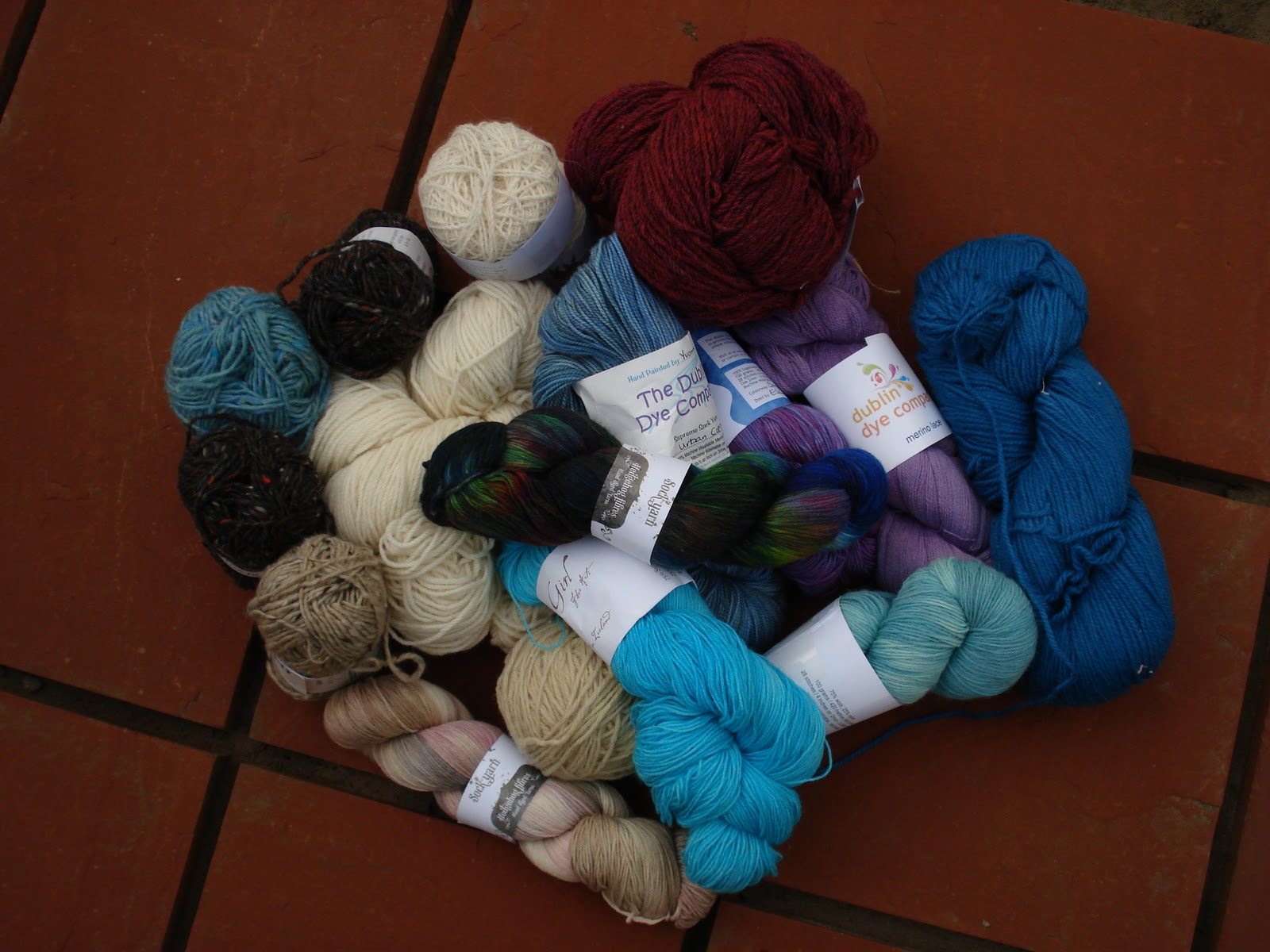
To the left you can see some of the yarn I have accumulated over the years, much of it is used in this book, all either spun or dyed in Ireland!  There is some that's a bit rarer that isn't mentioned (like the Kerry Alpaca I picked up on holidays, which is only done in very small batches)   Some of this is quite modern yarn, some of it older but this book would allow me to use up some of it!

I found the patterns to be modern but not without respect to the past.  There are some great Aran inspired patterns here with some deft modern touches.  Entertainingly the names are places from the areas the yarns come from.

There's some helpful advice on sizing and adapting patterns, many of the patterns are in the round or flat with minimal seaming.

Types of patterns: Cardigans (3); Skirt (1); Children's cardigan (2); child sleeveless top (1); Jumper (3); Hat (3); Blanket (1); Shawl/wrap (2); children's jumper (1); bag (1); cowl (1); Fingerless Mittens (2)

Number of Patterns: 20 (the blanket is a variation on one of the shawls)

Split of patterns: mostly adult with some children's.

Size Range: Women's patterns are 27-51"; men's 37.5-53.5" and she does include the actual sizes the pattern is supposed to come to so that you can adjust for your own style.

Colour/Black & White: Colour photographs; black and white charts

Schematics: yes

Target Audience: Intermediate to advanced, there are no projects without at least a little cabling.

How to knit guide: not really, there are some guides to some of the extra techniques but not the very basics, the book assumes a certain competence with knitting

Experimental/Classical/Modern: Classical with a modern twist.

Comments on patterns (all links to patterns are from Ravelry):

Kerry Woollen Mills:

(c) Joseph Feller
Killorglin (pictured right) is the cardigan that features on the front of the book, knit in Aran weight yarn, this is the one cardigan that my husband requested I knit him.... I'm sure it would be fine without the shaping!

Tralee is knit in a DK yarn, this is a skirt mostly knit plain with a cable hiding in the kick pleat. I do like how this looks, not sure it would work for me but it's interesting!


Listowel is a shrug with a heart-motif on the back.  This would probably be a great item as a wedding shrug or communion shrug.  Knit in Aran weight yarn this would be a pretty quick knit.

Caherciveen hooded sleeveless, children's top, knit in Aran weight yarn.

Cushendale Woollen Mills:
Knockmore is a nice compromise of a man's jumper with enough patterning using twisted stitches to break up the monotonous acres of knitting without offending male sensibility, the only objection my husband had to it was the original colour. Knit in a dk weight.

Ballyragget is an interesting hat knit in DK using the twisted stiches from Knockmore

Dangan is either a baby blanket or a shawl.  Knit in a sportweight yarn.

Belville  uses the tweediness of the yarn to create a nicely shaped jumper with some colourwork on the yoke, knit in dk weight yarn.

Ballinagree is a sleeveless jumper designed for boys in a DK weight yarn, looks pretty unisex to me!

Kilmanagh uses some colourwork on the flap (a bag with a flap! I'm planning for this one!) and sides.  It's interesting and knit in DK weight.

Donegal Yarns
Killybegs is an interesting cardigan with the cables providing some help with shaping.  Interesting work.  Using Aran weight yarn.

Bundoran  
 I liked this one enough I started it (progress pic to the left)!  Though I couldn't help messing with it and adding in colourwork.  It's not finished because I have to get more of the pale turquoise yarn.  I like how the cables interact with the yarn.  Knit in Aran weight yarn, using some of the features of the cables from Killybegs.


Ardara is a nice sleeveless cardigan, one on my would like to knit shortlist. Knit in Aran weight yarn.

Glengesh  is a wrap in an Aran weight yarn; worked from the bottom up with some shaping provided by short-row shaping.

Straboy is another one that makes my husband mutter noises about wanting one!  Knit in an Aran yarn I've seen this in action and it looks well.

Rossbeg is an interesting design, knitting in Aran weight this starts with a yoke and works down, it's an interesting piece.

Hand Dyers:
(c) Joseph Feller
Dalkey Cowl (pictured right) and Mitts combine cables and lace in a fingering weight yarn I have the yarn all wound up to start this one!  I love how this looks.

Rathcooney Hat and Fingerless Mitts simple elegance, this is an interesting piece the cocoon stitch changes to ribs.  It's a worsted weight yarn that has some silk in it.  Hence the name!


Buy/Borrow: I have to admit that if I hadn't got a copy, and I had borrowed it from the Libraries I would have bought it.  I like it and want to make too many patterns from the book not to want it.

Where found: I got a copy to review from Wiley, Dublin City Public Libraries has some copies in stock

The Blog tour:
15/9/2011 Stephen West 
17/9/2011 Hoxton Handmade 
21/9/2011 Shannon Okey
23/9/2011 Rosemary Hill 
25/9/2011 Ann Kingstone 
27/9/2011 Marly Bird 
29/9/2011 JC Briar 
1/10/2011 Woolly Wormhead 
3/10/2011 Anne Hanson 
7/10/2011 Stephannie Tallent 
11/10/2011 Alice Yu 
13/10/2011 Michelle Miller 
15/10/2011 Deirdre Thornton 
17/10/2011 Ilga Leja

Sunday, 13 March 2011

Aran FAQ

This is a Work in Progress. I probably will update this over time as I find more information and books.
New text is like this
Aran Knitters FAQ

Do Irish People still knit Aran Jumpers?
Yes, many of them for entertainment rather than money, there isn't a lot of money to be made from knitting and when you mention payment and the time it takes to knit a garment people are surprised at the amount of work and the little you get paid. Because most Aran jumpers were done as piece work and during people's evenings etc., people didn't regard it as real work therefore there are several issues associated with it.
Ireland has been a more prosperous nation and many things associated with old harder times were rejected.
Many tourists have an idea that Ireland is a land still in the early 20th Century and while aspects of Ireland are sadly behind, one of Ireland’s largest “exports” is software
From the Irish Central Statistics Office here in 2006 57% of households had a computer, 2% didn’t state and 41% didn’t. 35% of computer owners have broadband, 47% had another internet access, leaving only 18% of computer users in 2006 without Internet access.

When were Aran Jumpers invented?
There is no evidence for Aran Jumpers, despite a lot of photographs of the Aran Islands (at the turn of the century the Aran Islands were popular due to a widespread resurgence in interest in heritage)
1893: the only items knitted on the islands were socks, according to a report which surveyed cottage industries.
1893: The Aran Islands, Co. Galway: A Study in Irish Ethnography by Prof. A C Haddon - some of the extracts that are about wool, clothing, etc.
"All the men are land-owners to a greater or less extent; the holdings, or cannogarras, as they are termed, vary from about 11 to 14 acres, the supposition being that each cannogarra can feed a cow with her calves, a horse and her foal, some sheep for their wool, and give sufficient potatoes to support one family. Most of the fields are very small in size, and are surrounded by walls composed of stones piled loosely on one another ;there are no gates or permanent gaps in the walls. A man usually owns a number of isolated fields scattered all over the island."

"The farm will usually keep a family in potatoes, milk, and wool."
"The bulk of the men on the north island may be described as small farmers who do a little fishing. There are, besides, two or three weavers, tailors, and curragh builders. The butcher, baker, and other allied tradesmen are mainly related to the small population, which may fairly be termed foreign, such as the representatives of the Government and the spiritual and secular instructors."

"The dress of both sexes is for the most part home-made, being largely composed of homespun, either uncoloured or of a speckled brown or blue grey, or bright red colour. The people appear not only to be warmly clad, but, as a rule, to be over-clothed. Both sexes wear sandals made of raw cowhide, the hair being outside. These \"pampooties,\" as they are called, are admirably adapted for climbing and running over the rocks and loose stones. Some of the men are now taking to wearing leather boots."
"The spinning-wheel is similar to that used in various places along the West, but it differs from that employed in the North." 
1907: Synge reported that some of the islanders were beginning to adopt the fishing costumes common to the British and Scottish coastline (i.e. the dark coloured gansey).
early 1930’s: white aran sweaters (as we know them today) began to become the fashion for young boys to wear at their communion; still a child-only garment at this stage, and a male one.
later 1930s: Muriel Gahan (a knitwear designer in Dublin) develops the idea of turning these items into adult size and marketing them in Dublin in a tourist shop. Paddy O Síocháin gets in on the act and creates the company. They are encouraged by funding from the Congested Districts Board.
Here’s a photo from Mairead’s blog which shows the actual traditional costumes worn.
Here’s a video featuring the Man of Aran film from the 30s no white cabled jumpers in sight.

Why have Irish knitters abandoned the Aran tradition?
The Aran Tradition only dates to the 1930s so it’s relatively modern. It’s also very associated with a twee Irishness that many Irish people find quite embarrassing and hard to swallow. The traditional Aran Jumpers tend to be very bulky and unflattering and many people would like a more flattering style, adapting them can be quite complicated and often regarded as not “really arans” and there is no way to really win. Even if you pick modern designs that are influenced by Aran designs they are often not felt to be true Arans. There may be more designs influenced by Arans in the future and hopefully the dialogue between the past and the future will continue.

Why are the Irish Knitters so angry about Aran Knitting?

Many Irish Knitters are uncomfortable with regular castigation about not respecting the Aran Knitting Tradition and about allowing it to die out, while the commentators have no idea what their history or experiences around Aran Knitting is. There may have been stories of complete dependence on Aran Knitting to keep food on people’s tables. Many people have worked in Tourist Traps and had to tell tall tales to keep the tourists happy. It is difficult to research the truth of a traditional Irish Knitting because there has been so many stories built up around it.

Why do Irish-Americans respect the Aran Traditions more than people who live in Ireland?
There are traditions that have build up around Irish-America that are actually Irish American and are not actually Irish. For a long time Ireland was very dependent on Irish Americans for money and maintaining some illusions were in many ways more important than the truth and while both cultures have roots in the same source there have been different growth and in ways it has been quite different. The influences and experiences are different and the things that people find important can be quite different. Many Irish people regard Aran Knitting as interesting but quite outdated. At the same time Irish Knitting and Aran Knitting has the same relationship that Fantasy has to Tolkien, there always will be an influence whether or not people acknowledge it.

Do only people from the Aran Islands knit Aran Jumpers?
No, Aran jumpers are and have been knit by people from all over Ireland and all over the world. Commercial Aran Jumpers are made all over the world.

What is a real Aran Jumper?
What many people regard as a real Aran Jumper is often a garment with drop sleeves, with three sections of patterning, a central section (sometimes relatively plain) two mirrored or the same panels that usually are designed to go up to the shoulders and plain side panels. The advantage of this style of pattern is that it’s relatively easy to size up.

Where are the Aran Islands?
The Aran Islands are mid-way down the western seaboard of Ireland, geologically they’re part of Clare, the part that sticks out below them, whereas administratively they’re part of Galway, the part inland and above.

What is my Clan Aran?
Clan Arans are a marketing gimic dreamt up by a company called Clan Aran, you can find them here  they are based in Killarney. (see map here for distance from Aran Islands to Killarney as opposed to Galway or Shannon). Also see article where I find some 1890s Aran Island Surnames and compare it to the Clan Aran list

Where can I buy real Aran Jumpers?
One of the shops is O'Maille's 

What’s the difference between hand made, hand loomed and machine made?
Hand made are made by hand by a knitter, hand loomed is supervised by a knitter but made on a machine, sometimes with some stitch manipulation by a person and machine made is where a machine is programmed with the pattern and created. Hand loomed and machine made tend to be more regular with fewer errors and much flatter than hand made. Hand made also tends to smell more like sheep and have a slightly oilier feel due to the natural oils being unsuited to use with machines.

But my jumper says Irish Made, why are you saying it’s made in China?
Irish Made and made in Ireland aren’t always the same thing. Irish Made can mean made for an Irish company. Made in Ireland is still a bit slippery as so long as somewhere in the process there was Irish involvement it still can be legitimately called Irish Made.

Why are some Aran Knitwear items made in China?
Expense, Chinese manufacturing costs are much lower than Ireland.

What do the stitches mean?
That all depends on who you talk to. People have attached certain meanings but I think stitches are like dreams, you can attach any meaning to the stitches and some of them will only make real sense to the stitcher, no matter what anyone else says. Sometimes the stories make enough sense to other people that they were adopted by others. Stories have been built around some of the stitches and have become more rigidly adopted.

Who is Heinz Keiwe and why is there steam coming out of Several People's ears at the mention of his name?

This is the man solely responsible for the respect given to the myth of the Aran Jumper, a romantic idea brought about, not by a visit to the islands but by a visit to Dublin. He took the garments found in a tourist shop and took a look at Celtic knotwork and possibly the Book of Kells and combined all of these into a magical story that got a lot of people's imaginations. Many people who have done research and looked for actual historical evidence have failed to find any. If Aran jumpers were as prevalent as is suggested there would have been photographic evidence before the 1930's. There is none. There is evidence for jumpers that resemble English coastal fishermans jumpers, garments that would have been practical and wouldn't have interfered with the job of fishing. Several Irish People are historians and like accuracy and he made stuff up.

Who has written about Aran Knitting?
Deirdre McQuillan - The Aran Sweater
Alice Starmore - Aran Knitting
Margot Cullen - Knot Sure
Shelagh Hollingsworth - Traditional Aran Knitting
Traditional Aran Island Knitting by Pam Dawson
Traditional Knitting - Gwyn Morgan
Aran and Celtics the best of Knitter's Magazine
Elizabeth Zimmerman has some Aran Patterns in both Opinionated Knitter and Knitter's Almanac
Kate Davies has a great blog post on the topic, which was also an article in The Knitter Magazine (checked 15/3/2012)
Irish Knitting - Rohanna Darlington
A History of Handknitting
200 Aran Stitches the Harmony Guide
Deeds not words the Life and Work of Muriel Gahan - Geraldine Mitchell
Irish Times Article (as of 15/3/2012 behind a paywall)
Actually, the fisherman story comes from a JM Synge 1904 play Riders to the Sea where the fisherman was identified by a sock with dropped stitches.

Where can I find good Aran Patterns?
Now that's a loaded question. This depends on what you want from an Aran Jumper. The Harmony Guide is quite good for the drop shoulder version of the Aran Jumper with advice on how to make one to fit.

What designers have used Aran Patterns?
Gertrude Sampson
Glynis Robins
Cyril Cullen

Have Aran Patterns been used in other mediums?

What do you think of the books written about Aran Knitting? links to my review on this blog of these books
Deirdre McQuillan - The Aran Sweater - generally quite well respected
Alice Starmore - Aran Knitting - she examines four garments in the National Museum and comments on the development of the Aran style. Her patterns respect the Aran Tradition but take it forward and are knit in finer yarn in general.
Margot Cullen - Knot Sure - this is a biography of Cyril Cullen and has some photographs of some of his designs. He wrote some patterns for the RTE Guide which were popular and would have influenced Irish Knitters in the 60’s and 70’s, as this TV guide was quite popular.
Shelagh Hollingsworth - Traditional Aran Knitting - her intro was written by Kiewe, however the patterns are pretty traditional, it is widely available as it was reprinted by Dover
Pam Dawson - Traditional Aran Island Knitting
Paddy Ó Síocháin - Aran: Islands of Legend [this one I haven’t read, I have reserved it from the library and plan to read it soon - Deirdre]
Rohanna Darlington - Irish Knitting - she has a great intro on the development of the patterns, that she dates back to a pair of sisters who went to America and returned with some cabled knitting stitches, possibly from some German knitters.
Richard Rutt - History of Handknitting
Ethnic Knitting: exploration - more about technique than history, interesting variations
Carol Feller - Contemporary Irish Knits does some contemporary versions of Aran patterns and visits Irish Mills that are still spinning.

Aran Knitting books that I would like to review (feel free to suggest some in the comments)

Can I buy real Irish Yarn?
Unfortunately it can be hard to source true Irish grown and harvested yarn. For a long time there has been greater demand for sheep for food rather than sheep for yarn. We have sadly neglected many native breeds, in favour of breeds that produce more meat quickly.
Wicklow and Kerry Hill Sheep are actually listed as extinct breeds; Roscommon and Galway Sheep are still listed as surviving (see PDF here)
Sheep site with some policies here

There are only a small few yarn producers in Ireland

Cushendale Mill  imported to the US as Black Water Abbey Yarns 

Can I help Irish Native Breeds?

What shop first sold Aran Jumpers?
O'Maille's in Galway claim to be first

History of Aran Patterns
Patons were the first to produce commercial patterns Vogue magazine also printed them. Tivoli continue to design Aran style jumpers like this they also have other patterns, some of which use a lot of different yarns

How much were the Knitters Paid?
According to Weaving Tapestry in Rural Ireland by Meghan Nuttall Sayres Tapeis Gael Mentor Mary McKellis says (p 10) “‘These projects kept a pound in your pocket where they would otherwise be none’... recalling the days in the 1950s and 1960s when she hand-knitted sweaters for Gaeltarra Eireann for four shillings and six pence each.”

What weight is Aran Wool?
Aran Weight wool falls between double knitting and worsted. It's often worked with either 4.5 to 5.5mm needles.

Has this happened in other countries?
Staged Authenticity and Heritage Tourism in Science Direct.
From The Puzzle of Left-handedness by Rik Smits "Now and then researchers had their legs deliberately pulled by the peoples they were studying, and often with good reason. Strangers brought excitement, amusement and intriguing goods and customs. You might want to keep on the right side of people like that, in the hope that they'll stay and give you more things.  So the newcomers sometimes got more than they bargained for when they displayed an interest in something. It was an early form of the tourist industry. All over the world, 'natives' eagerly threw themselves into traditional handicrafts, dances and musical performances - many of which had never existed before, in that particular form at least"

How does Ravelry define Aran or Irish?
Aran = a style of knitting that includes intricate designs using cables, bobbles and other decorative elements that originated in the Aran Islands of Ireland. Please use this attribute only for patterns that are specifically made in the Aran regional style - this attribute will not apply to all cabled patterns. Lace and colorwork patterns should not be marked with this attribute.

Irish = knitting or crochet created with techniques traditionally from Ireland. Often includes richly cabled garments (knitting) or floral lace motifs (crochet). Please note that this attribute is specifically for traditional Irish crochet and knitting and should not be used on “Saint Patrick’s Day” themed items. Not all patterns with cables, shamrocks, or crocheted flowers should be marked with this attribute.

I heard a story that the pattern can't be honeycomb because there are no Bees on Aran.  Are there bees on the Aran Islands?
Yes, not only are there bees on the island, there’s a sub-species of bee.

Irish People talk about County Colours what are they talking about?
County colours are related to both Hurling (the fastest field sport in the world) and Gaelic Football and is from the GAA county colours which can be found here  please note that both London and New York are treated as Irish counties as well, there are several other GAA associations worldwide see here: if you’re wondering about Provinces there are four, Ulster, Munster, Leinster and Connaught and these correspond roughly to Northern Ireland (Ulster has 3 more counties than the part of Ireland referred to as The North); Southern Ireland, Eastern Ireland and Western Ireland. More information can be found on the websites of the individual provinces. Many Irish people will wear county colours during finals and will usually know what their county colours are.

What are you talking about with the People’s Republic of Cork?
Cork is Ireland’s second largest city. It is the most prominent city in Munster. Related to the county colours, the counties also have nicknames, Cork is the Rebel County. The county Colours are red and white and you can see the t-shirts and more about it here

Do Irish People wear Green on St Patricks Day?
Not all of them and seriously they don’t care, it’s usually a day off and yes there’s parades and overdrinking but there’s no pinching and no St Patty’s either, to Irish people it’s St Patrick or St Paddy’s.

Who are you and where did all this come from? What makes you an expert?
I'm a Librarian working for Dublin City Council, who has a degree in History and Classical Civilisation from what used to be UCG but is now NUI Galway,  I come from a small village west of Galway, that's close enough to the city (on my side anyway) that most folk went to secondary school in Galway city itself.  My father's family were farmers in our area and my dad remembers his mother and grandmother spinning using a large wheel.  He also remembers knitting socks.  In first year I did Archaeology and had an opportunity to visit the Aran Islands with the Archaeological Society, and then had an opportunity to work on the Archaeological Dig on Dun Aeongus for it's first month.  I also worked for a while for one of the Ferry Companies who go to the Aran Islands.  I've always had an interest in history and when I started knitting I was curious about the history.
A large chunk of this comes from the Irish Knitters Ravelry group and in particular the Aran Knitting Thread. A suggestion to consolidate it is here.

NB Congested districts board.  see sections 8 and 10 also  where WWI and a demand for Knitwear for frontline troops gave business where a decline in demand for lace started, a suggestion of drift from lace to knitting. Big demand for Machine Knit Arans even in the 1930s. note “training in machine knitting” From this pg 148 of the text and 20 of the PDF “Not the least difficult part of the Board’s duties is the developing of home and cottage industry. These comprise Basketmaking, carpentry, kelp-making, lace-making, knitting and the manufacturing of carpets and woolens.”
NB Maltese knitting partic Gozo
NB Newfoundland Aran Knitting - newfoundland pattern fusion of nordic and cables